

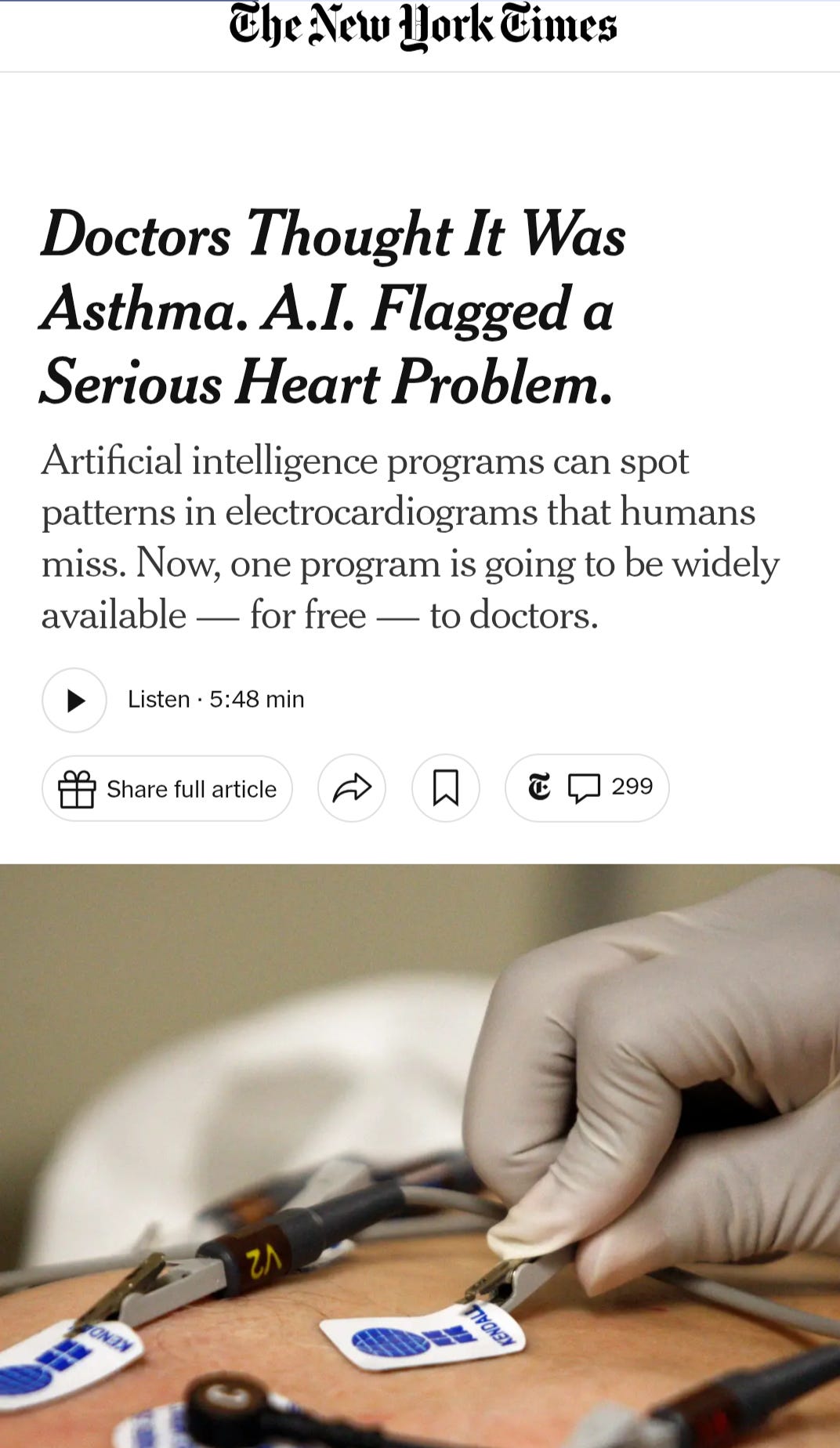
AI has already surpassed many doctors in terms of diagnostic accuracy and appropriate counseling about treatments. I have no doubt it will soon surpass even great doctors. Yet a news story claiming that AI found heart failure by reading an EKG is not it.
Rather than validating AI, the paper makes me worried the treating physician is on the express train to malpractice litigation and makes me wonder about the reporting standards at Nature Medicine.
This case report appeared in Nature medicine. A 45 year old male smoker presents with shortness of breath.
Last I checked, the patient is getting a cardiac work up. If the reader is aware of any hospital or physician who doesn't work a 45 male smoker with shortness of breath for cardiac etiology, let me alert my lawyer friends who specialize in malpractice.
The patient did get some cardiac work up. He got an EKG and a ‘biomarker’.
The biomarker is elevated.
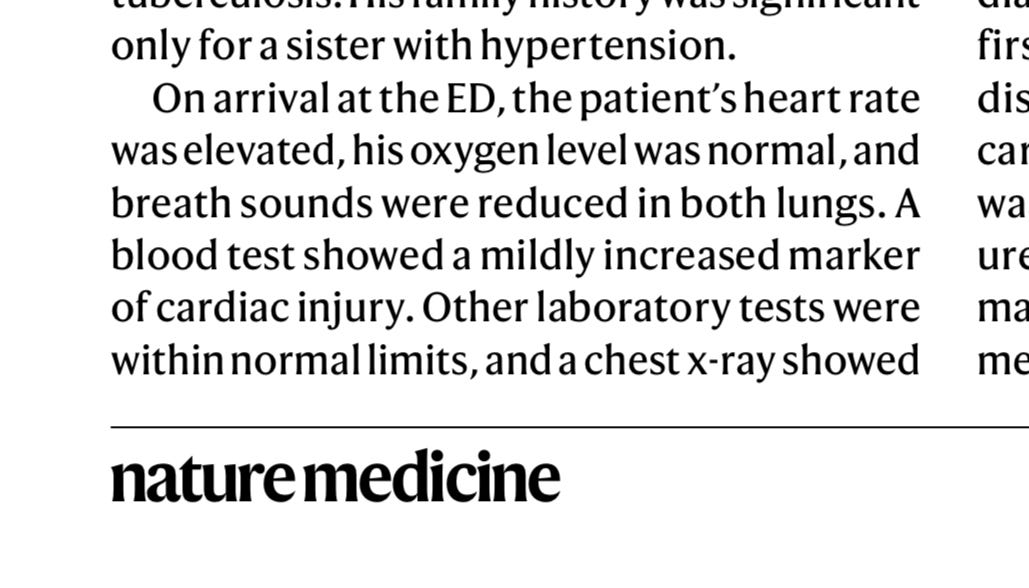
Almost surely it is troponin. What is the precise value?
Aside: It is no secret that I have been extremely disappointed with nature medicine editors. In the last few years I have seen so many poor quality papers published there. I see that they had to retract a randomized study on time of chemotherapy administration. Any good review would have identified the deficiencies at the outset. Here, imagine publishing a case report claiming that AI can do what no doctor did, and not reporting the specific biomarker that was elevated and exactly how high it was. It's hard to fathom that there can be any clinical expertise among the editorial staff.
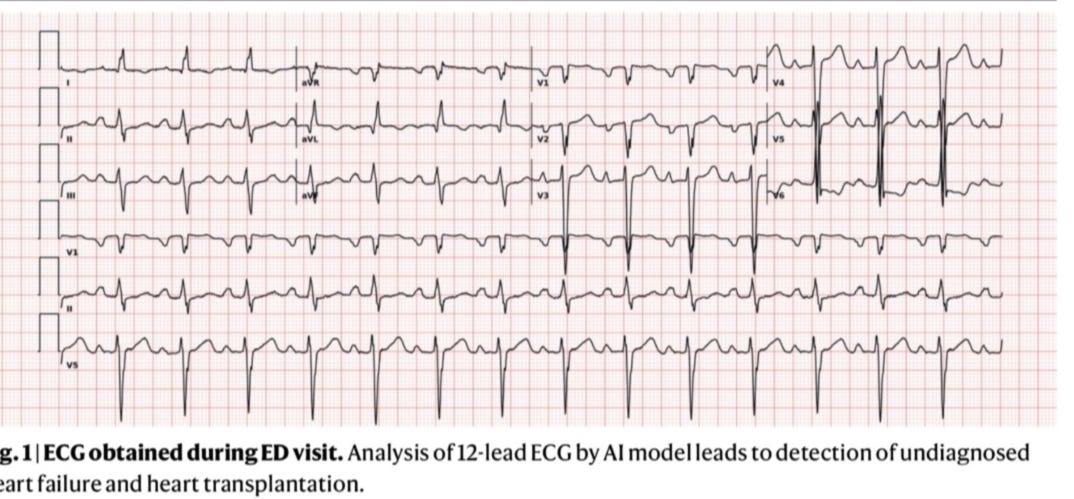
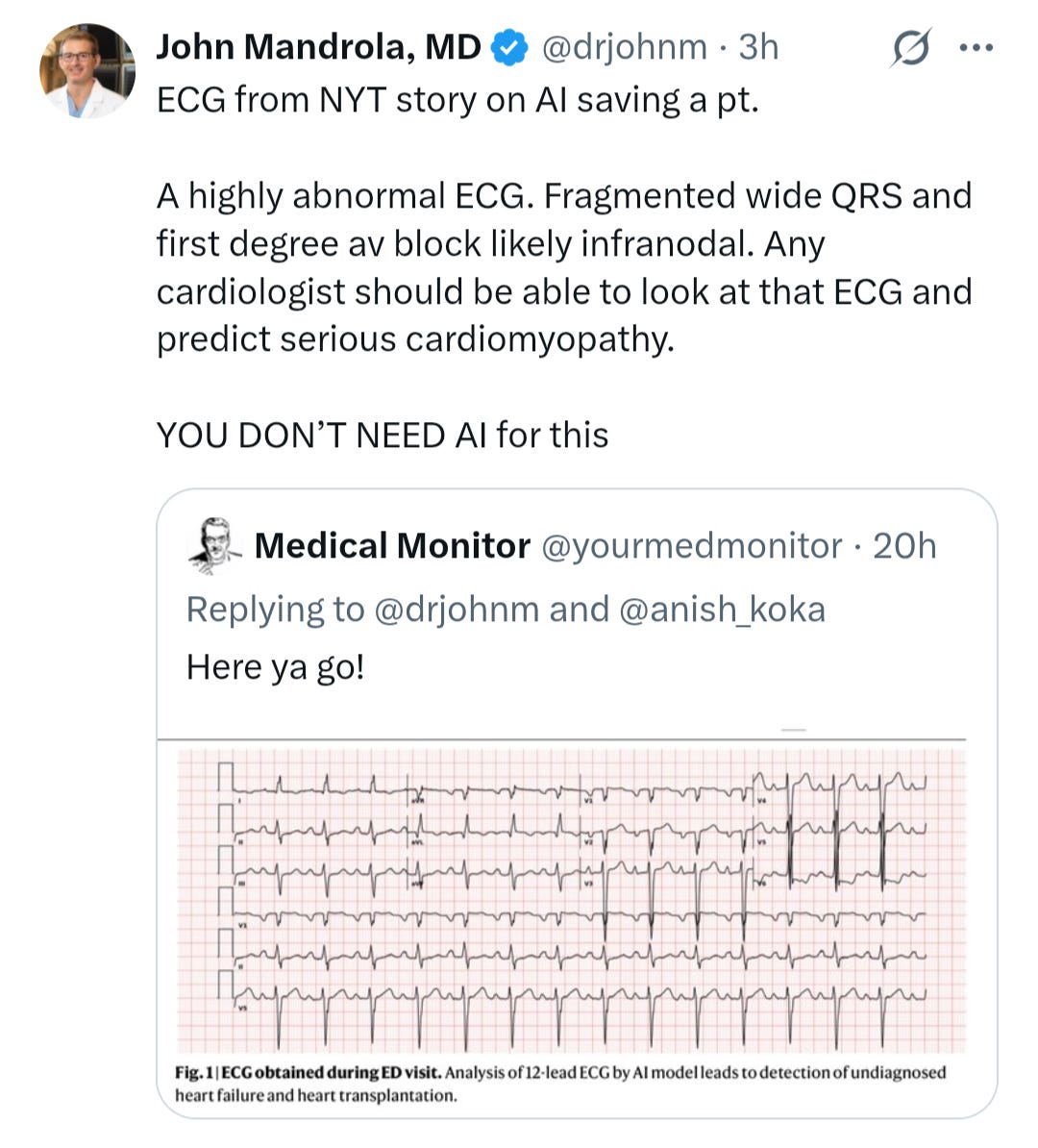
Next is the EKG. It's clearly abnormal.
Here is John Mandrola
I'm deeply suspicious the clinical note is dishonest about physical exam findings. Perhaps the patient had distended neck veins, crackles at the bases of both lungs, and pitting edema of the legs. I no longer have confidence this case report is faithful.
Next comes the AI part. Supposedly AI triggers further workup and an echocardiogram which finds diminished ejection fraction. Patient ultimately gets a heart transplant. AI gets the win.
Don't get me wrong: Thank God we had AI. We need AI to bail out doctors. But remember this is only in the context of what seems like poor medical care.
Most doctors would agree that in a 45-year-old smoker who presents with shortness of breath and elevated cardiac biomarkers, with an abnormal EKG, you shouldn't send them home with albuterol and a prayer. Instead they need a full cardiac workup, including but not limited to an echocardiogram.
And if doctors decided to publish this as a case report extolling the benefits of AI, they should at least try to adhere to basic standards of medical practice and fully report all lab values and provide all raw imaging. (I was able to review the echo but not the XR chest). My intern would do better than this case report.
Nature medicine needs an editorial revamp. You need to have clinicians who practice as part of the staff if you're going to publish clinical research.
Newspapers need in house medical expertise or they should stop covering medicine. Nytimes has done a disservice.
AI can help catch doctors’ errors. Doctors should aspire do be better. Claiming AI has transcended physicians is problematic when it is based on what appears to be borderline malpractice. Had AI not flagged the EKG, I suspect the patient could sue. The hospital would settle.
Embarrassing: "... a mildly increased marker of cardiac injury." Sounds more like a sentence from Newsweek than an ostensibly peer-reviewed scientific journal. Moreover, any MD with acute care training should know a 45-year old with new SOB cannot reasonably be diagnosed with new-onset asthma until CHF is ruled out. Add a grossly abnormal EKG and 'marker', and it's a lock—admit for cardiac work-up. The Times has been irresponsible with medical coverage for years, and needs an educated MD to screen their work. It's just one reason I ended my subscription. Vinay: take the job, straighten them out.
Vinay, I am a hematologist, not a cardiologist, but this could be seen across the room by any competent physician. My guess is they did one of those "fake" physicals which seem so ubiquitous these days where you wave a stethoscope at the patient through their shirt, glance at lab values, and make another appointment. Glad (if it is as reported, which I doubt) that they gave it to the AI which found something obvious. It is not clear why they still have jobs.
This is more a reflection on the current pool of doctors admitted for how many weeks they spent living in the trunk of their car rather than ability to be decent physicians which requires a certain level of mental acuity clearly missing here. But that would be a whole other article. Nothing more sobering than being on a medical school admissions committee these days.