

A controversial study has at last been published. Commissioned by the Biden administration, ignored by the Trump administration, a paper on alcohol’s health effects finally sees the light of day.
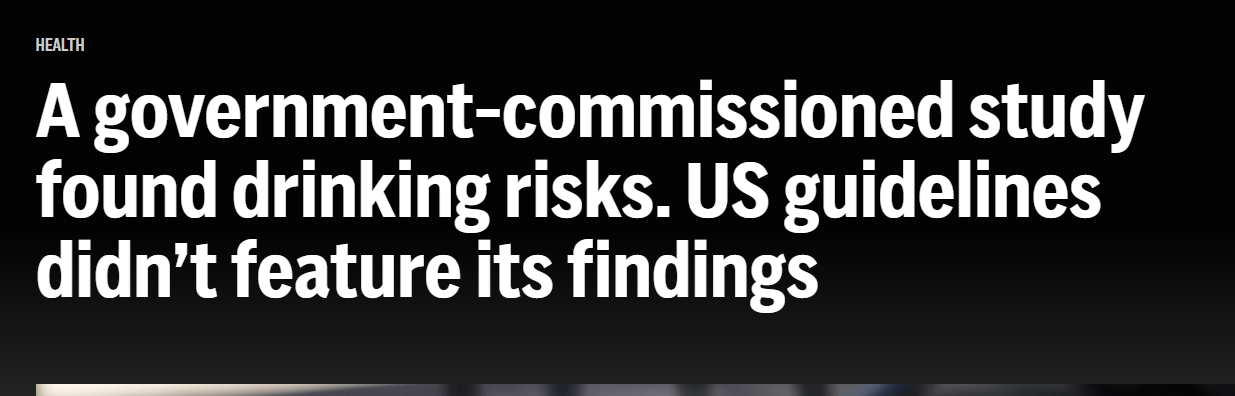
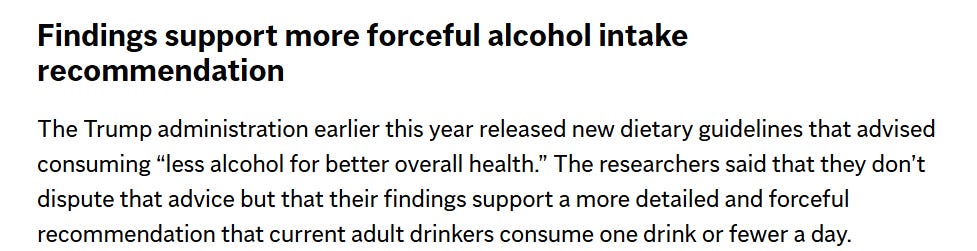
The media is setting the narrative as you read this. The new study is the Lord’s work, and shows that even a single drop of alcohol is bad. The Trump administration wants to hide that. The administration must be in bed with big-alcohol to claim otherwise— so the narrative goes. Here is the AP:
What does the paper actually show?
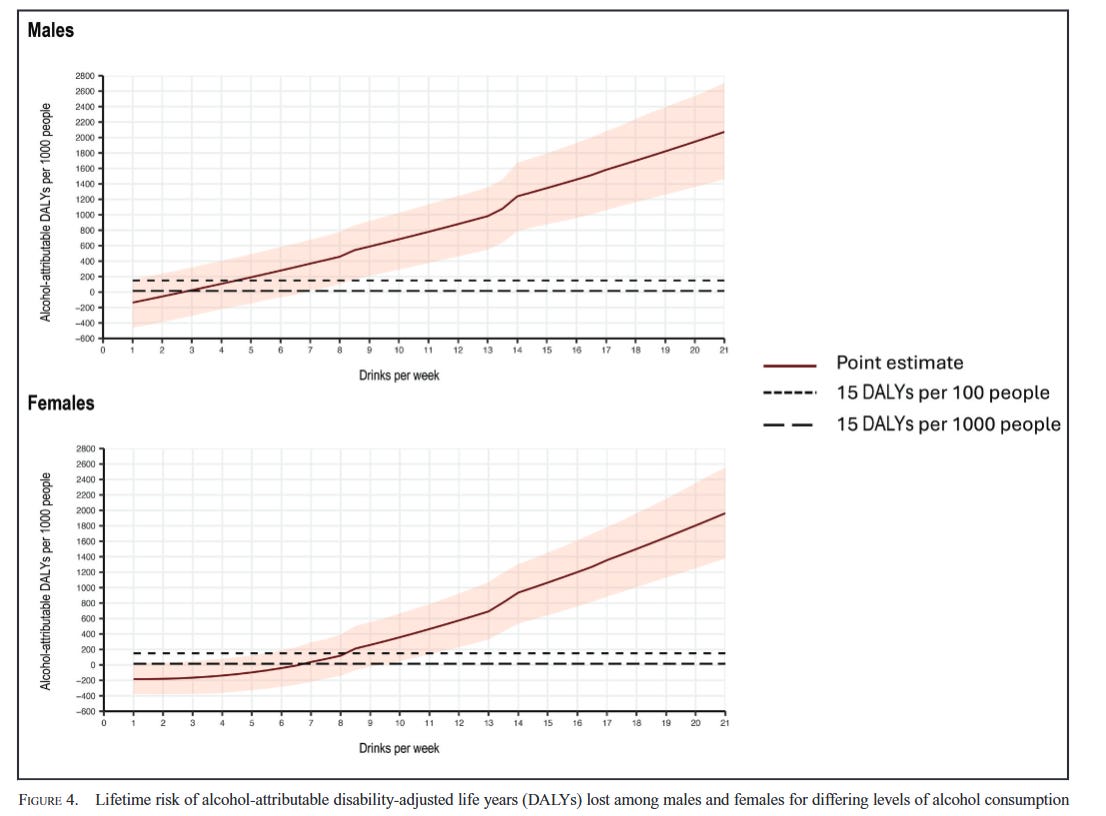
Here is the major finding. The authors model derived alcohol attributable deaths based on drinks per week, men vs women. Check it out!
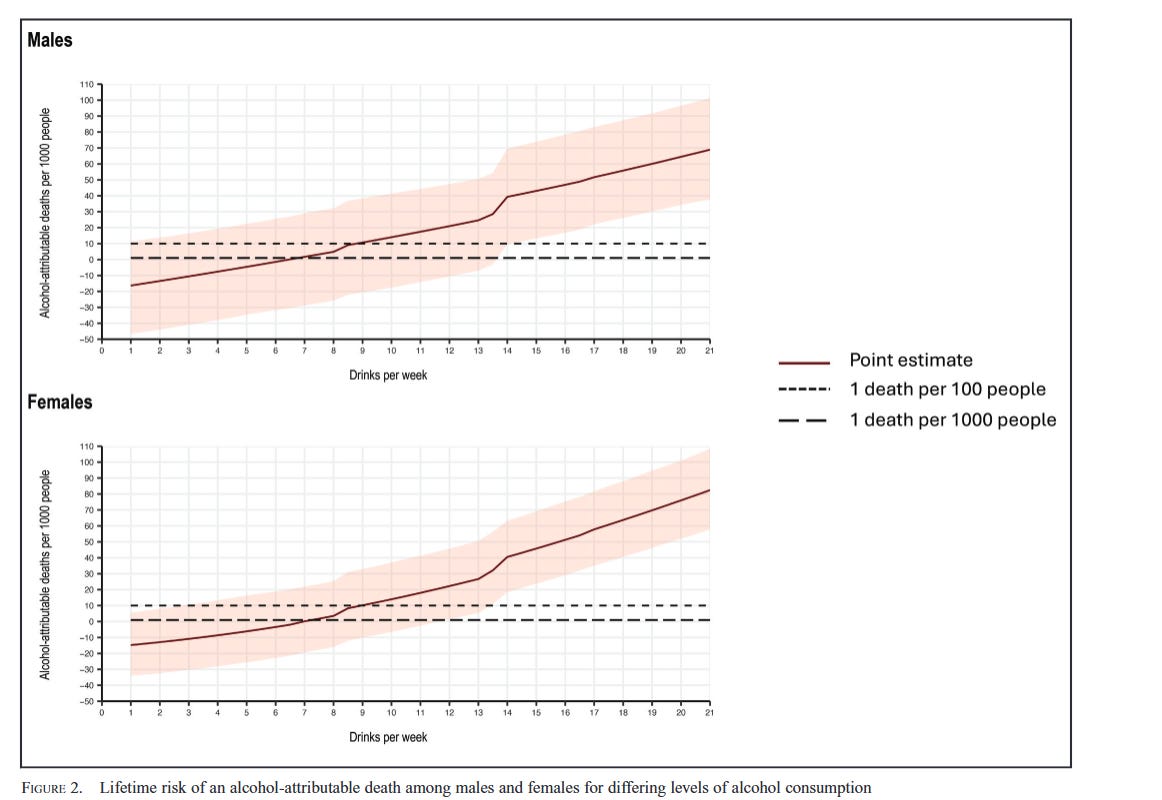
Below the bottom, dotted line is a protective effect, above the line is deleterious effect.
Here is how the authors summary that graph— this is literally the title of the paper:

Any honest scientist would look at that graph and say: Boy, it sure looks like modest drinking is protective, and past a certain point it is dangerous, and merely because statistical significance is not met at the low end of the modeled estimates, there is no reason to put your head in the sand and ignore the clear, linear relationship. But the authors claim that since the lower end of the graph crosses null— it must be interpreted as “no protective effect.” Reasonable scientists can disagree with that.
Is this paper good science?
No, the paper is low quality science. Here are the detailed methods.
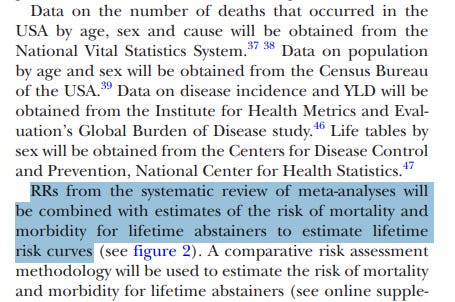
The authors decide which diseases have alcohol attributable risks and which don’t and they ignore all cause mortality. This converts an indisputable endpoint into one that requires investigator preference/ decision making. It’s a poor analytic choice— that adds bias to the analysis.
They then pool a bunch of observational studies and decide what the relative risks are from alcohol on those diseases. But this begs the question. Those studies are non-randomized. People who drink and those who don’t are different in other ways— and those differences, and whether or not they are properly accounted for (or if they even can be) is the crux of the disagreement. The studies measure alcohol use in a number of ways that may be incorrect— such as self reporting.
A model is like a juicer. It only tastes as good as what you put in, and they are shoving in rotten fruit.
No one debates whether drinking 10 bottles of wine a day is bad. Its bad. The debate is whether moderate drinking is bad, and the authors assume the very thing they wish to prove, by accepting at face value the relative risks, derived from poor studies, which are the crux of the debate.
They then construct several models to estimate the population impact, and assume people are drinking a bit more than they let on (I am generally fine with this assumption), etc. etc. But even with all their assumptions, their central finding reveals considerable ambiguity about low levels of intake.
Even when they model their results based on disability adjusted life years lost (a topic I have written about at length), they get bizarre results— that women, more than men, tend to gain a couple DALY’s from modest drinking.
The paper is published in a journal with an impact factor of 2. To put that in perspective, my mother’s refrigerator door has an impact factor of 3.
Bottom line:
This paper proves nothing. It would convince no serious scientist. It preaches to the choir— the dry choir.
Even if you accepted all of the authors’ analytic choices, you still get a signal that low levels of alcohol may be better than tee-totaling. But I question all the analytic choices, and this study does not change anything for me. I remain agnostic. I think Oz was broadly correct and pretty reasonable:

The media is eager to create a political narrative, but is unable to distinguish when science is independent, falsifiable and useful, and when science is contrived, malleable, and so biased that it verges on propaganda.
This paper is the latter. It was, at the outset, a misuse of taxpayer money, and its’ findings do not advance the alcohol dialog in any way. Publishing the paper was a waste of ink and paper and human capital.
For the good of America, the media must retain inhouse science expertise if it is a truth seeking business, a proposal I detail in Sensible Medicine today.

Welcome back, Dr. Prasad! Missed your informed takes.
Trump doesn’t even drink why would he want to “hide” this study? Everyone already knows alcohol is bad for us—what’s the big deal? This is not news.