

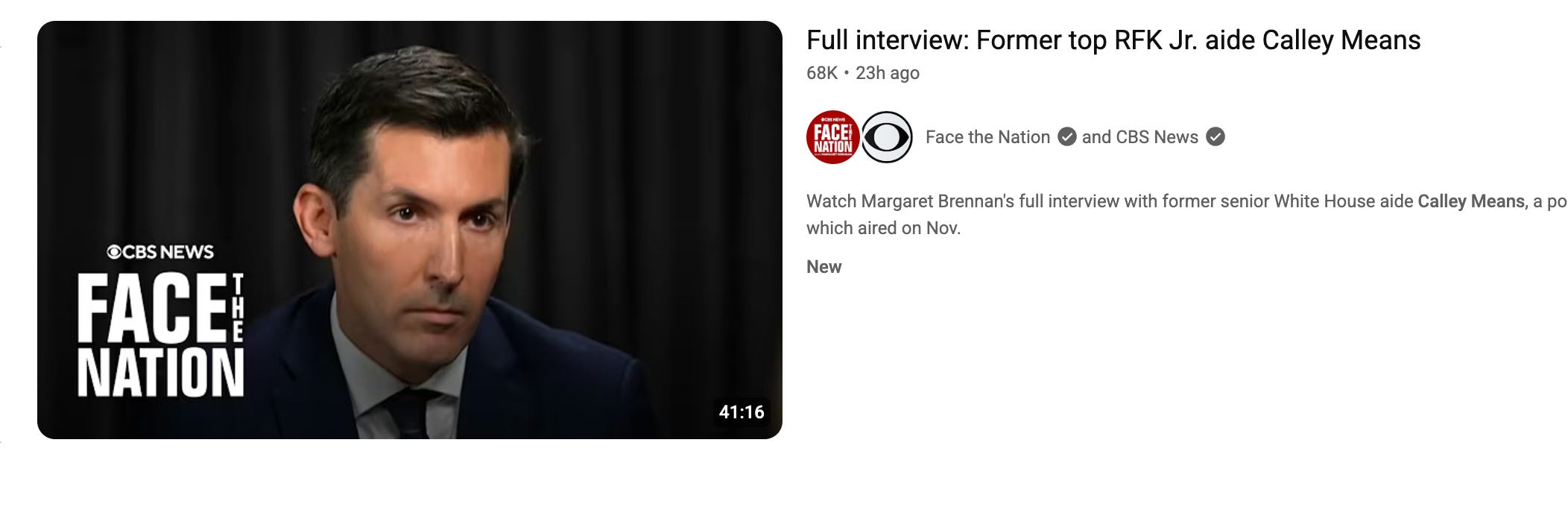
I have been asked by many to comment on Calley Means recent interviews. I offer 5 thoughts.
It is certainly the case that the US FDA approves some (not all) medical products that don’t work, almost surely don’t work, have harms greater than benefits, does not improve a surrogate endpoint reasonably likely to predict, has an inappropriate or unclear control arm/ poor trial design, etc. Some of this is a genuine difference of opinion among experts, but many of these decisions are made due to direct lobbying influence. This is truly swamp like behavior.
Regulation, at times, can also stifle progress, by setting up unnecessary or irrational hoops, and by slowing the growth of over the counter or generic options. Paradigm changing ideas can be held back by adherence to dogma. (Not discussed enough by Calley, but alluded to on one matter).
The basis of refuse to file at the agency is that a clinical trial is not ‘adequate and well controlled’. Using a control arm that has not been standard of care for a decade— is worse than alternatives— is not recommended by expert bodies— is conducting a trial that is not adequate or well controlled. The US regulatory agency must ensure that data supporting US marketing authorization is relevant for people who live … in the US, and not the sponsors.
The “swamp” does include (some) members of congress, government staff, politicians, lobbyists, and former officials who sit on the boards of major companies, etc.
Not everyone who is a swamp creature is malicious or greedy— many are deeply ignorant of medical evidence. As such, they can be persuaded by lobbyists (who are also ignorant), and not know what questions to ask.
News outlets that cover national politics have difficulty reporting stories from any other lens than Trump is bad, Bobby K is bad, and news outlets that cater to the biopharmaceutical industry have difficulty is doing anything to rock their advertising core, which is that industry.
Reforms to food, pesticide, agriculture and drug and device approval are winning bipartisan causes.
Health care swallows up trillions of dollars in GDP and does not deliver to the American people. Access is a pain. At times, we reimburse more for things that don’t work than things that do. US health care criticizes some wacky medicine and charlatans (as it ought to), while sanctioning equally wacky options. US Healthcare systematically undervalues the workforce, while overvaluing the administration. It swallows so much of our paychecks and will eventually face a real reckoning.
Overall, I am sympathetic to Calley’s narrative about wanting to advance the MAHA agency, but facing extreme headwinds. On topics where I had first hand knowledge, my impressions are similar to his, and on topics where I was not in the room, I cannot know. I wish him the best in future reform efforts.
Please consider trying to get Calley Means as a guest on your podcast!
That sounds an awful lot like a nonanswer answer. The public is concerned regarding the specific individuals named, the methods used, and are also desperately seeking answers as to why so many promises went undelivered. Indeed there were so many undelivered promises that the midterms were a reflection on promises made but not kept.