

If a little is good, a lot is better. That's the dogma of science and medicine. But is that always true? Can science funding be misappropriated?
Recently California voters passed proposition 38. At first glance it's a bill to increase immunotherapy research funding. What's not to like? But the truth is a bit more complicated.
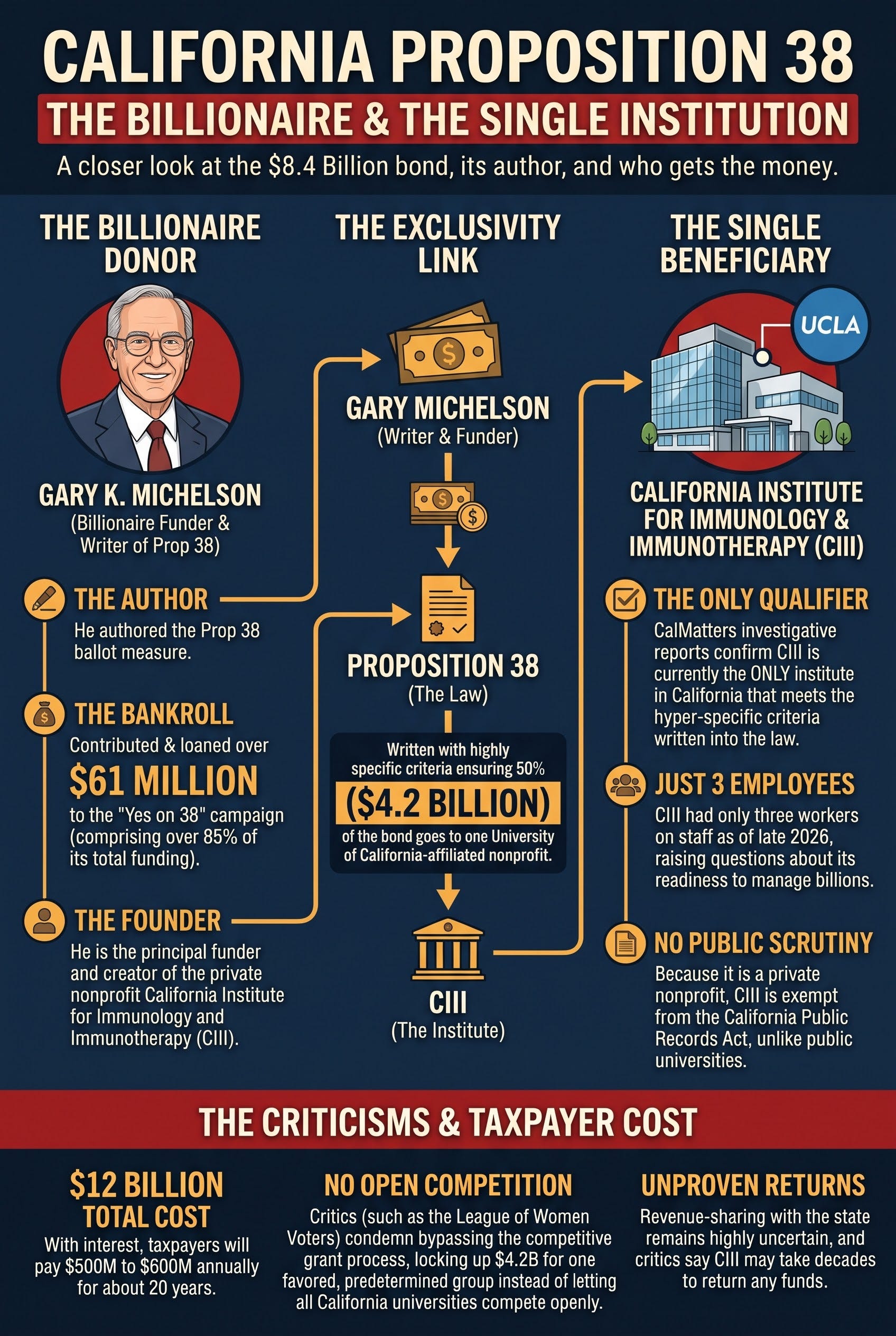
The bill was heavily promoted by a billionaire who is also a donor to a particular research institution in Los Angeles. Proposition 38 will force the state to issue $8 billion in bonds, costing the state roughly $600 million annually in interest, and to take these funds and give it for science research.
Half of the money must be given to an institution that meets specific criteria, which coincidentally is the very same institution that the billionaire donor has funded in Los Angeles.
What looks like a public referendum for science is actually a way for someone to coerce the state to match their donation. Not exactly a one-to-one match but something like a 40 to one match.
Reproducible, honest science is one of the greatest things human beings can do. Each year we divert billions of dollars to such efforts. But the truth is, a lot of the money is wasted. Scientists make false promises. Experiments are done under irreproducible conditions. There is extreme pressure placed on Junior scientists leading at times to cases of fraud. This happened to the former Stanford president. Not everything that works in a mouse translates into people. There is very little energy spent on Meta research, or studying what research is effective and what is not.
Consistency in science funding is important, and a windfall can paradoxically lead to bankruptcy. Imagine a child who has gradually learned the value of money from her parents, that kid is able to save and budget. They may know how to handle a large inheritance. But now imagine a child that never was taught the value of money, suddenly falling into a windfall. That's the precise recipe to fritter it away. There's an analogy to science funding. At times of funding glut, the least impactful, least important and least promising research is done.
It's easy to call for more science funding, just as it's easy to cut Science funding, but the challenge is in incentivizing reproducible, useful, and true science, and eliminating the rest. That's a project it seems few have the appetite for.
" The State " is a mechanism used to extract vast sums of wealth and power from the people and put it into the hands of those Shielded From View.
Thanks for writing about this Dr. VP. Voters need to be educated about how these bonds work. The money just doesn’t magically appear out of thin air, never having to be repaid, with no interest charges! In a state whose credit rating is less than stellar, which translates to a higher interest rate on our bonds, why do voters consistently approve bond measures? Notice the subject of the bond measure is always something meant to tug on voters’ heartstrings: schools, veterans, libraries, healthcare. If these measures are so important, include them in the state budget.