

In the last month, we have heard about two, exciting cancer drug success stories. Moderna and Merck have announced that a personalized mRNA anti-cancer vaccine has delayed the time until disease recurred in people with melanoma who are undergoing curative surgery, and Daraxonrasib, a new drug by Revolution medicine, was approved by the US FDA. Both represent real advances, but also point to open questions about the future of cancer medicine.
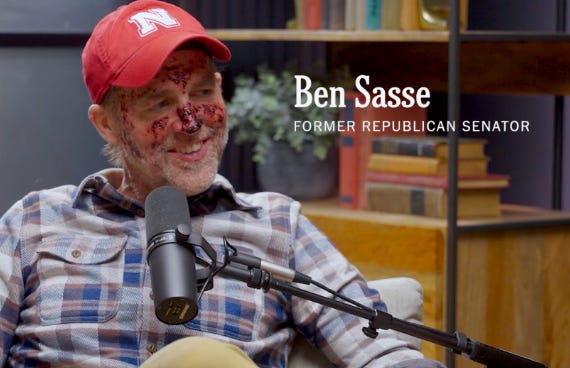
The pancreatic cancer drug targets Ras– a gene and protein– gone awry in a wide variety of tumors, and famously the drug that former senator Ben Sasse was taking during his podcast with Ross Douthat, where his face visibility wept with blood, which, when paired with his inspiring message, drew comparisons to Christ.
In a study that took over 500 patients with pancreas cancer, which had gotten worse after initial therapy, the drug increased survival from 6.7 to 13.2 months. Those 6 months is important time for many patients– more months with loved ones, and from a scientific standpoint the drug represents a remarkable advance in the chemistry of drug development– to drug what has long been undruggable.
https://www.nejm.org/doi/full/10.1056/NEJMoa2605555
At the same time, to keep things in perspective– a sad realization is that not a single person appears to be cured by this pill. Eventually, every patient’s cancer will get worse, and ultimately will claim their life. The side effects may prove challenging. 86.3 percent have rash– the blood weeping from Ben Sasse’s face. Side effects like rash may be manageable, bearable, tolerable in a 50 year old like Mr. Sasse, and even a 66 year old (the median age of the study), but this side effect can be more crushing in a person over 70, which is the median age of most pancreas cancer patients in the US. Diarrhea affected ⅔ of participants on the drug, half had nausea and 40% had vomiting. These are all more difficult for older folks.
In medicine, we often talk about the chasm– at times, the Grand Canyon– between efficacy and effectiveness. Efficacy is how well things work under the best of conditions in a clinical trial, and effectiveness is how they work in the messy real world, where people are older and frailer, have other medical problems, and may more easily throw in the towel if therapies have side effects. While daraxonrasib represents a true scientific advance– just how many Americans benefit and for how long will remain unknown.
The control arm of the trial had a 6 month survival— which is actually much longer than a real world patient who progressed on frontline therapy. The absolute survival of daraxonrasib in second line disease will be shorter than in the trial. Yet, notably, FDA approved the product for patients deemed unsuitable for chemotherapy, which will mean widespread frontline use.
Much less is known about the Moderna-Merck breakthrough. The company has only announced top-line success without any details made available about how much benefit the therapy provides. No numbers are provided.
What we do know is that for many people with localized or regional melanoma– in whom we can cut out all the cancer, a fraction have the disease come back, ultimately leading to death. The trial took patients who had their cancer surgically removed, and were randomized to the Merck drug (Pembrolizumab) which is already approved in this space, and the standard treatment, or the Moderna personalized mRNA vaccine and Merck drug together. The company reports that the combination extends the time till the disease comes back or patients die. The magnitude of this benefit and whether more patients are cured remains unknown. The benefit by stage is also unknown.
Here too we have– if we take this press release at face value– another amazing cancer success. Personalized cancer therapeutic vaccines– which rev up the body to fight cancer inside it– have long been prophesied in medicine, but overwhelmingly been defeated in studies. Moderna has done something that hasn’t been done before.
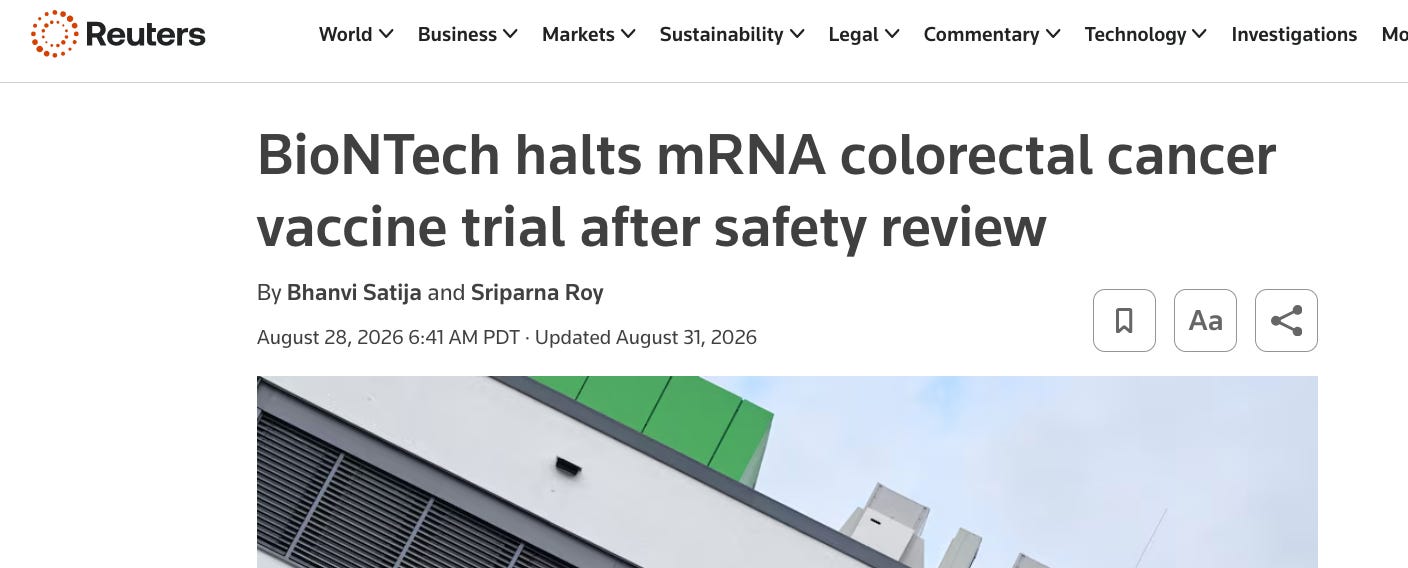
Again, let us have perspective. Some experts imagine a world where this will soon be the norm in all cancers– but such leaps of imagination ignore the fact that melanoma might be unique. Melanoma is one of two cancers that respond to the powerful immune stimulant IL-2. Melanoma was the first cancer where the checkpoint inhibitors– a class of drugs that unleash the immune system– work. Melanoma has long been thought to be unique (or at least among a handful of unique) immune tumors. Whether cancer therapeutic vaccines will work equally well in lung cancer, or colon cancer is at best, a guess. (In fact, a biontech trial is negative).
A widely circulated press release about the promise of a pancreatic cancer vaccine (based on an MSKCC phase 1) is not up to the melanoma standard– as that trial lacked a proper control arm. While hope springs eternal– as the Moderna stock reflects– the truth may be more nuanced.
Are we on the cusp of a revolution in health care? Is the war on cancer something that is finally reaching endgame? I started in oncology 14 years ago, and have witnessed a relentless increase in approved drugs and therapeutics. Some have been transformative, others meaningful advances– as these both appear to be– and yet other drugs have been marginal, mediocre or worse. Nearly all are priced astronomically. Daraxonrasib, for example, is 477,000 a year.
If I were an investor, I would bet on cancer to have more and more advances and discoveries, and earn more and more billions. I would be long on some companies, and short on others. As a healthy person, I am still trying to do everything I can– avoid smoking, keep my BMI low– to avoid it. I am not so bullish about treatments that I would let these go. And, if I had a loved one with cancer– I would be cautiously optimistic about trials and AI and the future, which, as always, can not come fast enough.
If you believe in this substack, become a supporter.
Thanks for the price information. I asked the NYTs and only got criticism and no one knew how much those 6 months cost but they were sure they wanted everyone else to pay for it. Your's is a balanced presentation. Although I often criticize BigPharma these are both good things and I think they and you oncologists are doing a great job.
Keep up with the unsaid nuance-telling. The public needs a balanced perspective.