

When I was a fellow, I got interested in the high price of cancer drugs. I had several patients struggle to pay for medications, and I wanted to help them. My colleagues and I published many papers on the topic.
We showed several things. The price of an anti-cancer drug exceeded $100,000 per year of therapy. This represented a relentless increase since the 1990s. The price of a cancer drug had nothing to do with its mechanism of action-- whether new or next in class— it was not related to how much longer it helped you live, and ironically drugs that had merely been proven to shrink tumors cost more than drugs that extended survival.
We wrote review articles which were highly read and cited. A few years ago I gave a lecture summarizing some of our findings. Here's the link.
https://youtu.be/wJJzZaZzgSc?is=HDrUxS06o1YFddIO
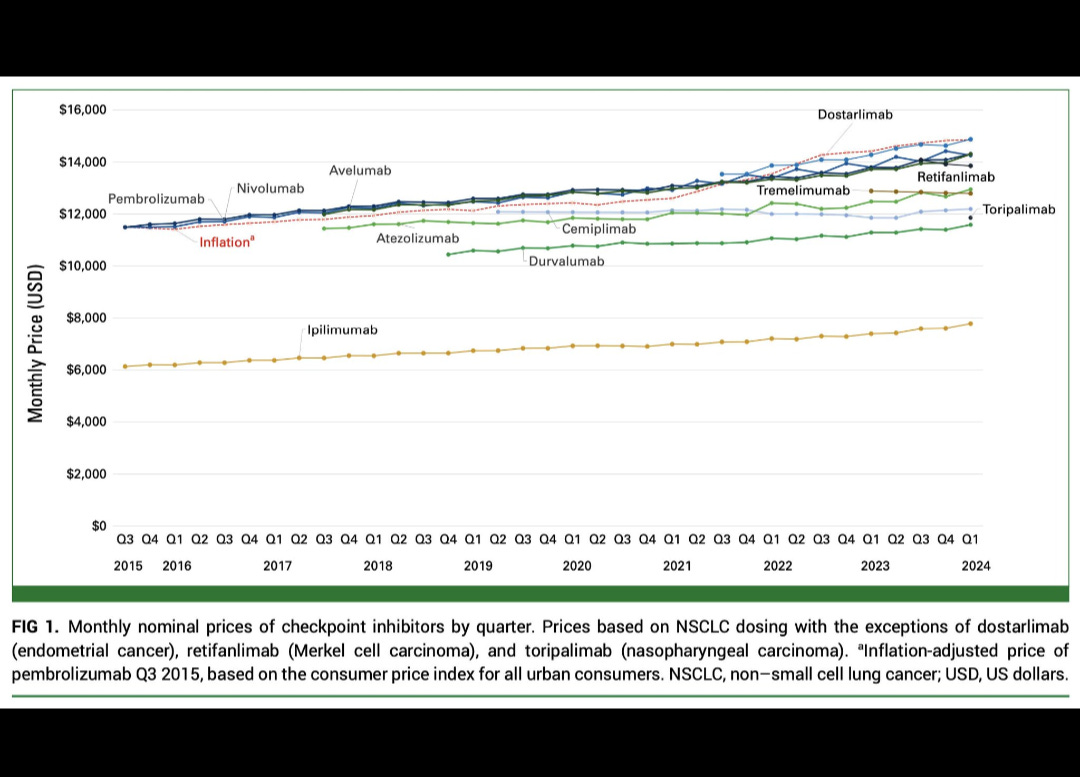
Now it's 2026 and the only thing that's changed is the price of drugs. It's a lot higher now. Just like a decade ago, some drugs extend survival quite a bit, but others are much more marginal. Some may not work at all.
There's a new crop of researchers and they're studying the same things. Is the price linked to novelty? Is the price linked to the regulatory pathway? Is the price justified by R&D outlays? Their papers look very similar to our papers just with a slightly different y-axis.
What lessons have been learned?
In the last decade there have been a number of policy movements to shift the burden of payment from the patient to the payer. This is resulted in fewer stories of a desperate patient who cannot afford a drug. Ironically, this has largely eliminated the public outrage over this issue, allowing the prices to soar ever higher.
Many argue that the high prices drive innovation, and surely they have a point. The more incentive there is in a space, the more companies will be in that space. What remains totally not understood is the relationship between spending and innovation. I've seen no well done study on this topic. Is the relationship linear? Is there diminishing returns?
It is clear to me that continuing to study and publish on this topic— rerunning old analyses—is unlikely to achieve any policy goal. 15 years ago I felt like some of our findings and methods were novel, yet there are only so many arguments one can make and the last 5 years or so have seen intense rehashing to smaller audiences.
The politics of this issue are bipartisan. Both political parties are unwilling to challenge the status quo. Ironically, the single best thing that could happen to this issue is to somehow transform it into a partisan issue. Turning this into a populist partisan issue would open up opportunities politically that do not exist currently. My advice would be for the political right to take this issue, which I believe is broadly popular to the base.
I find it difficult to be sympathetic with physicians who complain about high drug prices while simultaneously promoting or running randomized studies that generate tremendous market share for marginal products, or generate tremendous market share for products tested against unethical control arms. Yet, sadly this is the norm.
All of the efforts to mandate payment and shift the burden have backfired tremendously, as this removed the last downward pressure that existed 10 years ago which was public shame and outrage. It's hard to have a 60-minute special on the topic when insurance picks up the tab in full, and the only person who feels the price is all of us when more of our paycheck is swallowed up by premiums.
I was a resident (long ago) at the Memorial Hospital for Cancer and Allied Diseases, known to most as Sloan Kettering.
Back in the day, the attending oncologists gave the drugs, and the residents managed everything else. It was intense but I learned a lot. There was one cardiologist, one pulmonologist, one Intensivist, but we residents did most of the doctoring.
Everyone in my program went into heme-onc or ID. I chose ID because I thought H/O would be too sad.
I opened my first office in June of 1982, and in walked a Catholic priest who had been living in the West Village for seven years, short of breath and covered with KS.
I did almost nothing else for the next 20 years.
Anyway, drugs and money. One thing I learned was that someone with cancer who made it all the way to East 67th street, when counseled that the Phase I trial they came for offered a “one in a million“ chance of a good outcome would inevitably say, “no problem doc, I’m that guy” or some equivalent phrasing.
I always thought this gave the protocol guys kind of an unfair advantage.
Even though I never did Oncology, I was well educated in open questions circa 1975-79. It’s been really exciting to see many open questions become closed. From 1920-1997 the Chairman of. Surgery was always a breast surgeon. It’s telling that since 1997, it has been a prostate surgeon, because prostate issues are lagging 40 years ( at least) behind breast questions.
Why is the price only $480k per year? Why not $5 million per year? Seriously.
In other words, what are the factors that keep a check on the price. There must be some factors that prevent it from going to $5 million.
So identify those factors and leverage them more effectively. It is clear that the price is based on whatever the market (insurance companies and government/Medicare etc.) will bear.