

There is an 11 page document out now from AHA on coffee and cardiovascular disease that is getting some media coverage.
The media is quick to sell the punch line— Up to 5 cups may be good for you!—, but what is missing is any serious reflection on just how poor the data are.

The vast majority of the data presented in the document are observational studies. These studies- for a common nutritional exposure and a common health outcome—are useless. People who drink coffee and those who don’t, are different, and your coffee patterns change as you get sick and unwell, if you are hospitalized etc. You might as well read tarot cards if you want to rely on observational nutritional studies.
Let us look at the randomized trials. Here is the single best one. If you have afib and have ever drank a cup of coffee, and you get cardioverted, it is better to drink coffee for afib than abstain.
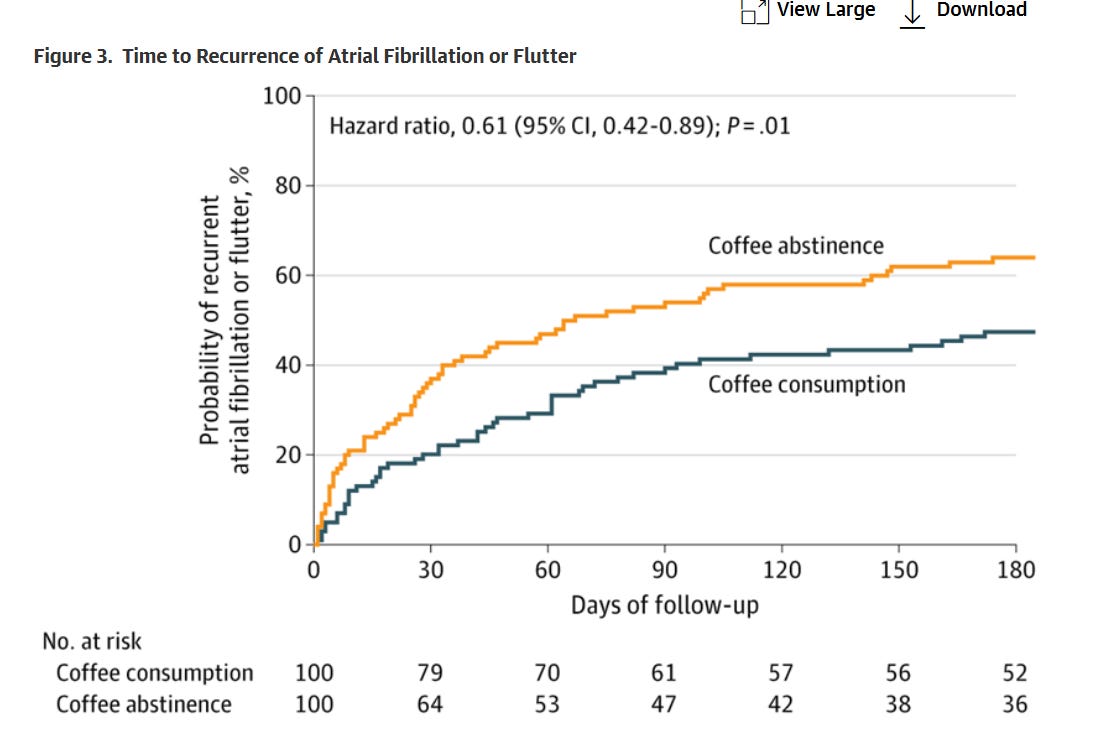
This is a really good paper, but let us not forget there are still open questions.
What happens after 180 days
In the long run, do you have MORE stroke. You see— if more afib then more DOAC. If more DOAC than less stroke. Ironically, coffee may be good for afib, but bad for stroke bc it lulls docs into false sense of confidence, and leads to less DOAC. I don’t know this to be true, but it is not yet ruled in or out by data.
In the long run, do you have a overall better QoL.
But still— a very good paper because the mantra was coffee is bad here.
Now lets look at the next set of RCTs (many of these refs are RCT or meta-analysis of them)
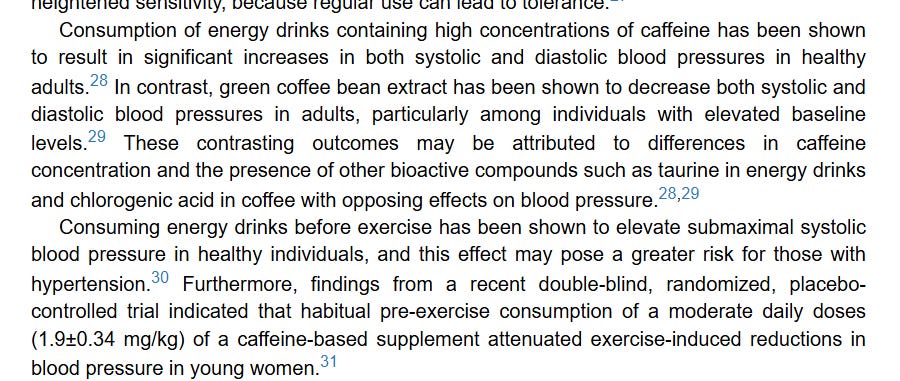
I have no doubt that caffeine can cause short term BP increases. But are these BAD or are they GOOD? If I am going to go on a long bike ride, hiking yosemite, lifting heavy weights, playing soccer or basketball or tennis, I find caffeine to enhance my exercise. So I can push myself harder, which later results in greater fitness. Perhaps even also lower long term CV risk. Many fitness experts share this view— but none of these studies even seek to evaluate this. It would be so easy:
Randomize participants to coffee before exercise for a month, or no coffee, and then measure VO2 max, resting heart rate, etc. Even then, we are still using surrogates. Yet, just like the coffee and afib paper— we may dispel misguided prejudices.
Here is another lamppost below which we search for our keys
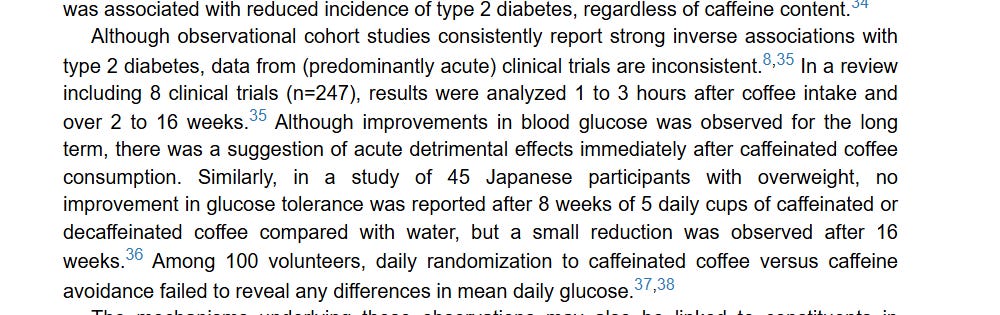
Again, this means nothing. Short term, abysmally tiny RCTs measuring glucose levels. There are similarly uninformative studies for lipids. Whether coffee improves or decreases mortality, or diabetes, or any hard endpoints is unknown.
Yet, the document concludes strongly— mixing up the weak to non-existent randomized data with the uninformative observational data.
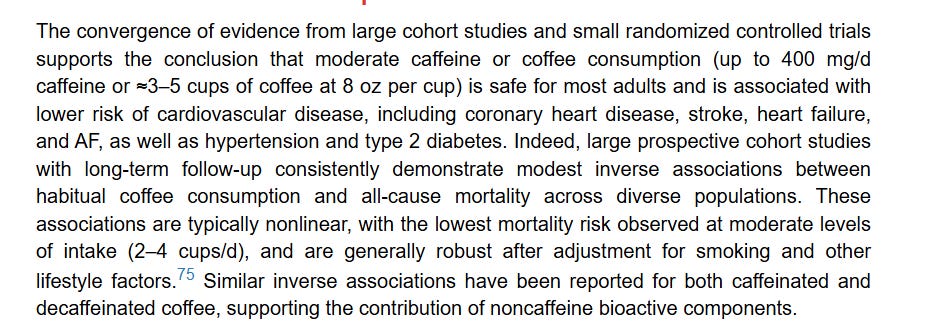
The conclusions that are powerful here rely only on the unreliable studies.
Here is how I would have written the concluding paragraph.
If you have afib, have ever drank coffee, and get cardioverted, you will have less afib if you keep drinking than if you abstain. There are some small trials assessing coffees effect on short term biomarkers that are uninteresting. Beyond this, we have no idea if drinking 1,2,3,4,5,6,7,8,9,10,11, cups of coffee is optimal for health— let alone cardiovascular health. We don’t know if 6 cups vs 3 increases the rate of stroke or heart failure, if practiced for years. We could make a claim here using UK biobank data— but that would be lying. Better to be honest and say we don’t know. The fact we know so little about this topic— despite widespread public interest— should be a call to arms to launch a research agenda. In the meantime, you won’t find guidance in this guidance document. Finally, we urge a mortatorium on public funding for large observational studies which are incapable of answering these questions. Those funds could be better spent on an RCT agenda.
That is the right conclusion. Let me know your thoughts below.
When I read the article about drinking 5 cups of coffee I thought instantly of you. Your last paragraph is priceless.
Sheesh! I used to drink a couple cups a day. I LOVE coffee! It is a huge quality of life thing for me. Just a couple of weeks ago I got an A-Fib diagnosis so quit coffee. I have been suffering ever since!!!! Is this article my hall pass for going back to coffee. My a-fib is mild.