

Dr Aaron Goodman made this comment on X

Woah— that’s a mouthful of technical words. Let me unpack his idea in this post.
First, I admit the tweet caught my interest. And although I love Dr. Goodman, I always trust but verify. So, I fact checked him.
I asked 2 AI programs to superimpose the curves he describes. ChatGPT Astra 6 extra high was a little slower (first), Gemini Argon (second) (Side note: AI is going to be so, so disruptive for cognitive work).
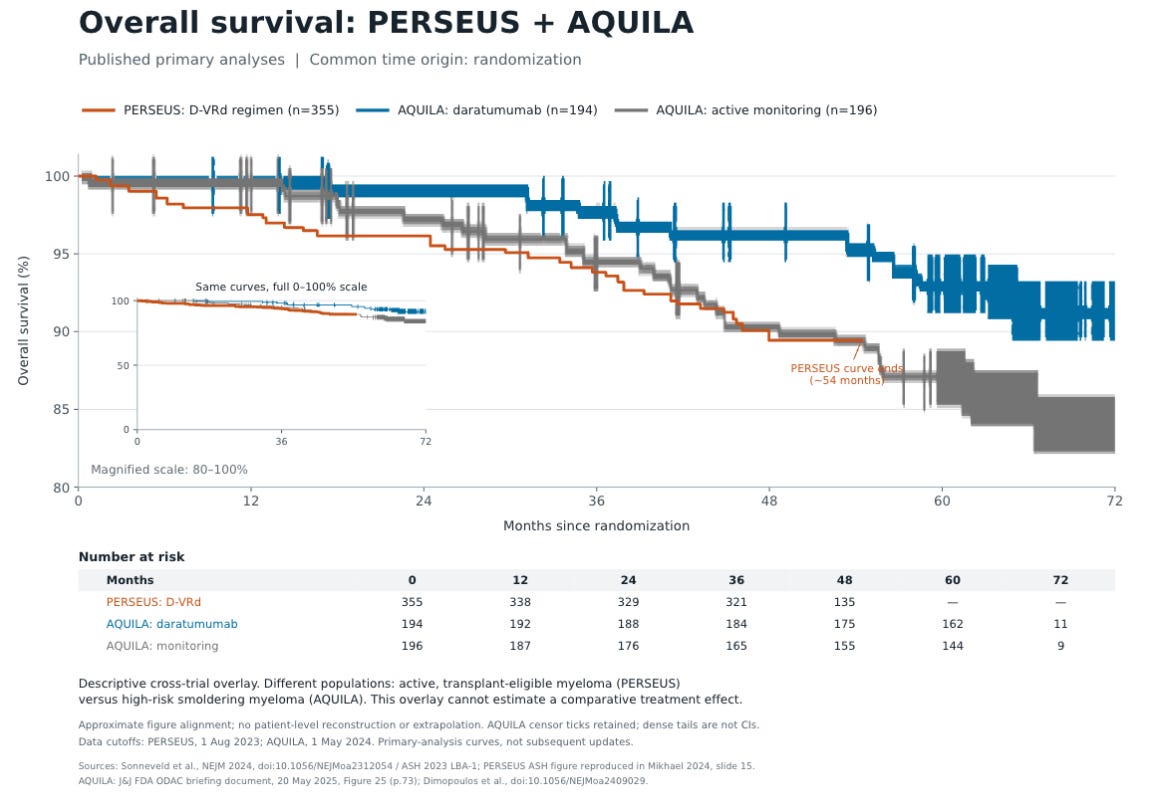
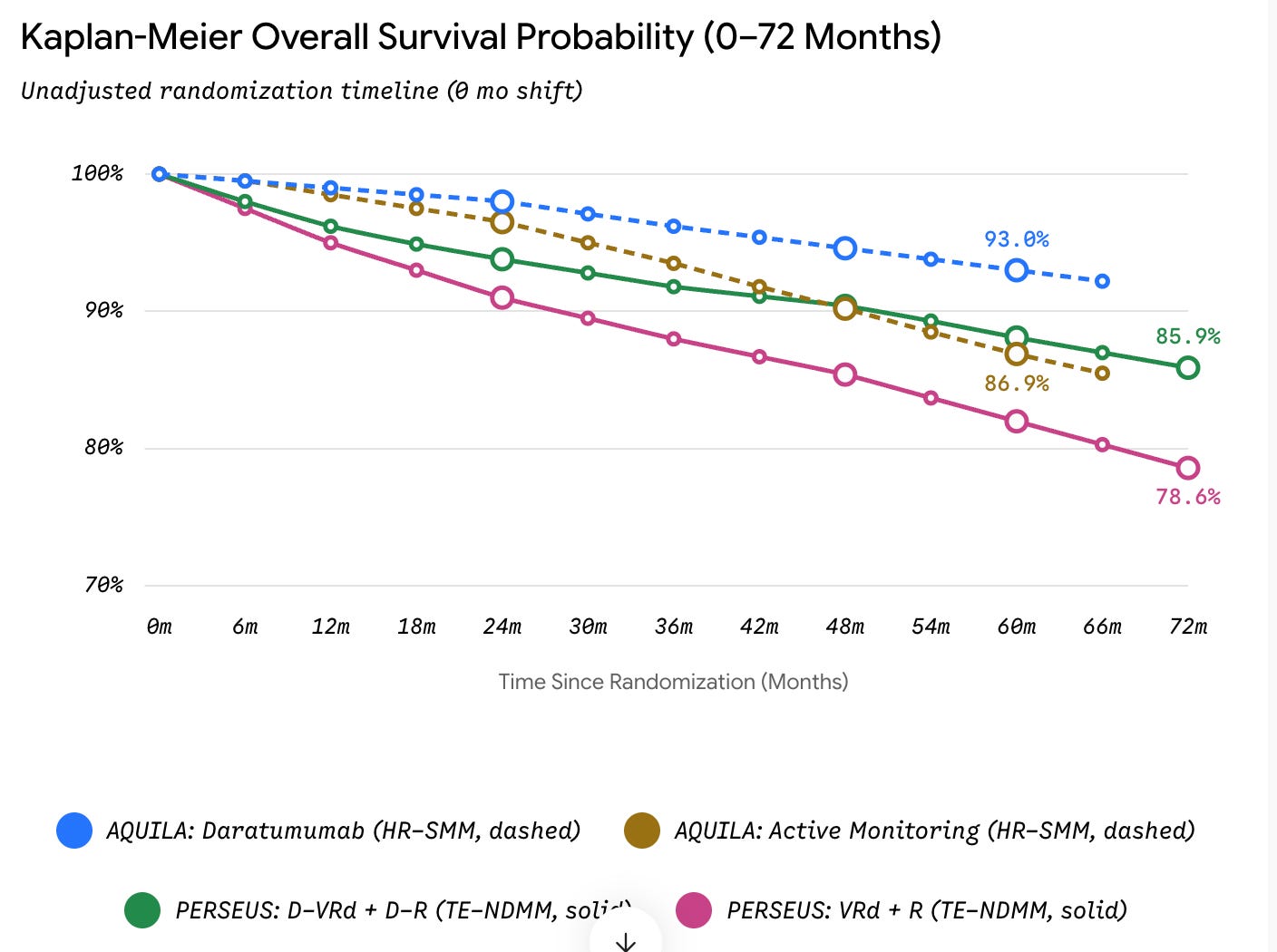
Aaron is correct— but what does it mean? And why is his point so important?
Smoldering myeloma is a pre-cancer state. It eventually (in many people, but not all) becomes myeloma, but often only after months or years. Multiple myeloma meanwhile is an actual cancer that warrants treatment.
The median age in Aquila is 64 and only 60 in Perseus, but a 64 year old with smoldering myeloma is expected to live longer than a 60 year old with myeloma per Flatiron (real world US data). (the curves should not cross).
Instead, the fact that the control arm of Aquila does worse than the treatment arm of Perseus means exactly what Goodman claims: the post protocol therapy in Aquila is so horrible— so negligent— so disastrous— that people with a pre-cancer do worse than folks with an actual cancer who get appropriate care.
With smoldering myeloma, the only endpoint that matters is overall survival. After all, if you treat a pre-cancer with a temporizing regimen, you add toxicity and cost, by definition. Your tumor will still eventually grow, and it will still eventually kill you. The only reason to treat yourself early vs. treating when the precancer becomes a cancer, is that by doing so you live longer or better.
So the only appropriate study would be to randomize to early treatment vs current standard of care, and measure survival. But that would be difficult, and make it hard to increase uptake for your product, so the easy cheat code is to randomize to early treatment vs poor care— if you run your trial globally the control arm will tank— then you can easily show a OS benefit. Indeed, Goodman argues that is precisely what the trial did.
Aquila wants to have it’s cake and eat it too. If PFS is a suitable endpoint for smoldering, the control arm should be Len. If Len isn’t standard of care for smoldering because it never shown an OS benefit (in a clean trial), then OS should be the endpoint of Aquila. But OS should be measured against actual US standard of care, not substandard care. Yet, Goodman shows that the control arm must have received substandard care.
When a company runs a study like Aquila, and approaches someone to author it— what should the doctor do? Accept the publication or decline and advocate for cancer patients instead? Is ethics or hirsch index a more important legacy?