

For me, the top 2 most talented, living, American writers are Donna Tartt and Jonathan Franzen. Today, I will review Crossroads.
I resisted reading Crossroads when it debuted because I was worried that after finishing it, I would have to wait years before another book of its caliber appears. Now I find myself in this predicament.
It is undoubtedly trite to say that Franzen is hard at work on a trilogy seeking to become the Great American novel of the 21st century, and so far so good— yet that is precisely what this book is— it is well on the way to being that novel.
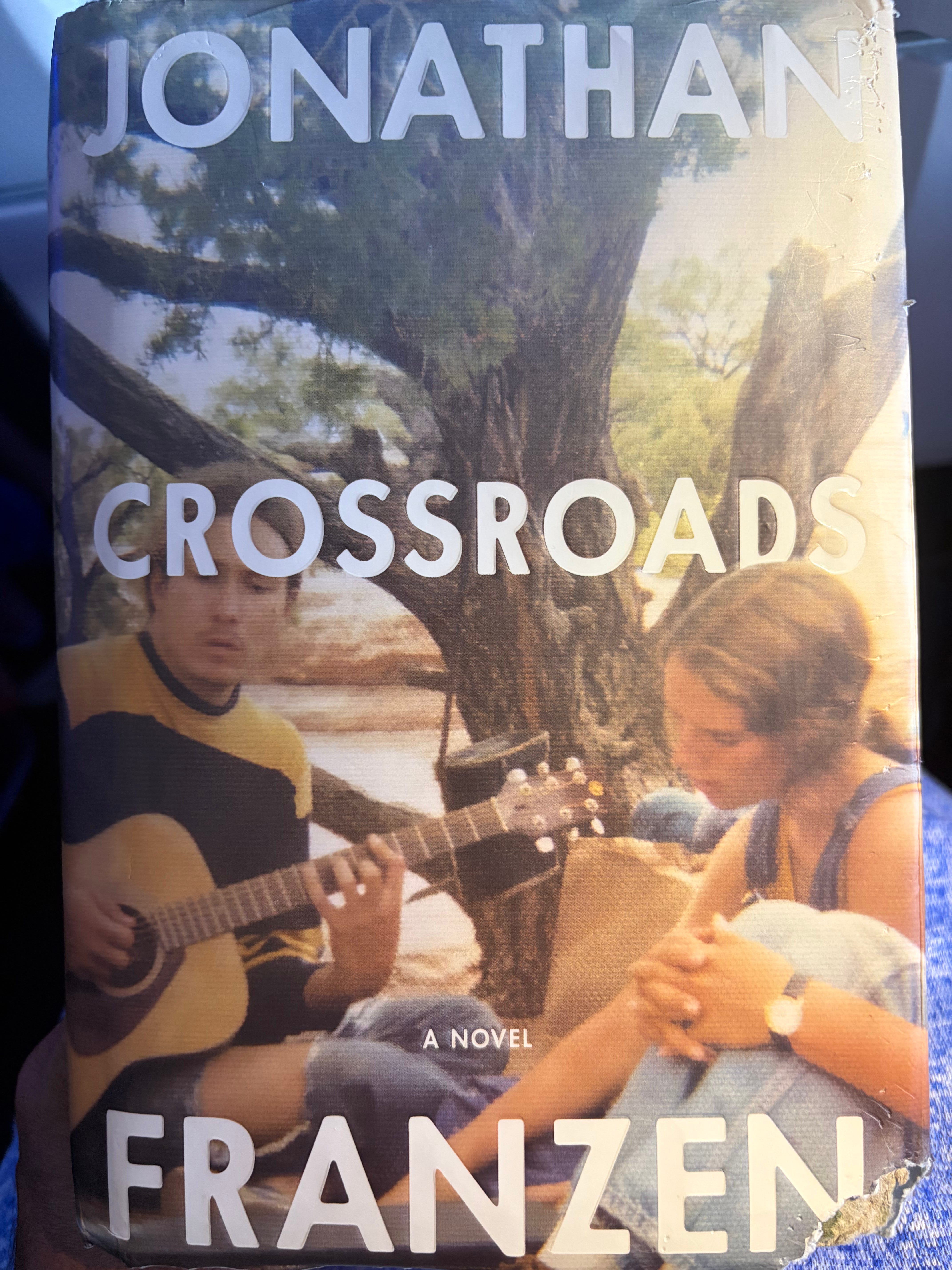
Who is at Crossroads? (Spoilers to follow). Obviously Russ is— between the church and Ambrose and his relationship with his wife and escalating and dangerous flirtation will Frances. Perry is at crossroads between his genius and drug addition. Becky between education and marriage— between selfishness and Godliness. Clem between joy and sacrifice. But ultimately it is America itself. The book is the crossroads of an America moving from a religious nation to a secular one through the tumultuous years of the 70s.
The star character is Marion. Her father’s suicide, sister’s absence, and the haunting scenes in Los Angeles as she is seduced by the salesman. Then her madness. An abortion. A deal with the Devil, and finally meeting a good boy in an Arizona church, and building a life with 4 kids. Marion who stares at Russ and informs him that he has no idea who he married—then proceeds to deliver on this proclamation. Marion is one of the great characters in American fiction, and Franzen is at the height of his powers.
Anticipation, and not the act itself, drives many novels. Flirtation, being in love, getting closer, then further, then closer again. In many ways stories about romance seldom cover the being together part. Rather they make you fall in love with falling in love. They are Marquez in Love in the Time of Cholera— waiting 51 years 9 months and 4 days for the opportunity to knock on that door.
But Russ is not in love— and it is not love that motivates his sexual desires, but ego. Russ, anchored forever to his grievance that he married the first woman he slept with, against the advice of his grandfather, is chasing Frances out of emptiness and self loathing, rather than desire. Franzen never lets us forget that Russ is thinking about only Russ— even the inevitable sex scene becomes utterly cringeworthy. (I’ve seen some critics fault the novel for this sex scene— perhaps they don’t get it— it is not meant to be sexy).
America is a complicated nation. We still haven’t made sense of ourselves. We used to love God, then we told ourselves we would be rational instead— but that was not in our nature— so we made new Gods— and it to extremes.
When Clem finds out that Becky is pregnant instead of going to college— he grieves for what she might have been; a woman who was educated at at east coast liberal arts school, who married a sophisticated and educated man, and had clever and daring children.
When I was growing up in the 80s— the idea that a woman should have a career before she had kids was increasingly accepted— and this was in contrast with the religious America of years prior. Although Becky assures her brother she is happy— God decided the right thing for her— I wonder as her brother does— what if….
Childrearing and family life is just one of many ways America has grappled with moving from Christianity to secularism. Like many Americans, I feel that my politics never changed, the world changed around me.
By 1980s standards, I would be solidly liberal— and like Clem, I wonder if the Becky’s of America would be better off had they kept their inheritance for themselves— instead of sharing it with their wayward brothers because “God would want that”— and instead gone to school, found a new path in life, and escape the rigid and narrow small town where they grew up.
Yet, American secularism didn’t stop with women slightly outnumbering men in colleges (a perfectly fine outcome). Instead, these values took on religious dimension of their own— we have created new Gods. In places like San Francisco, the median age of a first time mother is 33. As with medians, it is not uncommon for a first time mother to be in her 40s, or even 50s (REI needed). Women and men delay family for careers; freezing eggs, and embryos, and their identity. Because of the resident union, my university gives something like 30,000 to each resident to freeze their eggs. The wrong solution to the wrong problem.
Was the answer to barefoot and pregnant by 22— still in training with frozen eggs by 37? Or did secularism overshoot? Did secularism begin to take on the religious purity that religion once held?
We underestimate how jarring this transition has been to many Americans. And we underestimate that American’s are by nature a devout people— when they don’t have God, they don’t pursue a reasonable outcome, but pursue something else to extreme.
In every dimension of American life, we can’t do the sensible thing. Our economy is crippled by health care spending— but we are utterly unable to be honest and say what works and doesn’t, and insist it all does.
Our views on foreign conflicts are intensely one-sided. Whether Ukrane, Palestine, Iran— so many Americans as entirely certain who is good and bad, and whether decisions were completely right or totally wrong. Such certitude is a hallmark of religious thinking, as is confidence > understanding.
We cling desperately to the idea that we are a self made people such that we are utterly unwilling to offer children equal footing— proper nutrition and education in their most vulnerable years. Such legislation stalls, as Europe looks aghast at us.
When we were scared during the pandemic— fearful our suburban lives would be disrupted— we happily closed their schools rather than risk a few of us (very few per economic data becoming sick). A core religious belief across cultures is that older people sacrifice for the young. In the new America, it’s the other way around. Even the progressives who champion children were the first to happily cloth mask them.
Yet, Crossroads is one family in one decade. The decade where the absurdities and incongruities of religion became growingly apparent. Russ is there is help the Navajo— but he can’t stop the development creating a scar across the land— and is increasingly resented by those living there. Perry is brilliant, but without an outlet for brilliance, it can only be distracted by drugs. Clem is broken, unable to acknowledge that he is happy, and ensures he suffer instead. He pities his sister while he drives himself to ruin (She has the very thing he was scared to embrace). And Russ is like so many— forever thinking the grass is greener and if only— what about me.
The crossroads youth group is a joke. A performative operation— a prelude to the woke movement. Ambrose is the perfect metaphor for land acknowledgements and labor acknowledgements and feelings are facts and lived experience and all the pointless theatrics that actually don’t make poor, downtrodden people lives better. Kids who sit on the bus and bring their guitars to the Navajo land and want to have an experience.
But then again, this is just my interpretation of America and the novel, and as Franzen shows, we can each have our own view. Russ and Clem experienced the same events when Russ was expelled from Crossroads, but there are two distinct stories. Franzen wields these two expertly, getting us to be sympathetic to all involved. Ultimately, each of us will have to figure out for ourselves what precisely is at stake at Crossroads. Can an America founded by religious purists create a society that abandons God, but also abandons extremism. In Crossroads, so far, the answer is no.
Vinay, I know you do not read these comments. But your writing is so good, it cries for a copyeditor because your copyediting is NOT good. Isaac Asimov could type a draft on a manual typewriter once and have it be flawless. You are not he. I volunteered to copyedit your stuff when you first started this stack and I am still doing so. There is just no reason for high quality thinking to be deprecated by really bad grammar/spelling/punctuation. So I offer once a year, more or less, to do this, just in case you ever read comments.
Thanks for the review of this novel. I do love Donna Tartt so I'm excited to explore Franzen. A recommendation for you, All the Colours of the Dark by Chris Whitaker. Wonderful writing and storytelling. It is on my top 5 along with The Goldfinch.