

Every few months someone makes the claim that car seat and booster laws reduce the number of children we have. The other side makes the claim that it saves far more lives. What do the data say?
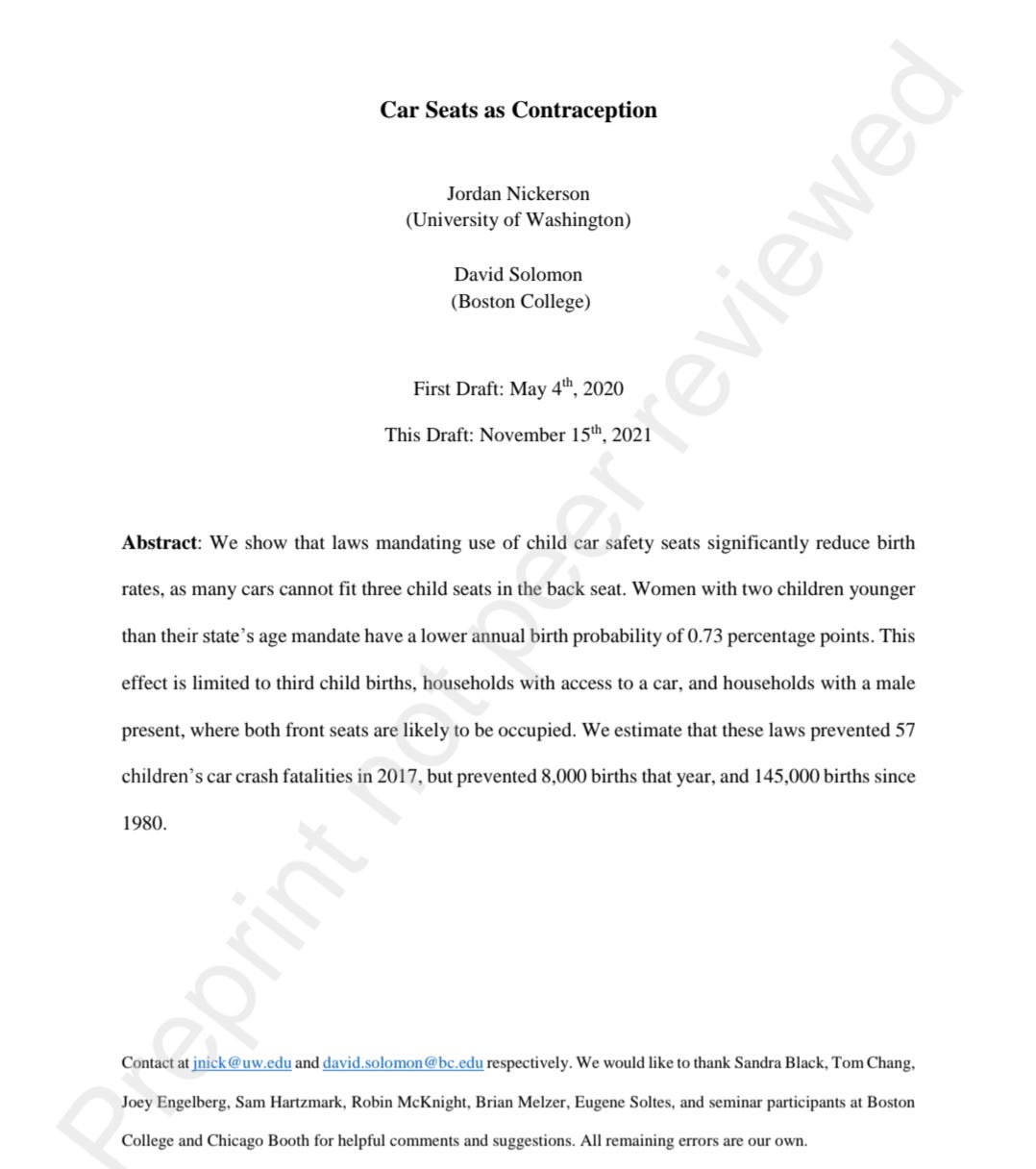
First. Let's be clear. This is a perfectly legitimate question to ask. One side appears to claim it is misinformation to state that car seat laws may be net detrimental— that is clearly wrong. It is a debatable claim
Second, the evidence car seat mandates save lives is very weak. As the authors note multiple groups find no effect of state rules and this paper confirms an effect that verges on null.
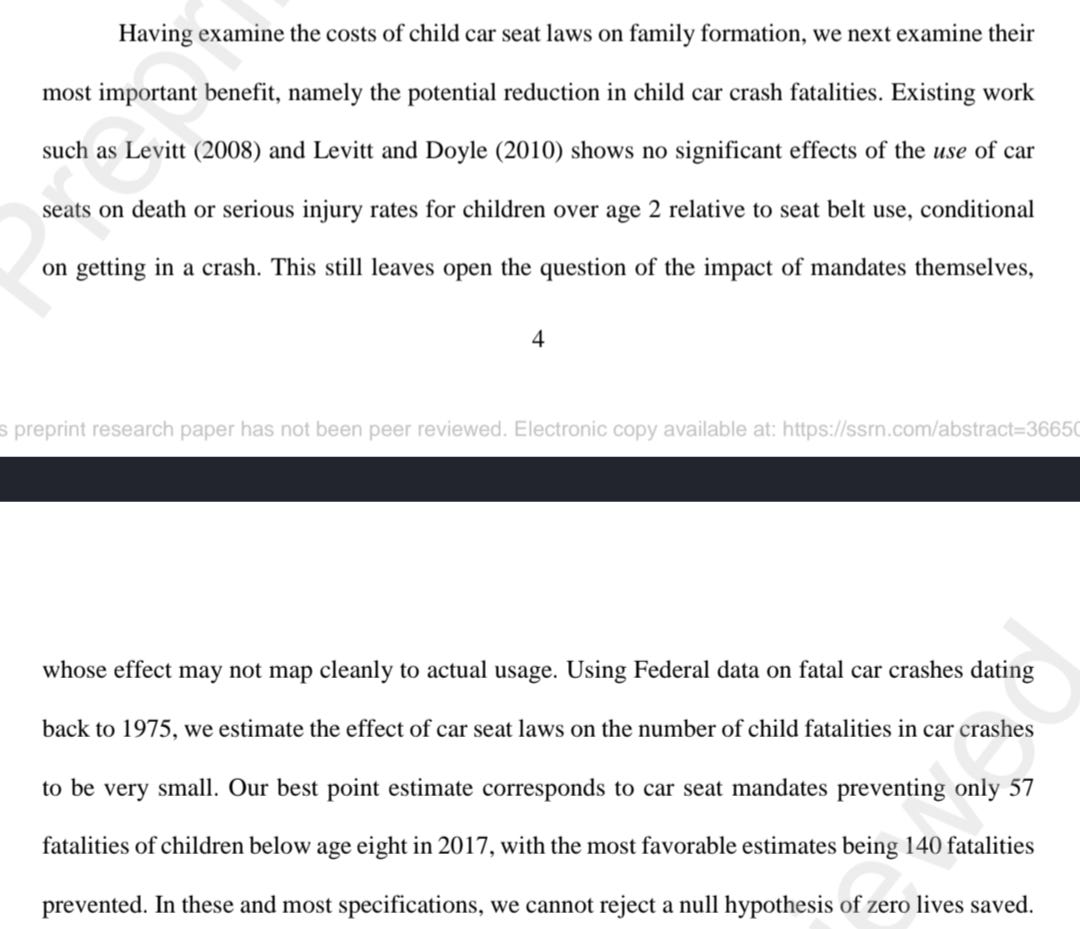
Instead the AAP has relied on weak studies. Including a famous one that was retracted and ones that are confounded by comparing people who follow rules precisely against those who don't. As a general rule, a causal observational paper appearing in the economics literature is of higher methodologic quality than one appearing in the pediatrics literature.
Third, If car seat laws discourage thousands or tens of thousands of parents from having one additional child (as this paper suggests), but save three dozen deaths, that is a bad societal trade-off.
Fourth, the burden of proof is on the state. The state intrudes into your life and makes a policy intervention. The state has the burden to show how many lives are saved and at what price and whether that's acceptable. If the state is allowed to get away with runaway safetyism, next thing you know the state will mandate you make your 2-year-old wear a cloth mask to go to the public library or fly on an airplane over a virus that poses nearly no risk to them. Crazy things like that.
Fifth, looking at the paper it is a high quality causal study that is not conclusive. While the authors go to great pains to show the effect is present when plausibly related to the birth of a third born and when there are two parents in the front seats, and based on staggered implementation laws, all of this is still circumstantial evidence. The authors may fail to capture the key confounder which is as attitudes change towards American Life shifting from having many kids to # My career and # duel income no kids, etc. This may coincide with both a change in birth rate and a change in safetyism and that may actually vary in different regions. Although this paper is persuasive, I'm not 100% persuaded.
Sixth, this is one of the rare situations where I think further research is unlikely to have value of information. I tend to believe the existing literature, including this paper maps upper bound estimates of effect and is enough to say that the state should ease up on car seating regulation. This may be hard to hear for folks in public health who have nothing better to do than to come up with the lowest value interventions to fight about, but their efforts would be better spent elsewhere. They should consider instead embracing improved childhood nutrition in public schools.
In conclusion. My view is that car seat legislation has very little impact on child safety in accidents, and likely some impact on decreasing birth rate, with very low confidence, and this is enough to say we need to stop expanding state mandates and perhaps curtailing them.
Meanwhile..... in California a new law requires that children as old as 15 must pass a 5 step test (which will particularly stigmatize children who are short) in order to not sit in a booster seat. Yep, you heard that right: Teenagers up to 16 can be required to sit in a booster seat.
Beach chairs save lives too. Lower the risk of drowning and shark attacks.