

When I was training, there was a popular lie among oncologists: The best treatment for your patient is a clinical trial.
Obviously that isn't the case. Sometimes it is, but sometimes standard of care is best. A few years ago this trial sprung up.
https://www.thelancet.com/journals/lanhae/article/PIIS2352-3026(21)00273-8/abstract
Instead of using the well established and curative regimen RCHOP the trial was an uncontrolled phase 1 combining venetoclax with epoch R. At the time, a few of us criticized this trial.
Why would you skip a less toxic curative option to participate in a more toxic regime adding an unknown investigational agent??
Spoiler alert eventually the regimen was tested in and halted in RCT for excess toxicity and death.
If you have a curative option with a 65-85% chance of cure— participating in a phase 1 trial with a more toxic backbone and an investigational agent known to suppress marrow is a bad decision. That's an honest second opinion, and I bet privately many oncologists felt the same.
Recently some oncologists lamented second opinions that discourage trials. All trials have been vetted by the company, IRB, investigators, regulators— ergo all are ethical and good, the argument goes.
This sadly is a delusion. All those protections and the Swiss cheese model holds true. Errors still happen. In fact quite often.
If you want to have an oncology trial appraised email me the trial and I will write a post on it if I get time.
Why do bad trials exist? Companies are conflicted. They want their products to have more market share. Like parents they think all their kids are brilliant, even when they are dunces. Investigators have strong professional interests to run trials— even dubious ones. No one gets promoted by opposing bad trials. Universities make money from these trials. Lastly IRBs are full of people who know nothing about oncology. It is hard to fault them.
A new article shows many tax payer funded trials are bad. Great paper by Manni.
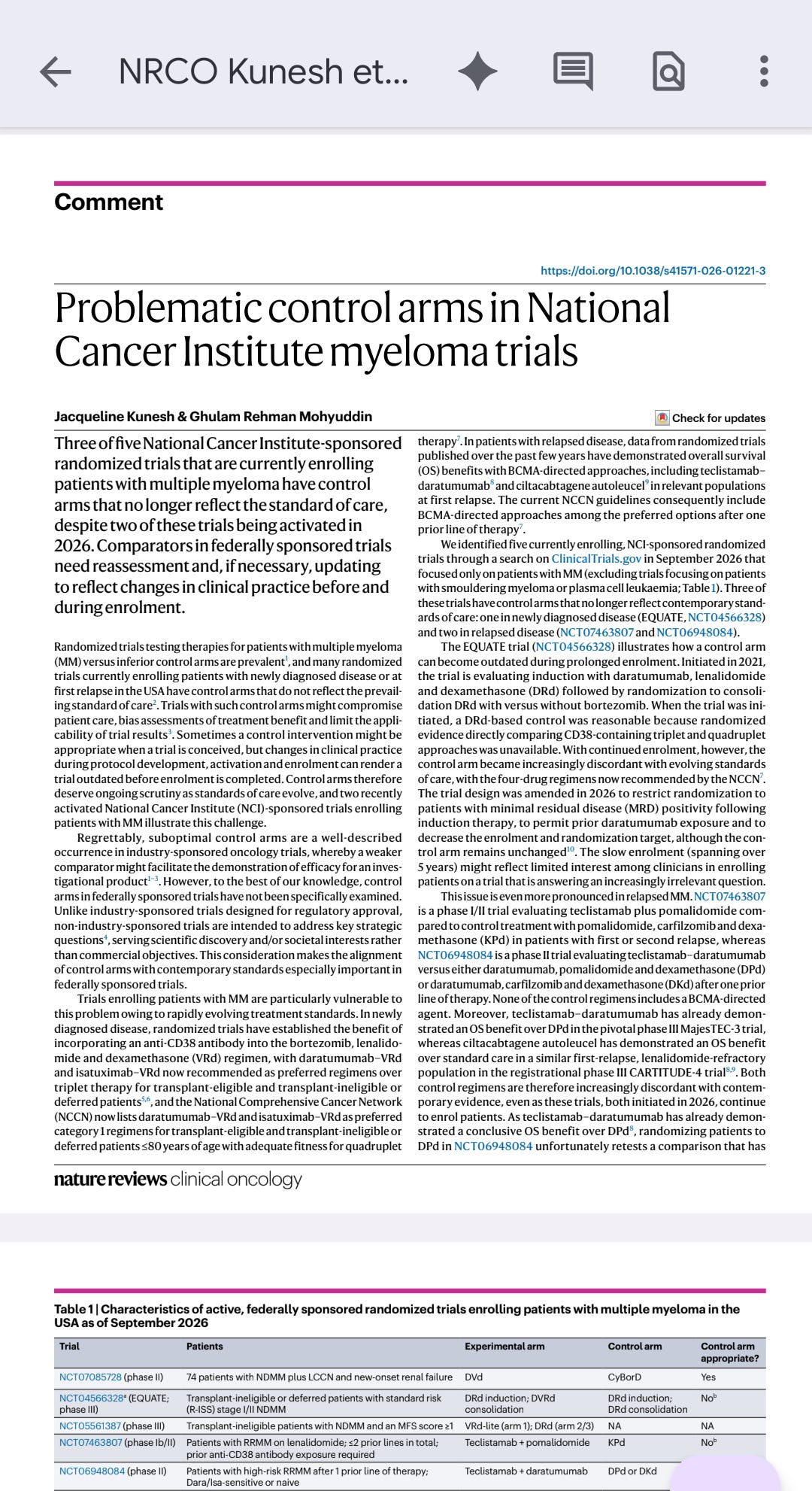
One further point. For any incurable cancer, you want to maximize the time you can keep a patient alive and well with approved drugs. Yet many trials require a patient to have progressed on some or all drugs. As such there is a tension between judiciously using the drugs and burning through them. Second opinions here are needed as some docs seem to want to burn through options.
Final point, a lot of people don't want prediction markets to include clinical trials. If they did, the truth about many trials may come out. Some trials are not exciting, others use an unethical control arm and are certain to win. Lopsided probabilities in a randomized study 5% or 95% are a tell tale sign of a bad trial… like a straw man control arm or a super toxic drug. Caveat emptor.
This of course depends on the trial and the disease. In short, nuance. Something that seems to be in short supply these days.
30+ years ago I was diagnosed with Wilson's disease. Having become increasingly symptomatic (neurological symptoms) in the 18 months prior to diagnosis, I was anxious to begin treatment. My neurologist cautioned me because the standard drug had a track record of initial worsening of neurological symptoms with half of those who worsened never getting better. He advised me to participate in a trial for a new compound. I did, spending 8 weeks inpatient at the University of Michigan hospital. They saved my life. My symptoms began to improve before the 8 weeks had ended and continued to improve for months after. I was put on a maintenance regimen of Zinc Acetate, which I still take. My life retuned to normal thanks to that trial. I shudder to think what would have happened if my doctor had simply gone by the book and prescribed penacilamine.
Of course every trial is different and so is every disease.
Nothing beats informing oneself and there's no better time to do so than nowadays.
My husband and I have both lost spouses in the same amount of time with treatment than we were told they could possibly last without it. The difficult part was the sense that perhaps their quality of life was diminished because of treatments. At this point if either one of us were to get diagnosed with metastatic cancer, we have made our peace with God and will let it go His direction at this point. For us, quality of life is more important than adding time suffering.
I got my bachelors in biochemistry and worked 35+ years in pharma and academia research. I have watched many clinical trials come and go. Some worked, many more did not. However, I am hopeful that the future of scientific research will benefit from SI pointing research in more fruitful directions.