

I’m increasingly asked to give second opinions for friends and family with cancer undergoing treatment. When I look deep into the chart, I find the same recurring, medical errors.
I want to preface this by saying these errors do not happen because your doctor is a bad person. Almost surely, your doctor is a good hearted person— who is doing there very best. The reason the errors occur is because oncology training places no emphasis on critical thinking and practicing judiciously. It is a systemic issue.

With that disclaimer, here are five red flags to look out for. Just like actual red flags, these do not inherently mean the doctor is wrong, but they should trigger suspicion and you should ask important follow up questions.
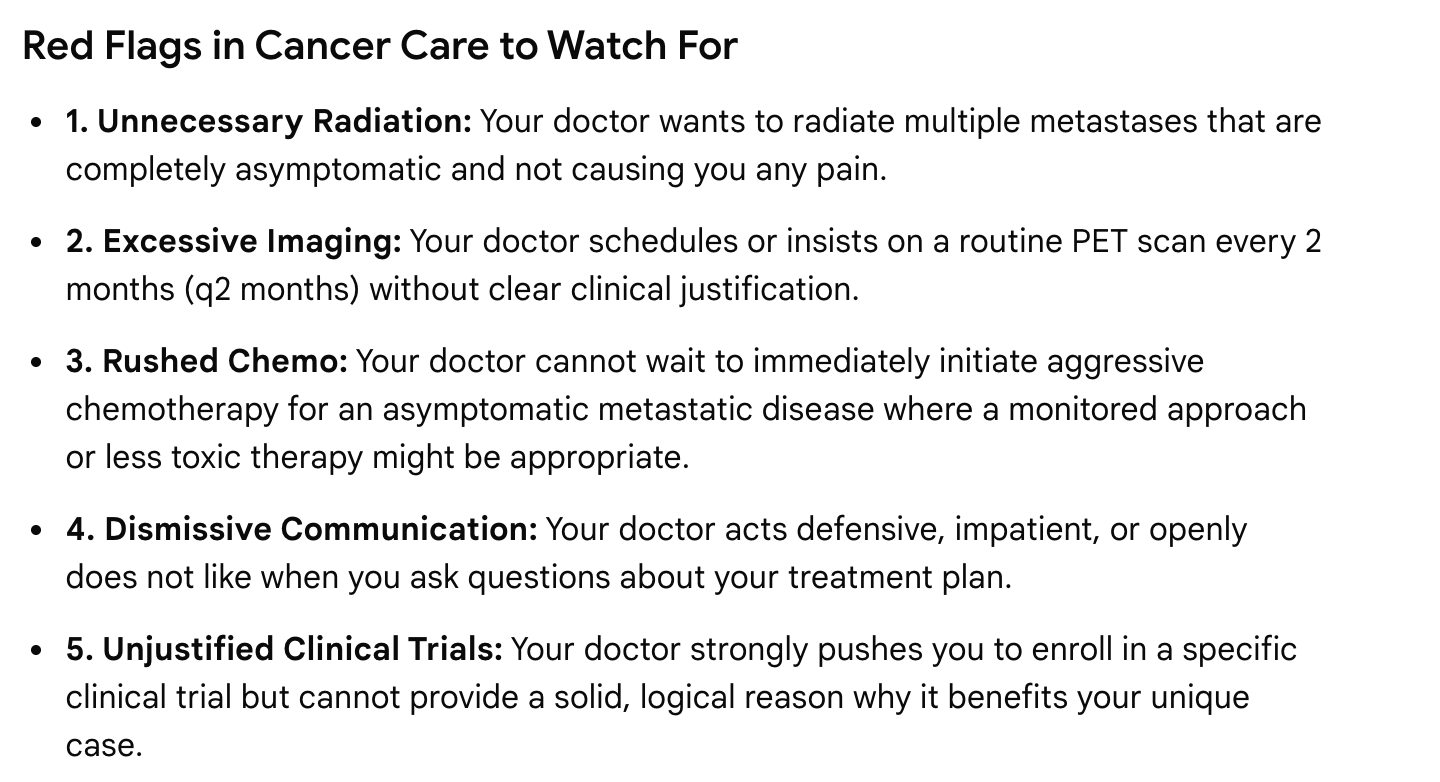
1. Your cancer has already spread to different parts of your body, but the doctor wants to radiate or cut out (surgery) multiple spots that aren’t causing pain.
Radiating spots that are causing a great deal of pain makes sense. Radiation, if your cancer is localized, can make sense. But radiating many spots that aren’t causing problems— after the horse has left the barn— should raise suspicion. Ask your doctor: what evidence justifies this? Is it randomized? Is it an underpowered phase two that’s inappropriate for changing practice or is it a phase 3?
The same is true for getting a bunch of surgeries on various parts of the body after cancer has spread. Generally there is no evidence to support this strategy— and there are serious downsides. Both of these practices have been widely embraced without evidence. I have even seen a patient with metastatic pancreatic adenocarcinoma get metastatectomy— that’s malpractice.
2. Your cancer has already spread to different parts of the body, but you feel okay. You haven’t lost weight and you don’t have night sweats. Your doctor says it’s important to start chemotherapy, targeted therapy, or immunotherapy right away. No time to wait.
As a general rule, there is very little evidence that early treatment is superior to delay treatment in asymptomatic, low volume metastatic disease. Ask your doctor: why the rush?
They may say something like people who start later do worse; that’s a very different question from: If I start now, will I do better? The types of people with delayed starts differ in more reasons than the timing of the therapy.
The same issue arises when the tumor starts to grow after it is already shrunk. Should the doctor start a second therapy the moment they detect growth or a rise in a blood marker— even if you are without symptoms. Again, ask what’s the rush? Is there evidence to support this? Why not start a month later?
We do have randomized data in some tumors that leaping to treat biological markers just adds more chemotherapy, more side effects, more cost, but no more life.
3. You’re getting a pet scan every 2, 3, 6 or 12 months.
Why all these PET scans? Why are we not doing CT scans? Do the scans need to be this frequent? Your doctor has some explaining to do.
The key question: is there evidence that doing this scan, this frequently improves clinical outcomes.
is this really the only scan capable of following your disease?
The doctor may say something like We want to catch it the moment it starts to come back. But that begs the question. Why the rush? See number two.
4. Your doctor seems irritated or dismissive when you start asking questions about the evidence.
It’s always possible they’re busy, or having a bad day, but the deeper concern is they do not understand the evidence base. That isn’t their fault. Medical education doesn’t teach it at all. (See above - most doctors are good hearted)
Find a doctor who takes the time to answer your questions. Within reason.
5. If your doctor is keen on a clinical trial, ask them two questions
1. What’s the response rate of the drug?
2. Is this a new target or mechanism of action, or is there already an FDA approved therapy hitting this target?
Being excited about a clinical trial makes sense if there are already impressive responses, or the response rate is above 10 or 20%.
Being excited about a clinical trial makes sense if this is the second drug to hit a target, and that prior drug has a good response rate. But, in this case, ask your doctor why you can’t get that prior drug?
Yet, if the doctor has no idea what the response rate is, has no idea if anyone has responded, and it’s a completely novel target, why on Earth are they excited?
Are they profiting from putting you on study? This is sadly a growing problem.
In conclusion: your doctor is a good person, you can trust them to babysit your kids. But whether or not they’re providing good cancer care is something different entirely. These are five things I commonly see when I review cases for friends and family. Just like red flags in life, detecting the problem is not the end of the story. You need to investigate, ask tough questions, and push on it. At the end of the day you may be satisfied, and there may be good reasons why the doctor is getting a q2-month pet scan, and you are undergoing 6 local radiation treatments for mets, and the doctor is switching your therapy bc your M protein is up. Alternatively, you may find their explanations lacking. I often do.
I once had a patient who left me a negative review because I told him his asymptomatic metastasis didn’t need me to radiate it despite my lengthy attempt to explain my rationale
I’d add failure to offer prognosis and failure to provide in a comprehensible, quantitative manner. Most people don’t spend their lives studying cancer survival rates by type, stage, and treatment effectiveness. They can be clueless about their situation. Research shows patients want and value prognostic information. The reasons why doctors give for not providing are understandable but not excusable in the vast majority of cases.