

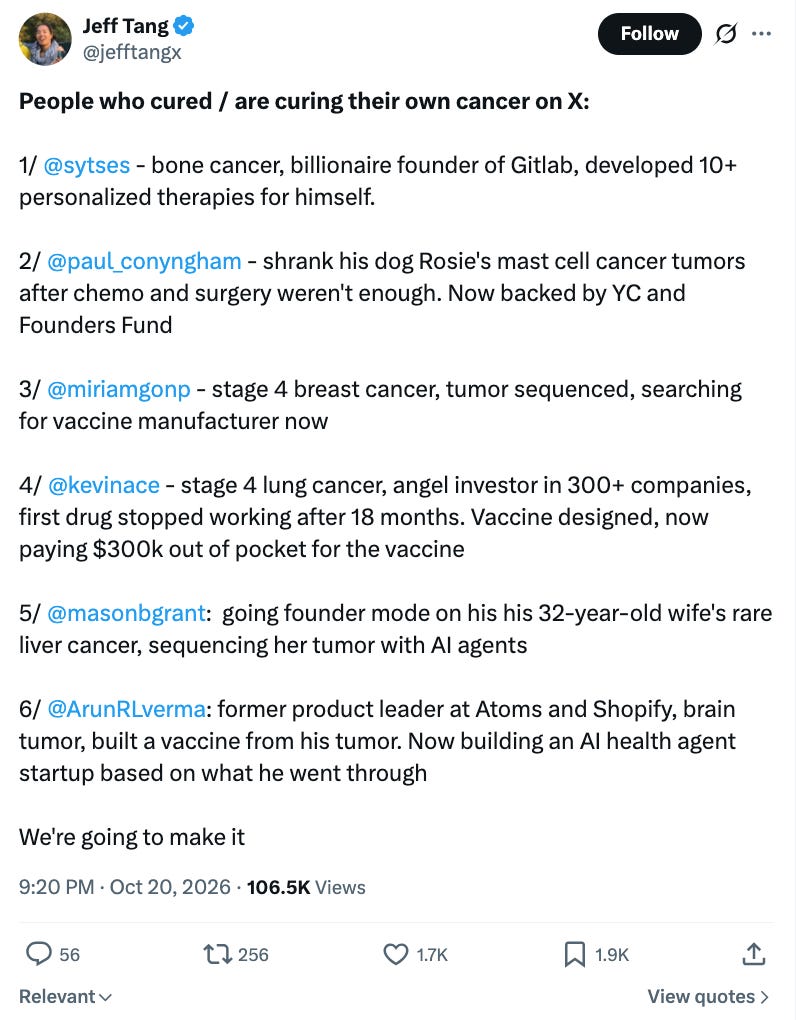
There is a growing movement of people who are curing their own cancer— by going Founder mode on it. Cancer is a terrible disease, and I wish these founders the very best. I'm rooting for their success.
Founder mode often entails sequencing and the administration of drugs that are bespoke, or not undergoing conventional drug development.
Of course, two things are possible:
Founders are curing their own cancer/ even though most doctors failed (Edison mode)
They are fooling themselves and possibly others (E. Holmes mode)
Here are 8 things I ask to help me make sense of these claims:
How was the cancer found? Was it symptomatic? Or was it picked up on a scan or test most people don't get?
If a 72 yo person presents with stomach pain and yellow eyes and was found to have stage IV pancreatic cancer, then a doctor can give them a prognosis: Most patients live between 4 and 20 months. If the founder takes something novel and ‘cures’ themself and is alive 7 years later— I am inclined to say: yea, they did it!
But if a cancer was found on a preventive whole body MRI, or on a CT scan accidentally found cancer after a car accident, and it’s, say, brain cancer, then the brain cancer survival statistics don’t really apply. We know people with some brain cancers live 18 months from when they present with crushing headaches and seizures, but we have no idea how long people live whose grade 2 astrocytoma is incidentally found on an MRI others don't get. Is it 20 years or 40?
When I hear about a founder with grade 2 astrocytoma who's doing well 3 years later I don't know if that's because of the novel treatment, the early diagnosis, or just what you'd expect if you scanned everyone's brain with MRIs.
Did you get surgery, remove all cancer, and the ‘cure’ is keeping the cancer away? Or did the cure shrink the cancer?
If you had a tumor fully resected, and it is indolent, it will take a long time to reappear no matter whether you eat turmeric, Xeloda, or take a novel bespoke gene therapy. If instead, your tumor was actively growing, visible on scans, and your cure made it shrink— that has to be taken seriously.
After your treatment, did you use a surgery to remove the last of the tumor? If this occured, the treatment is less impressive than if no surgery was needed.
Is a biological correlate distracting? If a treatment increases immune infiltrate at the tumor site- that doesn’t mean much. If the treatment increases T cells targetting.. you name it.. in the blood— that doesn’t point me any direction. Does the treatment shrink the cross sectional area of tumor?
Did your novel, targeted drug used a heavy, nonspecific payload? If you make a new drug but tether it to MMAE or a powerful radioisotope, note that the payload can be cleaved after killing one cell, or before, and the payload can do cancer killing all by itself. A high enough dose of an ADC with active payload will work in other places besides the target. Microtubule inhibitors work in a lot of cancer. It takes extra to persuade me that the novel ADC is critical to that.
If you use your novel drug with a tried and true backbone— new drug + chemo— it is impossible to know what <new drug> adds. If you have a doctor who says “I’ve never seen responses this good with chemo alone, ergo new drug must have helped” That doctor needs more education — or should be recruited as your kol depending on your goal. All sorts of responses happen stochastically with tried and true drugs, including some great outcomes.
If you find your tumor has a rare fusion protein that is consistently found in the cancer— DNAJB1-PRKACA— for e.g. and you make a small molecule inhibitor targeting the kinase activity (perhaps leveraging RevMed chem), then yes, I am a believer. But if you use a peptide vaccine instead… not as much. The history of the platform and class and success rate of the platform and class matters.
I love animals— I love having pets, and I want to end unnecessary animal research. Having said that, curing your pet— dog or cat — is a wonderful thing, but not as impressive as curing a human.
Some of the stories that I read about founders are genuinely impressive and warrant further, exploration and others are almost surely drawing the wrong conclusion. The founder is participating in unproven medical therapies that are not extending their life, but they do not see it.
I wish everyone who decides to pursue their own treatment for their own disease the very best, and I'm rooting for their success. I just hope they're careful to see the difference between Edison and Elizabeth Holmes. These rules of thumb may help.
These folks panic when they or a family members gets cancer and then try to cure it suddenly by going into the biology that the NIH and FDA (where you worked twice) and cancer industry should already be investigating. If we stopped funding piecemeal profits from isolated targets that have patents and FDA approval and instead actually looked at the biology using the 10 hallmarks of cancer and integrating that with an engineering AI approach, we could probably cure this disease for most people, most of the time. The industry and the regulators and researchers that they control (fund), don’t want cancer totally cured so they ignore systems biology and continue to make exorbitant amounts on single biomarkers. I wish you would call this out Vinay. You know this.