

Bryan Johnson— the wealthy tech entrepreneur who is experimenting on himself in an effort to live forever— said this
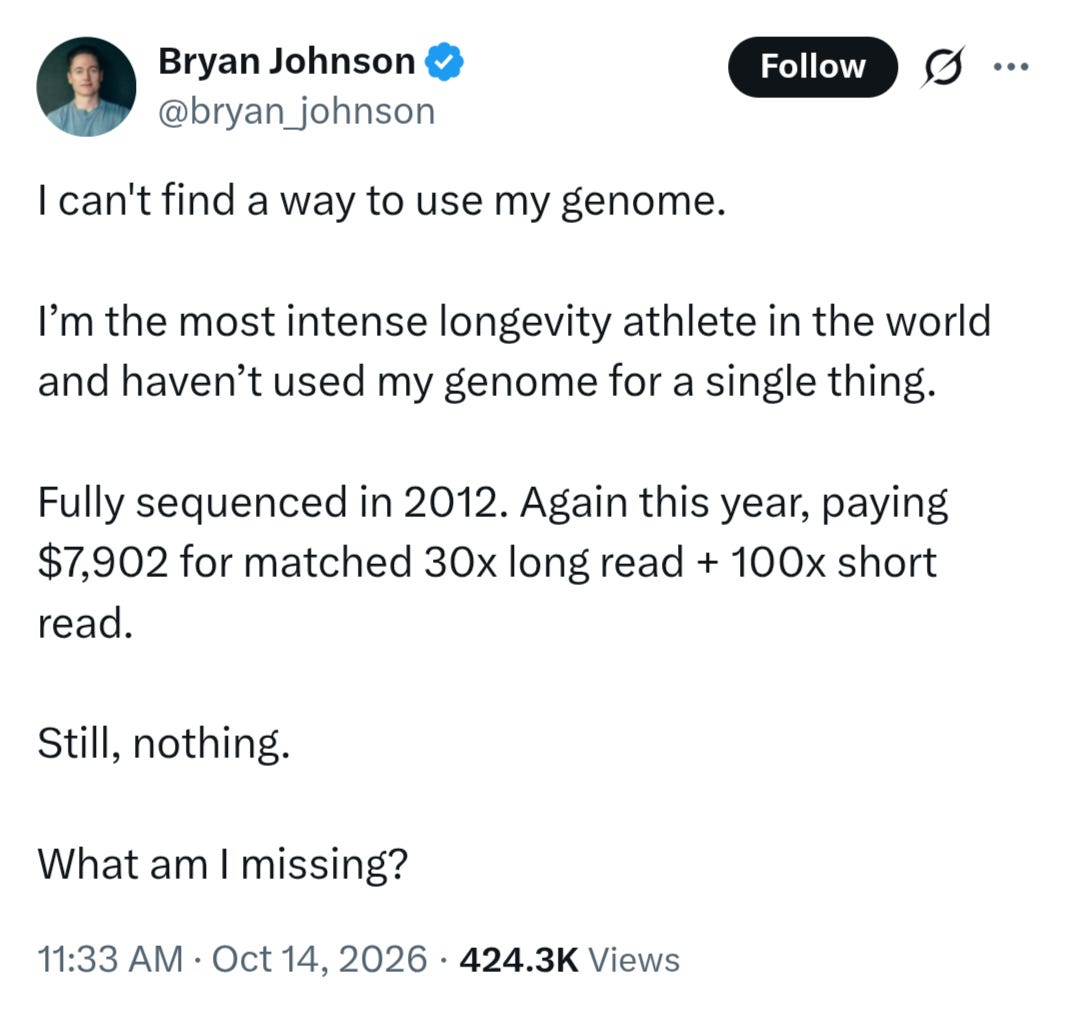
He is missing nothing. Two decades ago, leading science figures like Collins promised that genomics would affect all aspects of medicine— in sickness and in health.
Sequence your genome to learn what blood pressure pill or heart burn medicine to take— that was the promise.
Yet, Brian is correct that for healthy people (or those with common conditions, e.g. HTN) the answer is: genomic knowledge has little to no practical value.
It isn't that you are perfect and can’t improve. It's that we all need to do the same things. Diet, exercise, medication, lose weight, (for Brian, swapping blood from you teenage son, wearing a red light, swallowing a thermometer and going in the sauna)— these all can be recommended to everyone regardless of genome.
Of course with disease it's different.
In cancer medicine, the genome is use commonly. Mostly we use the Cancer's genome. Not yours. Only a tiny handful of HLA specific therapies, transplant, use a portion of your genome. Many drugs target the Cancer's genome— regardless of yours.
The biggest drugs of the last two decades have nothing to do with the genome at all. Their large market share is buoyed by the permissiveness of the label. Pembro makes hundreds of billions precisely because it works so indiscriminately.
Rare and childhood diseases have also benefitted from genomics in diagnosis— though treatments often lag.
For some diseases, we now have bespoke gene editors. For conditions that present with childhood symptoms, genomics is often vital.
Fixing small defects in enzymatic processes is one thing, fixing large structural defects, where the defect proteins pile up in cells over years, and then hoping to undo the damage is quite another.
Ultimately, the idea that the human genome is like the letters in a book that tells you how to build and run a person— that analogy has done a lot of damage. The human genome sequence is like taking a Lego sculpture in a lego exhibit- one with 10 million pieces— putting it under a hydraulic press, and then looking at the patterns of colors, trying to deduce the shape and function of the original object. DNA is a moving, living molecule with 3 dimensional interactions we can scarcely understand.
It is nothing like letters in a book.
That DNA is a dynamic 3D molecule is one consideration. The other (potentially much larger) consideration is that whatever the DNA instructs gets modified by untold (thousands? millions? billions?) downstream mechanisms that include untold interactions and feedback loops before impacting a health outcome. Sequencing the genome was a low-hanging fruit when it became technically possible but its significance was massively over-hyped. We have a very close parallel in brain research. We now have massive efforts to map "connectomics" -- the precise details of neural connections down to synapses and molecules -- even though every first year neurobiology student will tell you that the identical circuit will generate any behavior you want depending on the status of un-measured variables. So, while connectomics may be interesting in some cases, they will surely not explain how the brain works. Still, it is massively overhyped and -- big shock! -- attracts endless funding and diverts it away from potentially more impactful research.
I saw “Bryan Johnson” and immediately thought somebody misspelled the AC/DC lead singer’s first name (not that Vinay is a great editor of his spelling errors here 😉). As a GenX og, THAT Johnson will far outlive Mr.-I-don’t-want-to-die-Johnson. The delusions that money creates astonish me.