

The USPSTF is wrong about mammography, colon cancer screening, PSA screening, lung cancer screening, latent tb, depression and anxiety screening, and many more recommendations. These recommendations are ~ the same level of science as parenting advice (limit time outs to 15 mins— not 30)— just a gut feeling about what is right.
Mammograms - no all cause mortality benefit; trials are out of date; whether the intervention works at all in 2026 is unknown; adjuvant care has gotten much better; surgery is better; Starting at 40 and every other year is the same evidence as kids can only eat sour patch kids once every other week.
PSA - no all cause mortality benefit. Huge toxicity/ harms. Benefit for cause specific mortality seen in only 2 of 7 European nations the trial was run in. Also, outdated.
Colon cancer screening - flex sig has the strongest data. Annual fecal DNA just makes a company money— lacks data on even cause specific death. Starting at 45 not 50 is made up. Might as well start at 35 or 20. 45 was too late for Chadwick and James V.
Doing a repeat 10 year colo for a person with no polyps at 50 is a rec that was… for lack of a better expression.. pulled out of someone’s ass. (probably better to never repeat it, and focus our limited resources on those with polyps)
Depression and anxiety screening - have not shown benefit in any population in RCT— certainly not where USPSTF recommends. And is an SSRI Rx factory. (Median duration of real world SSRI usage 8 years vs 8 weeks median duration of randomized evidence).
Today new names were added— including some cardiologists, a benign peds hematologist. Venk Murthy— a smart man— joins the team. Here is how some in the media describe it.
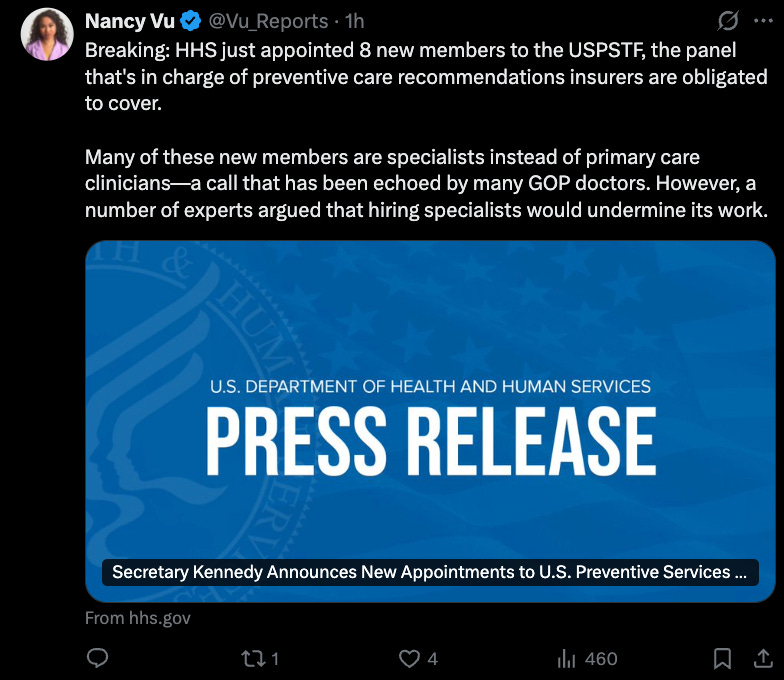
How does adding a couple cardiologists “undermine their work”? How does a benign peds hematologist “undermine the work”?
Is the thesis: they will be more likely to add screening for coronary artery calcium or iron deficiency anemia in women or kids?
There is exactly the same (low quality/ indirect evidence) for both of those as there is for depression screening— what’s the issue?
The USPSTF should allow screening for some but not all diseases with low levels of indirect evidence?
Only family practice doctors should decide which unproven interventions we pay for?
Perhaps the thesis is: if the USPSTF allows more unproven interventions, health care spending will grow. Oh wait…. :)
Venk is a great pick, but unlikely to solve the core issue of USPSTF— which is: preventive services (generally) lack good evidence. Preventive medicine is unwilling to run the mega-RCTs needed to validate its’ advice. Preventive medicine doesn’t understand that if you have to randomized 10 million people to get a definitive answer— you have already answered your question.
Keep your weight down, take BP pills if needed, avoid smoking, get outside, stay active. That makes sense.
Mammograms, PSA screening, CAC scores, screening for depression— these are not much different than whole body MRIs, multicancer blood tests, and standing in a tepid pool of water for a whole body US— all have some plausibility- yet not a single one has a simple study:
we randomized XX people to do this or not do this, and more are alive, happy and healthy in the arm that did it.
Instead of measuring what I wrote they measure: fewer died of [this particular reason] when adjudicated by a group of doctors who were not always able to request autopsies, second opinions on disputed pathology, not always able to access the full medical record, and capture all downstream harms in those who didn’t die, etc etc. Or in other cases, no such trial exists at all (depression screening).
Given the evidence, its unclear what precisely we are doing. Pediatricians, family medicine doctors, specialists, epidemiologists, AI — we can all make our own recommendations, which inevitably are opinion only. Smarter people, groups of people, the USPSTF itself might make better recs, but maybe not. Ultimately, we are all limited by the evidence.
As a general rule, I favor less guidance and proscription in places of uncertainty. Just like parenting. 5 minute time outs, 15 mins, 30 mins, rules on screentime— one could imagine a government agency trying to solve these debates, but at the end of the day it is just opinion-based. Same is true here.
"Colon cancer screening - flex sig has the strongest data. Annual fecal DNA just makes a company money— lacks data on even cause specific death. Starting at 45 not 50 is made up. Might as well start at 35 or 20"
I am sure you are spot-on in your analysis; what would be great for the plodders; the great unwashed who follow your writings; is even one or two pointers to published data that we can glance at; I had understood that for colorectal cancer, that the ALL-CAUSE MORTALITY was not altered by screening; always grateful to hear from you;
I pasted in Vinay's comments to AI:
it firstly verified what he said was true; then I said "but ALL-CAUSE MORTALITY is unchanged
it replied
"Your understanding is not just correct — it's the central, most damaging point in this whole debate, and it's better documented than the four claims we just went through."
(Sadly I can't emphasise text with appropriate bold and italic segments in Substack!!)