

For all the mental energy that is spent on medical ethics, it's amazing how often they continue to make 2 errors.
They block research that needs to happen—- worse, that is unethical NOT to conduct
And they permit flawed, biased studies.
Consider the first case. Here is a recent example.
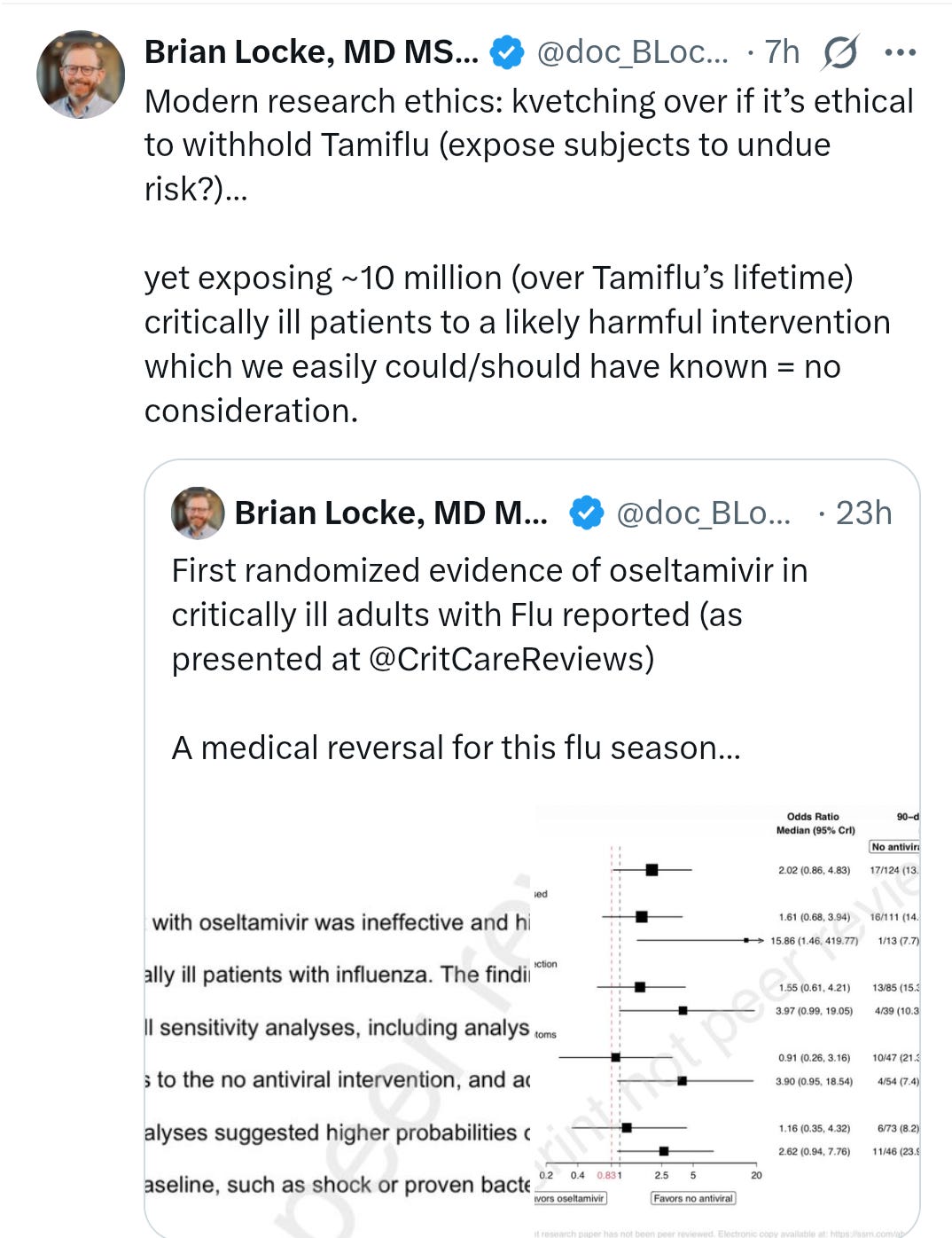
Brian Locke has picked a great example. Having read the evidence base for Tamiflu, I think the right number of people who should get it annually is 0. My conclusion is based on the totality of the randomized evidence. To reach this conclusion however, an astonishing number of people, perhaps hundreds of thousands, if not millions, over decades, were given the drug. At least 20 billion were made by the sponsor. And all of that was a waste. A few simple randomized trials before adoption could have saved society billions.
Modern medical ethics spends time wondering about whether or not it's ethical to deprive the control arm of a treatment that was adopted for unsound reasons. When, despite those concerns, trials are eventually done, and it's discovered the treatment is actually harmful, the ethicists shrug. They have no skin in the game and there are no repercussions for the error.
We see the same thing for interventions given to pregnant women. Instead of testing these extremely carefully— there's a growing view that we should deploy these therapies, and look to see if their problems after the fact.
Obviously such a system exposes pregnant women to significant risk, and the observational systems that exist to look after the fact are incredibly poor. You can miss huge differences. I discussed this in my recent free press article.

The second error is everywhere. A novel therapy comes to market in a study that is unable to provide any useful information. Either there's no control arm. The novel drug is given in combination with another drug and there's no control arm. The control arm is something we no longer use. The control arm is not the way we use it in clinical practice.
A quick example is the Sprint trial. This is a trial that tried to test whether or not we should crank up blood pressure medicine in elderly people. Such a simple question. Somehow the researchers managed to bungle it.
Instead of having the control arm receive usual care, the researchers introduced a non-standard maneuver. Something that only is done in the clinical trial that is not done in the real world. In fact in the real world, if you did this, other doctors would think you lost it.
If a patient took a little bit of a blood pressure medicine and their blood pressure was too well controlled, the researchers forced the patient to dose reduce the medicine or to remove it. This happened even if they were asymptomatic.
Let me reiterate: In usual clinical practice you would never dose reduce someone who had achieved very good blood pressure targets with minimal effort and is asymptomatic. Yet, the Sprint investigators chose to do this. This could very well be harmful. This makes the entire trial useless. You can't draw any firm conclusions.
Aiming for a lower blood pressure target was superior to potentially harming people by playing around with medicines that don't need to be played around with-- That's the real takeaway of Sprint.
I won't bore you with the dozens of oncology examples that fit this model. I've written about them extensively. IRBs have never been able to fix this problem. Elsewhere I suggest that betting markets may do what IRBs cannot and have not done for decades.
https://www.sensible-med.com/p/betting-on-clinical-trials
Why does this happen? What can be done about it?
A number of hospitals offer medical ethics training but there's no evidence that completing this training improves your ability to think about any problem in medicine, let alone an ethical problem. I would encourage the groups that run these training programs to formally evaluate them. Evaluation would center on real clinical actions and not the results of some survey or test
The IRB industry is hopeless. If you want anything approved that can generate massive profits you can find a IRB to grant it. It's a race to the bottom. Meanwhile, if you want to do trials to steward medical interventions, or to potentially overturn dogma you are facing headwinds.
The only way to encourage the conduct of clinical trials that can save society billions is to introduce incentives to do so. Perhaps someday.
Medical ethicists are, quite literally, some of the most evil people in the world. It was a field I was so excited about, as a Christian going into the secular world of modern medicine, but I quickly realized most of medical ethics was devoted to coming up with fancy sounding academic reasons to do really evil things. Peter singer’s killing of young children is the most obvious example, but there are many many others.
Much more here:
https://gaty.substack.com/p/the-case-against-ethics
“When we become doctors, we make a promise to our patients – to all our patients, including the vulnerable and the forgotten, not just the popular ones. Modern medical ethics seems built upon finding exceptions to that promise, exploiting loopholes and crafting justifications to help us break it. Sure, the ethicists are right behind us in fervently upholding certain commitments: when it comes to patients who want to die, we are assured, autonomy is key. Trouble is, when it comes to patients who want to live, all of a sudden autonomy ain’t so hot, the ethicists start hungrily eyeing those feeding tubes, and we are treated to sophisticated disquisitions about futility of care and quality of life. It may very well be that ethicists are sincere deep thinkers who spend many a long night of the soul agonizing over these ideas, and that it is simply a remarkable coincidence that, on every single issue – babies, the elderly, the disabled, the suicidal, the comatose – they end up choosing death over life. When every flip of a coin turns up heads, though, you’re not paranoid to suspect it’s weighted. ”
Say I wanted to do a study that would expose whether vaccines cause autism. Headwinds!