

If you are trying to lose fat and gain muscle, midjourney has a non-invasive test that might be helpful at tracking your body composition percentages. If you are trying to find pre-cancerous or early cancerous lesions and cut them out before they spread, it is hard to imagine this will be of value.
Just as allbirds transitioned from a shoe to an AI company, midjourney is transitioning from an imaging to health care company.
Their new ultrasound technology requires submerging in a warm pool of water for a scan. Who hasn’t been to the doctors office, and looked around and thought, “the only thing that would make this better is wearing a swimsuit and dipping into a lukewarm pool of water?”
AI is supposed to help boost or reconstruct images, but you can’t boost what is not captured. There are tremendous limits in what ultrasound can “see.” Interestingly MR has made considerable advances. It is hard to imagine using an arguably poorer technology.
But the biggest challenge in all this is that when you find lumps in the body that look odd they can be one of 5 things
Totally normal tissue fooling you
Abnormal tissue or even cancer that if left untouched would not do anything in your natural lifespan.
Abnormal tissue or cancer that has already spread microscopically, and no matter what you do will still kill you in 2 months or 2 years or 2 decades. (early treatment doesn’t improve outcomes).
Abnormal tissue or cancer that has not yet spread, but will soon, but if you cut out right now, or take some medication (aka possibly the new work by Charlie Swanton) you can change the future.
Abnormal tissue or cancer that has spread, but early treatment improves outcomes.
You want a body scanner to find 4s, but not 1s or 2s. You want to find 5s, but not 3s. I know the lay person intuition is that there has to be more 5s than 3s— what with all this medical advance— but let me assure you— when something is metastatic, we are mostly in the 3s business. (Insert someone citing some low quality observational study, and my rebuttal).
Do 2s,3s,4s and 5s look different under the microscope? No
Do they look different with sequencing? No
Do they look different with gene expression profiling? No
Do they look different with proteomics? No
Might they look different with some future technology? Yes, and the moment you find this, the whole strategy starts to make sense, but right now it is dubious.
There is an added complexity with 4. The process of cutting the tumor out has to be less harmful than the benefit of removing the tumor. This depends on how bad the cancer is, and where the surgeon is cutting.
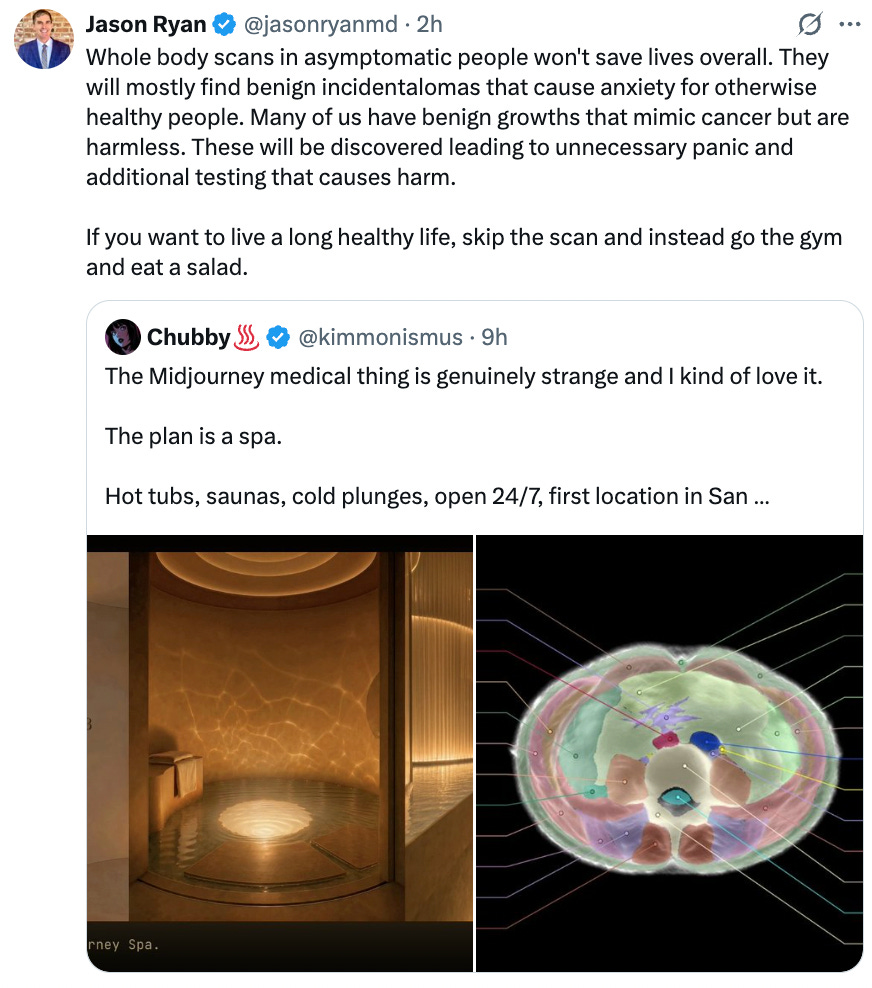
Can these challenges be overcomed? Yes, and if you are working on them reach out, I have some ideas, but for until that happens, I think Jason Ryan is right.
Btw, i advise everyone reading to watch your youtube on mammography screening. I learned so much.
So, are you not a fan of the cancer screen blood tests that companies like Function are putting out? Do those also struggle distinguishing 1-5?