

Coming soon on Sensible Medicine, Adam, John and I give 3 opinions on the prompt: can you trust your doctor, but that format is too brief to do this story justice.
First, let me say, I am certain the doctor involved feels terrible, and, if true, it was a accident—caused perhaps because pediatric CT surgery places fewer mitral valves than adult surgeons, and perhaps because the valve looks very similar in both directions. A small surgical error with profound consequences.
Second, at the same time, I think the story is emblematic of health care’s biggest failures— groupthink, dubious rationale, and outsourcing, and must be discussed.
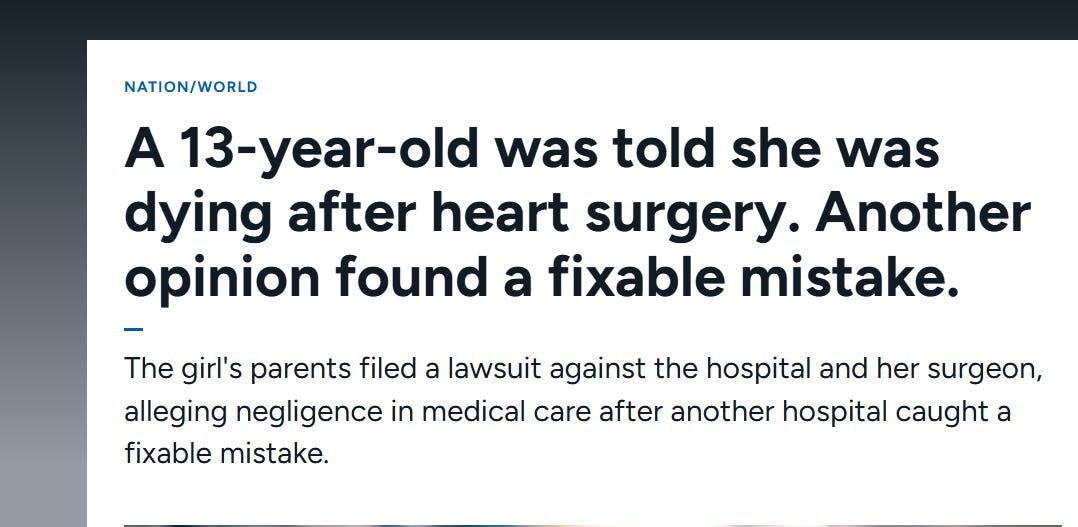
According to the legal documents reposted online at the link:
A 13 year old girl was undergoing the placement of a mechanical mitral valve. The reason for this is unclear. My first question in any medical case is why was the intervention performed? why now? what evidence supports now, and not earlier or later? But in this case, I can’t explore those questions because no pertinent information is provided in the public documents.
After surgery, the surgeons couldn’t restart her heart, and put her on ECMO. They were told the valve replacement had gone well but her heart was weak. (RV failure and an upside-down mitral valve would be hard to differentiate).
They did additional imaging and procedures/ surgery (unspecified), and sent in Palliative care team who asked about donating the organs. They said, she might need a heart transplant or artificial heart but only Seattle could do that. If they transfer her, she might die enroute. If she remains, she will die.
Her parents decided to transfer. (Must have been a gut wrenching decision). Seattle performed coronary CT which suggested the valve may be positioned improperly, and ultimately repeat surgery found the value was sewn in in upside down. When fixed, the patient improved dramatically. The family is suing OHSU and the surgeon.
The key medical error here was sewing the value upside down. That would look a lot like RV failure. One can speculate about hard it was to see the valve orientation when removed from the packaging, and how big the child’s heart was. If very small, the surgeon may have used a valve not designed for this location. One can also speculate about how often the surgeon performed this procedure in a child this small with this value. We don’t have enough information to unpack this.
Yet, the deeper errors resonate with me, and apply to all of medicine.
Groupthink. Once the incorrect diagnosis— the surgery was done correctly, but the heart is weak— was made, very likely it was self-reinforcing. Information that fit that narrative was trumpeted and information that didn’t fit was ignored. It is possible OHSU has imaging that shows incorrect placement— a good attorney would look for this— but that was ignored or missed because the narrative is so dominant.
In my experience, this is the most common error in medicine. People tell me why they think something is going on, rather than present the facts and allow me to think through things. That is why when I sign on a case. I start with reading all the imaging, pathology, labs, and medication administration and then think about the case, and only later read the doctor’s notes, which I often find biased or inaccurate or worse. I only read the doctor’s physical exam and review of systems when I want to transition from non-fiction to fiction.
A recent example, I read that a core needle tumor biopsy was obtained but the pathologist writes that very little <5% of the specimen contained tumor. Then the sample was sent for sequencing and there were no mutations. Yeah, no duh, I thought, normal tissue adjacent to cancer has no mutations. But what about the cancer? They did repeat the biopsy and send the tumor? Right? They didn’t. All the doctors notes dutifully explained how the tumor had no mutations. facepalm. Had I started with the notes, I would have been mislead.
The key question: was the surgery needed now? No details have been released in this case about the logic for why now, and not earlier or later. Why this valve and not another. Why this surgeon and not another. But I often find these questions unanswered or poorly answered in oncology.
Because I have a modest social media following, in addition to my clinical duties, I am often asked to review cases for other doctors. What do we do now? Is the question they ask me, but almost always, I ask back: why did you do what you did? Why did you start chemo for this person with two, 1cm asymptomatic lung mets, whose primary was resected 2 years ago now, and not simply repeat imaging closely to see the tempo of growth and think more about when to pull the trigger on chemo? Is there data that early treatment is superior— let me just answer that rhetorical q— no.
Why are you performing a repeat PET on this person with known malignancy responding to chemo Q2 months? Just get a CT Q3 or Q4 or, if he feels so good, Q6? Is there evidence that finding tumor SUV avidity rising should lead to change in therapy— let me answer that q— no! You just burn through treatments faster and no evidence of improved survival.
Why did this the person with multiple myeloma on tec-dara get a mammogram?
You get the idea. Why are you doing what you are doing. On my last week on service before my departure for government service, I stressed that my only goal on rounds was I just want to understand what we are doing. People chuckled. But I was serious. It sounds simple, but in practice it is hard to achieve.
Palliative care. I love, love, love palliative care doctors. Sometimes I think they are only ones who are sane in an insane world. But boy, it is a big screw up to ask to harvest a child’s organs when you sewed the valve in upside down. Are you trying to kill my kid for her liver, the family must be asking. I can only imagine how furious they would be.
I think we have abdicated too much to palliative care. If you take care of people who get sick and die, you need to do the whole job, and not sign off on the hard parts. You should have the end of life conversation. You need to learn how to titrate opiates, how to prescribe stool regimens. You need to own this human labor.
In my career, I have had well intentioned palliative docs tell patients things that were not accurate. Asking a 21 yo leukemic with PML-RARA fusion if they want to consider hospice. Wtf! Hospice? No. She was just diagnosed. We are curing her. Stand down, soldier. No hospice. Cure. The last attending consulted you for nausea, but that was before I came on service, so never-mind, I will manage that.
There is too much specialization and not enough ownership in 2026 medicine. Doctors rely on palliative care and toss out a sick patient whose reimbursement dips, and prioritize those who pay higher (might sound harsh, but this incentive is driving the hospitals thinking).
What is the lesson here: my guess is hospital administration will settle this case, and then continue their PR campaign, promoting themselves as the top hospital on this street, and a center of excellence, and only hospital with a cyborg that controls a robot, or the worlds largest cyclotron, but no one will ask the harder questions that desperately need to be asked to reform medicine.
I believe doctors are good, honest people. If you drop your wallet and a doctor finds it, there is a 100% chance it will be returned. Coming soon on Sensible Medicine, we ask a different question: can you trust your doctor? Stay tuned for my reply.
Also if you believe in this substack, please subscribe
I am soooo glad you have returned with your wonderful and insightful commentary! It is a loss that you and Marty Makary are no longer at the FDA but that was unfortunately predictable, I think. Thank you both for reforming the drug approval process and trying to improve the FDA.
"I only read the doctor’s physical exam and review of systems when I want to transition from non-fiction to fiction." - Spot on - so much templated BS + note bloat, much of it leftover from older coding requirements requiring an MS 3 H&P.
This is a blueprint for fixing a car or building a house.....with a heads up that medicine is a little more complicated. You need IQ, but also you need to proceed stop by step , always telling your self that you are not that smart.