

Recently Reed Jobs argued that the NIH budget should be 100 billion— that would mean more cures. But why stop there? Why not 500 billion? How can we limit it to 100 billion and let people die? Why not a trillion? The problem is if you don’t acknowledge trade offs you can’t make a principled argument. What are the tradeoffs with more funding?
There is no doubt that 1 billion dollars in NIH funding will yield more scientific advances than 0 dollars— but assuming the relationship between funding and innovation is consistently positive ignores the key tradeoffs.
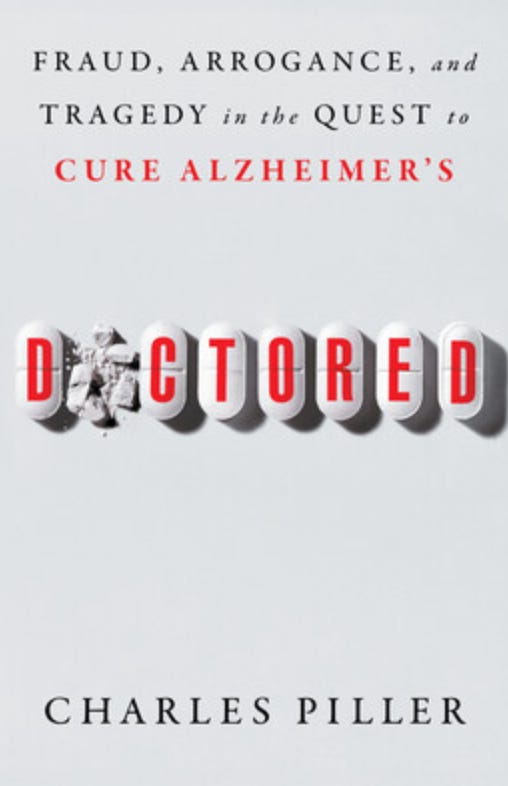
Let’s imagine that investigators exist on a spectrum from those that do the most truthful and reproducible work to those who do flashy, perhaps fraudulent work. Let’s also agree that being famous and “brilliant” is no guarantee which bucket an individual falls in— as we have witnessed many accomplished scholars having their work revealed to be no better than cooked.
Science advances the more truth we generate and may even be impaired by the more fraud we perpetrate. It is possible that each additional dollar generates 55% truth and 45% fraud— but maybe past a certain point, it flips the other way, and more false leads are generated.
Some argue that 1 true fact is worth it even if offset by 1000 false starts— but this is clearly wrong. Science can be anchored by false and dominating ideas, dominated by groupthink and entirely fields can go down the wrong path. At some ratio, the net vector is unfavorable.
Additionally, when funding grows abruptly in science— it can lead to graft. Universities building mini-armies of mid level administrators. If you have more money, you need more admins, and more rules, and more paperwork, and more admins to process all that. You need more donors— to fill the gaps with what federal funds cover— and more square feet of lab. You also need more young people to toil away in the labs— forgoing other career opportunities.
If science grows abruptly, political pressures may decide what the new priorities are. For a few years it was a DEI bonanza— adding the words disparities, people of color, pregnant persons, generational trauma, equity— were widely encouraged to get funded. Now the inevitable retribution is in place, and these words may even lead an application to be automatically discarded— even in some cases of mistaken identity, “we aim to look at the diversity of t cell receptors.” Did you diversity?
All that said, it is possible that the shape of funding and innovation looks something like this.
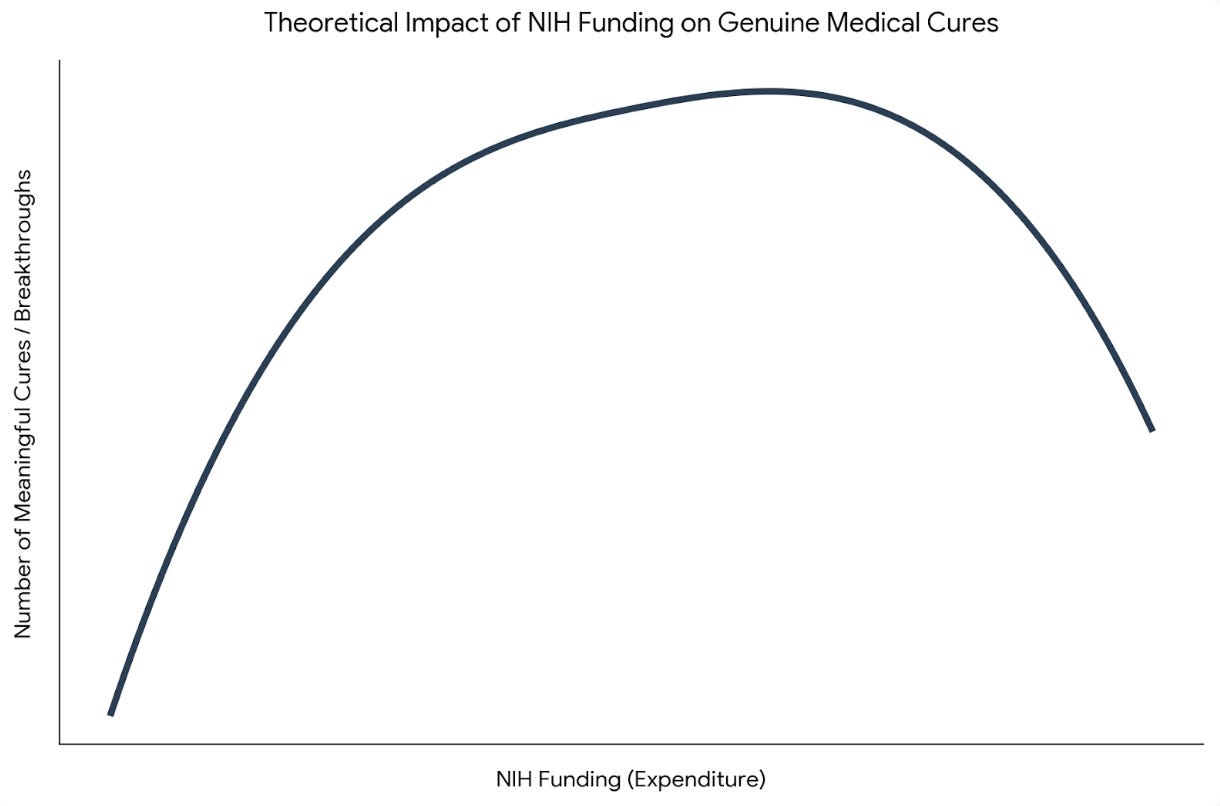
So where are we on the curve? We have no idea. Studying this would require basic diligence. What percent of NIH grants are true and reproducible? To date, there has been no systematic effort to study that.
Is it possible the current science cuts are reducing cures— absolutely. It is also possible that we have already overshot. Unless we invest in assessing science honestly, discussions about how much to fund science are largely theater.
Very interesting and I think this applies to all research and funding, especially where government dollars are involved. I see AI research falling into a similar trap.
The trade-offs are not only within the scientific-industrial enterprise but external to it. When we spend more on biomedical research we allocate less to other beneficial/deserving activities - e.g., better education, infrastructure, food, air, justice. Same for healthcare, the spend on which, in the US anyway, is delivering diminishing benefits while clawing resources from everything else we care to publicly fund.