

In the first episode of my series on longevity, I tackle the question of how many hours should you sleep for maximal quality and quantity of life. The 4 books I read had widespread agreement, but also notable disagreements.
On the short end of the spectrum, all agree— less than 7 or 6 hours of uninterrupted night time sleep, for years on end, is bad for body mass, cortisol and mortality. I think it is uncontroversial to say that fragmented, short, irregular sleep is not healthy.
On the long end of the spectrum, there is disagreement. Two books advise 7 to 8 hours as the ideal amount, and one even cautions that there are risks to oversleeping. A third book however is more open minded, arguing that some people may benefit from 9 or 10 hours. I discuss the specific books in the video, if you are curious. Spoiler alert: ultimately, I tend to share the open-minded view.
Here, I want to tackle the evidence that is used to argue that more sleep is deleterious. It is an observational study that provides an important lesson for scientific readers. Here is the main result.
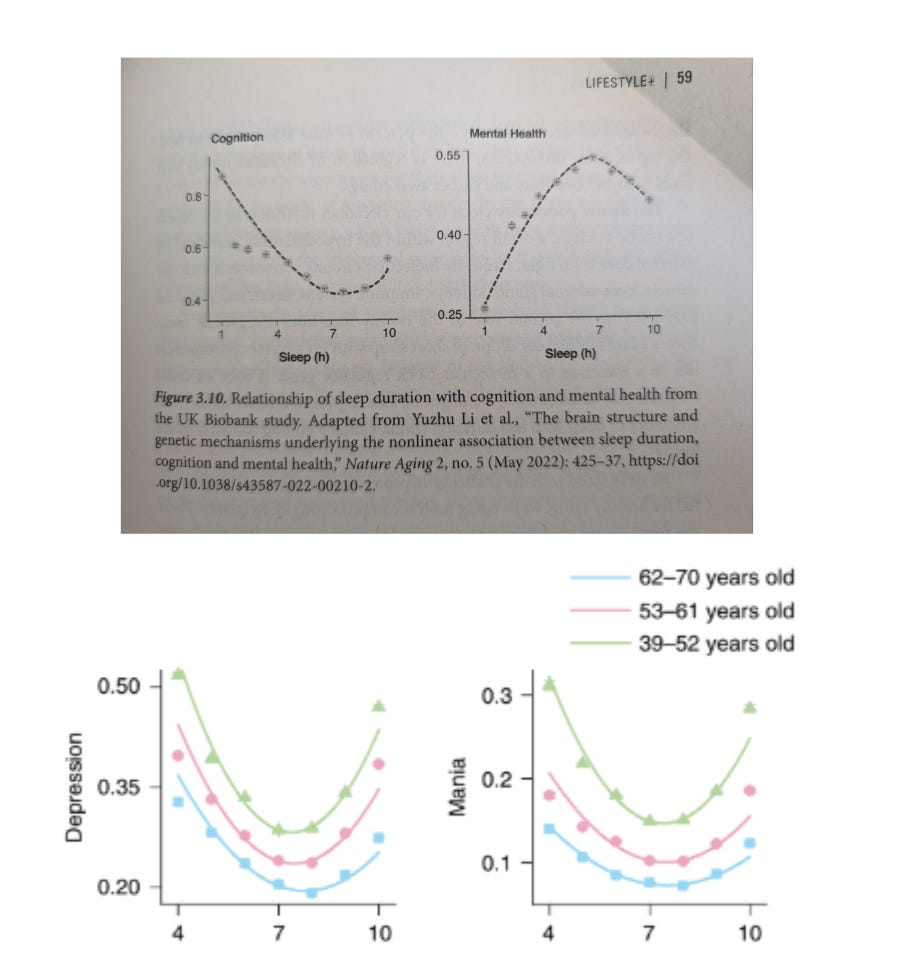
The figure shows data from the UK biobank— a longitudinal study of hundreds of thousands of individuals with different sub-cohorts that complete unique surveys and/or imaging or other modalities.
The paper shows a simple observational design that plots a range of outcomes against hours slept per night.
As you can see, there is a J-shaped curve— which is epidemiologic speak for a curve where there is an optimal point. Here that occurs between 7 to 8 hours. Additional sleep is associated with worse outcomes, including cognition and depression.
When you read a study like this, you have to have a crystal clear idea of how they collected the data. Is the x axis— hours slept— coming from a video of participants sleeping? a sleep tracker? a diary? a survey? And, how precisely is the information gathered and coded?
Turns out, it is a sleep survey with this specific question:
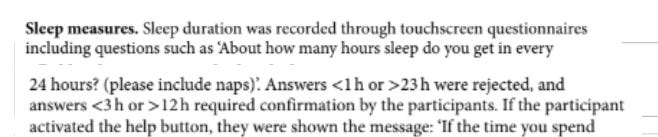
It is 24 hour sleep totals, including all naps.
Your first thought should be: that is different than uninterrupted sleep overnight. In fact a person who sleeps 9.5 hours every night is lumped together with a person who sleeps 6 hours and takes a 3.5 hour nap. Or a person who sleeps 5 hours and takes 2 naps.
Suddenly we have at least one alternative explanation.
People who sleep 7 to 8 hours might be disproportionately those who do it at night, while higher hours might include relatively more people who are nappers. Nappers are different than non-nappers because they may be more likely to have chronic medical conditions, more likely not to work, more likely to be otherwise in poorer health, etc.
There is a clue in the lower figure— that among persons most likely to be in the workforce— longer sleep is particularly “bad” but probably only because it is a greater selection filter for these confounders.
I am not aware of convincing evidence that a healthy person is dis-advantaged by sleeping 9 or 10 hours, if their body desires it, and in the video I discuss evidence from Athletes to show more sleep is likely beneficial for athletic performance.
Stay tuned for more updates from this series and a new video on nutrition science dropping soon. But here take home the lesson that all science requires a detailed examination of the methods.
Welcome back sir.
Yes, methods are critical. I would prefer a study design that requires in-person interviewing on sleep patterns. For example, I might respond with a quick and lazy answer if completing a questionnaire on-line. Or I might use bad-math to estimate average sleep-time over a span of 14 days.
On a side note, I treated myself to a fancy goose-down comforter, (duvet) + fancy sheets and I sleep like a baby.