

I understand that mathematicians are upset with how quickly artificial intelligence is solving some long-standing and inscrutable puzzles. I sympathize that perhaps the AI is just brute forcing the solution and not elucidating of fundamental principles of mathematics.
But don't try to use a cancer analogy if you don't understand the field.
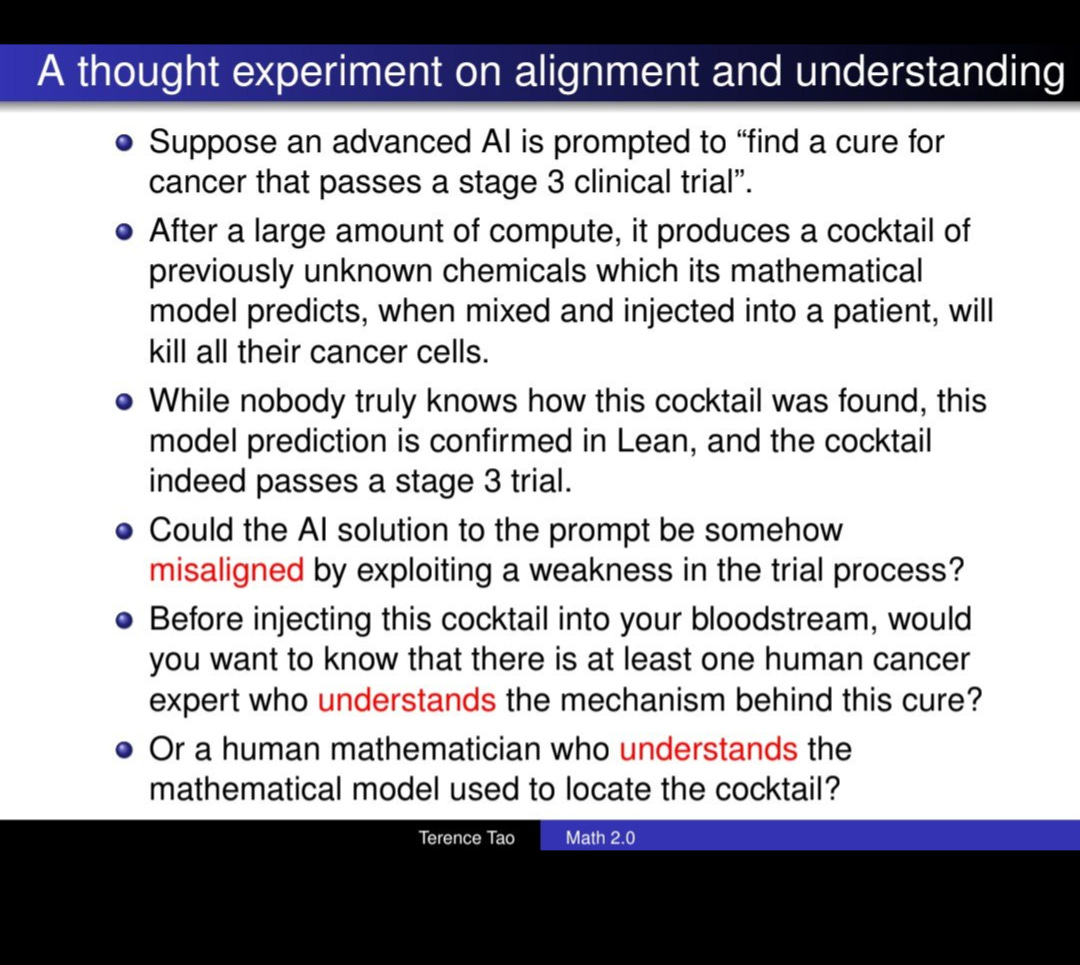
This week Terrence Tao argued that patients would want the reassurance of knowing a human cancer expert understands an AI derived cancer cure before getting it. This betrays a deep ignorance about cancer medicine.
1. There are many commonly used cancer drugs where we do not fully understand the mechanism of action. If you think you know how Adriamycin works, I think you haven't read enough about it. We still debate how docetaxel works in prostate cancer. Is it microtubules that are trafficking AR receptor, or is it the cellular division?
There is no underlying theory that explains all of the places ibrutinib works it and where it doesn't. The same goes for venetoclax.
A drowning man will reach for the blade of a sword. If a phase 3 clinical trial is positive, as Tao postulates, but humans do not understand the mechanism of action that would be level one evidence to administer a therapy. Every cancer patient on Earth would want it. Every doctor would give it. Tao is not even close to the bleeding edge of what patients will want or not want. Patients will want a drug in a tumor that lacks phase 3 data if it has phase 3 data in a different tumor, and a compelling mechanism of action. Patients will want a drug that has phase 2 data that's very promising. Patients will want a drug that has been given to five people and has a promising response rate. These are all things doctors will do in the right situation. Patients will even want drugs that have never been administered to a person but have helped a mouse or fly. This is where some doctors would give it and others wouldn't. Here I would warrant caution, but I just want to point out the depth of desperation.
A drowning man will reach for the blade of a sword, and we hope cancer patients do not go as far as to seek unproven remedies that can only harm them. But they certainly do. If AI generates a cancer combination cure that no one understands, but passes a phase 3 randomized control trial, there's not a single cancer patient on Earth who would say no thank you. We currently accept far less.
What Tao is missing about cancer medicine is something fundamental and deep that many are missing it. People know how computers work. People know the edges of mathematics and can check the theorem produced by open evidence. There is no one who knows how the human body works. We have a much deeper understanding than we did a hundred years ago, but we don't know if we have understood 5% or 50% or .05%. . We don't even know what we don't know.
The human body is a collection of trillions of cells, and is the constant interaction of the three-dimensional shapes of countless intracellular and extracellular products that interact in emergent ways that we have not even close to grasped. We are the prisoner in Plato's cave looking only at the mere shadows thinking we understand the world.
Despite this blindness, through serendipity and trial and error, we have deduced interventions that do improve outcomes. In many cases we have some plausible story as to how they work. But even these stories are partial and incomplete and not fully vetted. In other cases we have no idea how they work. No one knows how inhaled sevofluorine knocks you out. At the same time I know with confidence I don't want you operating on me unless I'm breathing it in.
If mathematicians want to complain that computers are replacing them, they should seek the comfort of chess Masters complaining that they have been bested. But they should not look for comfort from doctors. We would do anything to help our patients. We would do anything to extend survival. We already do things on a wish and a prayer and a mechanism of action and a hint of bioplausibility.
If AI conjures up a cocktail to cure cancer and we don't know how it works, but it passes a phase 3 trial, you can bet we will be on our knees thanking it, or more likely giving a standing ovation at our plenary session.
Great post. My husband works in drug discovery. They use AI all the time, but they have to guide it every step of the way. It’s a tool to help modeling, but it definitely hasn’t come up with any drugs on its own, yet.
Great insight for several reasons, off the top of the head is that being a genius in a field doesn’t give one an overarching or exceptional advantage or competence in another.
Your analogy is right on! Terrence is indeed confused about the why (causes of cancer) versus the how (mechanisms by which causes enact) of cancer therapy developments. Rational cancer therapeutics target both the “why” and the “how”….
What Terrence, and frankly the vast majority of cancer docs don’t fully comprehend is that mathematically, given the permutations of the human genome, and the ever varying composite of environmental exposures, human (epithelial carcinoma) cancer IS incurable with any degree of certainty.
We can prolong lifespans with cocktails as Terrence envisions the most rational attempt at cures, but we do so in rational legalese terms (reasonable probabilities of response or success), but certainly not mathematical certainty.