

When we imagine how medical technology will change our work and lives, we are constrained by our reality. Patients report symptoms to doctors who schedule scans and then give treatments… this is our paradigm. The wall inside our mind. Our imaginations aren’t creative enough to truly envision how disruptive new technology may end up being.
Consider the current cutting edge…
As you see the patient, AI transcribes the note, and pulls up suggestions from Open Evidence recommending which tests to order…
That’s just not imaginative or disruptive enough. Why does the patient need to see you? Why is a visit needed?
Let’s try again.
When you are home and feeling ill, you ask Alexa for health advice, and start listing your symptoms. Alexa recommends a Chest CT, and schedules it nearby. You drive to the center, and complete the scan. By the time you are in the parking lot, AI has already read the image and phoned in a prescription to the nearby pharmacy, which you pick up on the way home.
Nope. Still trapped in a mindset. Why do you have to enunciate your symptoms? And also, why are you driving the car? Rookie mistake.
Try again.
You sign up for a new health care service. When you launch it, you do an virtual interview intake and the service deduces that you are the kind the person to blow of your health. You aren’t a complainer. AI asks you (in front of your wife) if you would consent to allow it to optimize your health in any non-invasive way it see fit without bothering or notifying you— as long as the interventions were non-invasive. After all, if you are involved you would only procrastinate. And after all, it is just collecting information. You agree. AI asks one follow up. In order to improve health for all people, do you consent to AI running some tests or interventions on you— this is only for societal good— without your explicit consent each time. Your wife looks at you… Ok, you consent again.
One day, you notice your car drives itself home via a different route. When you get home you wonder about the detour. Turns out the car drove you through a CT scanner because it noticed your movement and behavior was different, and it wanted to work things up. Awaiting you, next to your meal, is a prescription tablet to take. The active ingredient was discovered by AI, and the confirmatory trial was run by AI.
“That’s not possible,” you shout, “imaging modalities can’t see through the automobile’s frame.” Of course, AI laughs, it solved that years before—during the boom of midjourney.
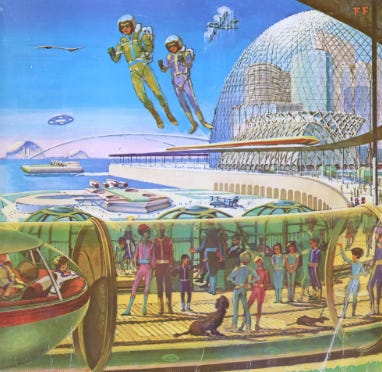
Technology’s full impact on health care would mean that every aspect of how we seek and provide care is changed.
You don’t track your health, your health is tracked.
You are given care, you don’t decide to seek care.
Data is collected about your health in ways you are oblivious to (with your upfront consent, just once of course)
Treatments are studied on you and others around you— because you are a good person and consent to that, and this happens if and only if, AI can’t figure it out using observational methods (strangely AI admits that this is often the case).
You consent to receive treatments in quiet moments, and you may waive your right to know you are receiving these treatments
For medical interventions that require trade-offs, you can describe your philosophy and values/preferences or you can ask AI to deduce that about you in the course of it’s monitoring, and then you can waive your individual decision making.
Practically what does this mean for technology makers and investors?
Instead of developing clinician decision support, develop methods to monitor people in their homes/ in the course of their day to day lives. Surely, AI will soon be able to predict when someone may be headed towards illness before they think to ask about symptoms— if you can track their steps, gait, patterns of wakefulness, heart rate, blood pressure (someone needs to make a reliable tracker of this— that doesn’t go around the arm), sweat patterns, skin conductivity, skin temperature, armpit temperature, stomach sounds, bowel patterns, bladder patterns, food consumption, weight, height, visceral fat estimate, body fat estimate, etc.
Instead of investing in imaging that requires a participant to walk into a center, what sort of biological data can be generated from monitoring our trail around the house? Invest in collecting data unobtrusively.
In the Human Stain, Roth wrote,
“We leave a stain, we leave a trail, we leave our imprint. Impurity, cruelty, abuse, error, excrement, semen - there’s no other way to be here.*”
How much of the human stain we leave around the our house can be assayed and tracked.
If AI technology is as disruptive as other advances — electric vs steam engines, computers vs slide rules, combustion engines vs horsepower, etc— we need to reconceptualize all of our assumptions about health delivery.
A patient noticing something wrong (or their wife noticing it), nagging them to see a doctor, the doctor blowing it off, the patient’s wife nagging again, the next doctor taking it seriously, the diagnostic test performed, the therapy prescribed— that’s our current model. A model limited by the fact that the information about the person whose health we are trying to optimize is filtered through so many fallible people, and requires cumbersome ways to obtain more objective information. AI’s greatest disruption will be to eliminate the human barriers from this equation and take the information silently and unobtrusively, and obtain more, silently and unobtrusively, and then learn how to course correct… silently and unobtrusively.
Will it succeed? Will we find new pitfalls? I am only sure the answer to the second question is yes.
A final point, which I may elaborate on in the future. Every single intervention in medicine that actually drives gains in life expectance has come from technologic advancement. Sorry health systems and equity researchers have done next to nothing. Technology that is fiercely debated— where some love and others hate— is almost universally garbage that takes us nearly nowhere. The technology that no one argues with— including drugs and devices— that is where gains come from. If AI becomes one of those technologies, it won’t be by patching our broken, inefficient system, but by slowly and systematically replacing all the imperfect actors. It will be a transformative technology in the way PPIs eliminated surgery for ulcers.
PS: In the future, I will write more about the enduring and important role physicians will always have— don’t be depressed my doctor friends.
*Yes, I am aware, Roth was using this to mean something else entirely.
I’ll bet AI wrote this. 🤪
Excellent, and thought provoking as always. I am at the tail end of my career, so these thoughts are not terrifying to me in an existential way as they might have been 20 years ago. Your thought experiment/ predictions are Orwellian, certainly, but my individual perspective is more that of C S Lewis’ space trilogy. I see the stain of original sin, like the fiendish mad scientist from N.I.C.E. rumbling through the present and future, wreaking havoc wherever he goes…