

If you buy a branded GLP1-RA, it might cost you a $1000 a month. If you buy a compounded version from an online pharmacy, it will cost you a median of $217.33 (IQR, $159.36-$289.24) (per a new JAMA letter). That’s a big savings to the person who wants the drug.
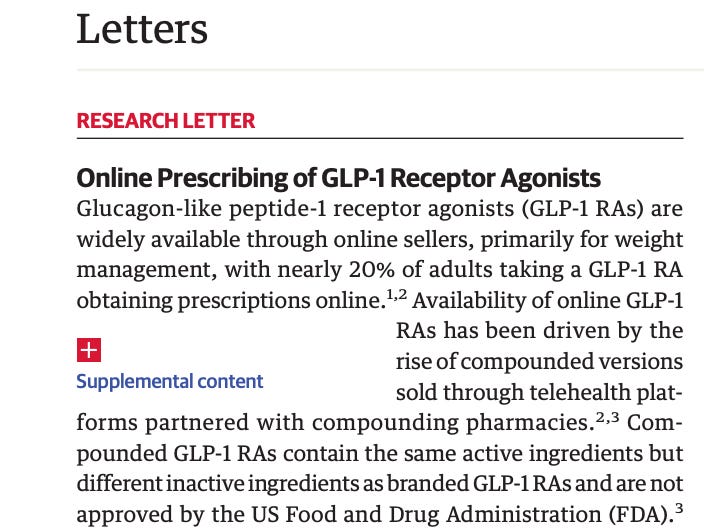
If both the branded medicine and the compounded medicine were the same price, and equally easy to get, I imagine most people would take the branded product. But given that the compounded medicine is cheaper, and, as the new letter suggests, easier to get, then naturally many will go that direction.
Even drugs that aren’t (yet) approved are available from the compounder. Stat recently speculated that Trump himself got retatrutide via a compassionate use from Lilly.
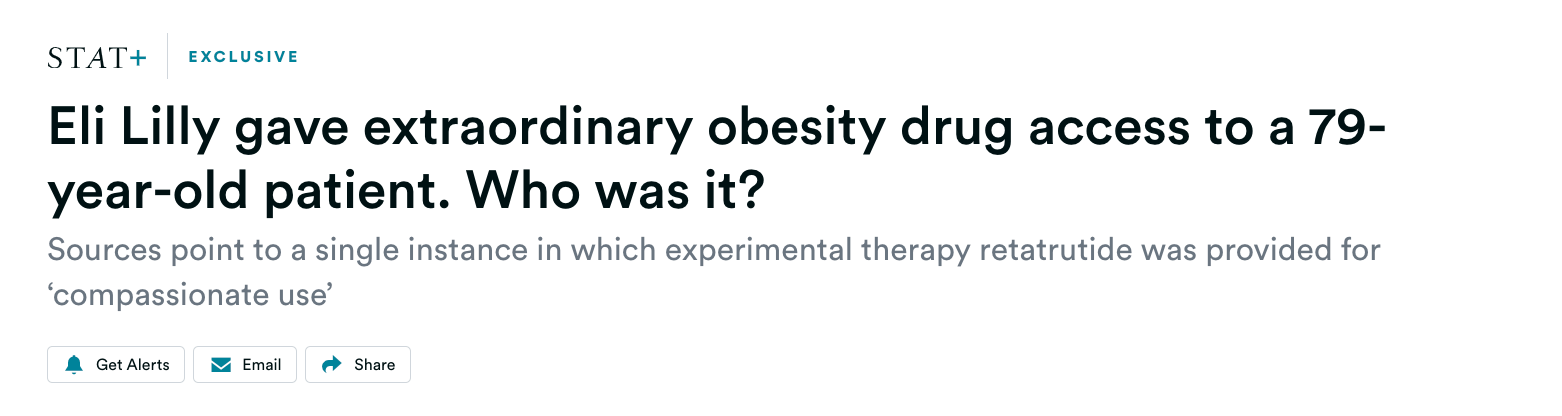
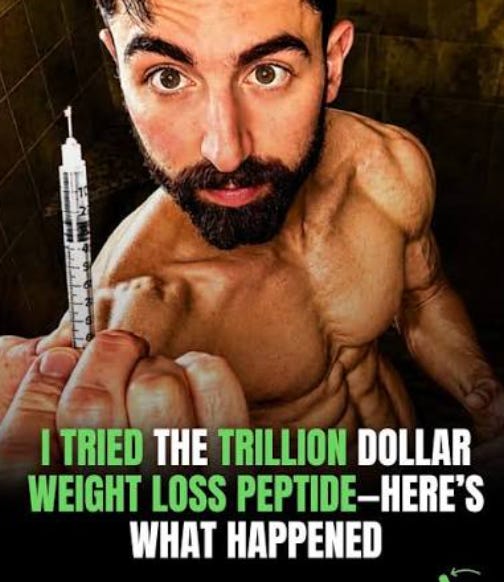
The White House press officer denied this, and mocked the reporter for running journalistic speculation. Yet, what was lost in the narrative is that perhaps as many as 10k, or 100k or even more people have gotten retatrutide from the compounders. Including some doctors self experimenting, and documenting for youtube.
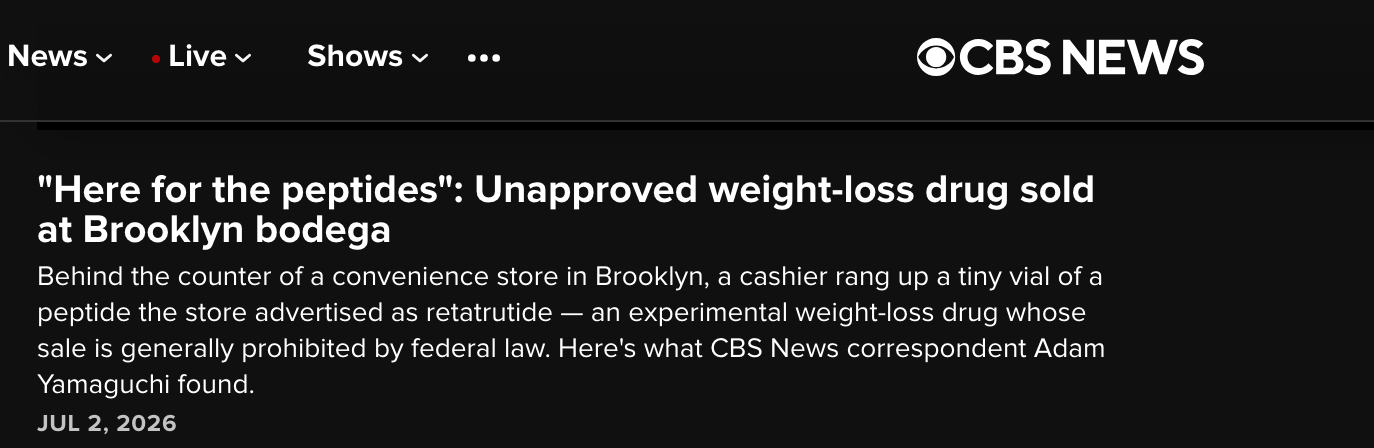
CBS news is taking the opposite tact. Too many, not too few people are taking reta.
Obviously, there are massive financial interests that would want to sell these drugs for $1000 a month. Compounding pharmacies threaten this. Is the fear about compounders geniune or it is hysterical— principally serving entrenched financial interests?
In order to elevate these discussions, here are questions, you the reader should ask when you see news like this:
Ok, this JAMA paper is critical of how easy it is get to get these drugs from online pharmacies, but have they shown actual harm? Do they report the rate of adverse events and severe outcomes when compounders are used in stead of branded drugs? Do they factor in the gains from more people taking the product (who otherwise would not)? Is the hypothetical patient in the study benefitted or harmed by the prescription? The compounder didn’t ask for photo id— ok sure, but how often do people give their GLP 1 to someone else (This isn’t vicodin)? And if it so easy to get, why would that happen? What precisely is the concern here? In the absence of demonstrating these things, should they chill out?
For CBS, do you have the rates of adverse events from bodega reta vs clinical trial reta? Are they higher? If so, by, how much?
Instead of data, authors are relying on emotional arguments: of course branded drugs are better than those from a compounding pharmacy. Who would want a filthy bodega drug.
But this is a distraction. Instead ask them to quantify their feelings. How much better? Which adverse events are worse? Are all compounders the same? Is there a trade-off with access? And finally, are you sure your coverage and research is working in the best interests of the American people or the best interests of companies that stand to make or lose a trillion dollars?
FWIW, my personal 2 c is the heart rate increases from reta are concerning, and even though it is an insane fat loss drug, that should be monitored. Even if the heart rate increase is ultimately harmful, the huge weight loss may outweigh that and it may still be, on balance, net beneficial.
In the meantime, remember to not be persuaded by emotional arguments.
I am a retired MD, an internist who focused on diabetes management. I made good use of exenatide and liraglutide but retired before the longer acting forms were available. I prescribe semaglutide to my wife in very low dose. She has hypertension, and a very strong FH of HTN, with both parents dying of hypertensive strokes, which was difficult to control with multiple meds that resulted in excessive fluctuation, with episodes of both moderate hyper and mild hypotension. She was mildly overweight with too much visceral fat and mild CKD with eGFR in the 45-55 range. She, like the great majority, was able to achieve but not sustain weight loss more than a few months and thus the semaglutide. This has resulted in a sustained approximate 6 lb weight loss with marked improvement in BP control on 50mg losartan and HCTZ 12.5mg with much less fluctuation and no hypotension and stable renal function, actually slightly better.
I get the med from a compounding pharmacy which I think is good quality. It's combined with Vit B6 which I think is innocuous. Drug companies object that delivery of the GLP-1's with vial and syringe leave patients subject to dosage error. However, we have been treating diabetes with insulin by vial and syringe for 100 years or so and have accommodated to that more hazardous agent. Vial and syringe delivery has multiple advantages including lower cost than auto injection devices and more importantly the ability to manage dosage, both amount and timing in a much more individualized manner depending on clinical response. This is especially important for an agent with extremely common and significant non-fatal adverse effects that are very dosage and timing dependent. It's my opinion that cheaper and more flexible GLP-1 RA availability, such as from good quality compounding pharmacies, would allow thoughtful doctors and their patients to make much more widespread use of these dramatically effective agents. However, this would demand more rather than less doctor-patient interaction which is what I fear might be happening with the TV advertised online entities.
Whenever someone -- usually an elite Wellness Wonder bitch starts to sigh and say, " Do we know about the long term effects of Ozempic, etc."
I stop them and say: 70% of the population won't have a long term. Anyone who is trying to stop the use from the branded version or the compounded one is worried the public will walk form their diets and dopey exercise and endless life style hacks like Get up at 5;00AM!!