

There is an old saying in medicine, “show me a healthy person, and I will show you someone who hasn’t had enough tests.”
In 2026, in a world sold on whole body imaging, CT DNA assays, and deep sequencing, do healthy people still exist? Or are they an endangered species?
I was reminded of this question when I heard a debate recently about whether we ought to treat smoldering myeloma (SM).
SM sounds bad— the sort of thing you wouldn’t want to have— I mean, it is smoldering—but what does it actually mean to a person?
Well, the person feels fine. He has aches and occasionally feels tired, but no more than the average joe.
His BMI is normal, he looks good, his bones are intact, his blood counts are reassuring, his kidneys are working fine, and his blood calcium is perfect.
Instead, he has some proteins that are elevated in his blood stream, and when we drove a hollow bore needle into his pelvis (PS: you’re welcome!), we found a higher fraction of some cells than other people would have.
He has a higher chance than the average person to someday have one type of cancer, but that chance is not 100%— the best models likely overestimate the risk (see the Will Rogers phenomenon)— and some people don’t get the cancer even with many decades of follow up— to the point something else strikes them down.
In other words: he might be healthy or seriously ill.
Jesus said, “Those who are healthy have no need for a physician, but those who are sick do.”
In this case, there are massive financial incentives to consider this gentleman sick. Should he take a monthly 10 to 20,000 a month medicine? Should doctors prescribe it?
Our patient who feels just fine, might ask: Will I live longer?
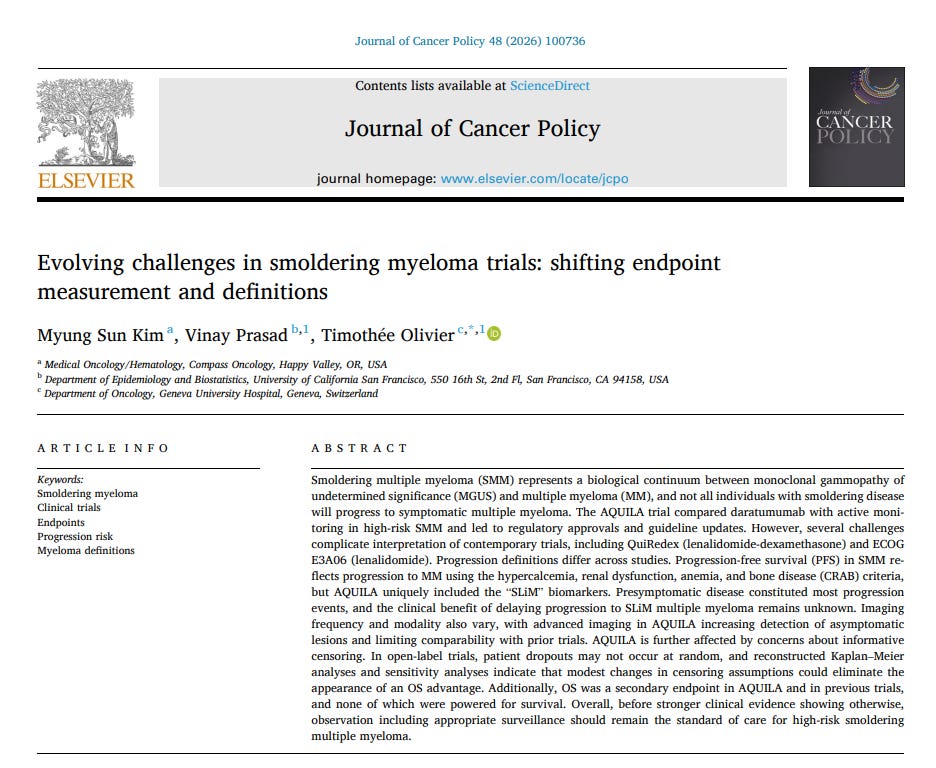
Oohh, tough question. The best answer is it is unclear. OS estimates are early and volatile. The control arm likely got care that doesn’t represent what you would have get as well.
Will I feel better for longer?
Ahhh, good question. Sadly the trial wasn’t designed to answer the how you feel question, but principally measured a lot of other blood tests. Fully explained here:
My friend John Mandrola says, “My view of health prevention is that time spent being a patient is less time living a normal life.” Yet, others may add it up differently.
But it isn’t just cancer
Each week I hear about a “healthy” person who found out their testosterone or vitamin D or some other level was “low.”
What does low mean?
Outside the laboratory provided 95% CI… i.e 95% of healthy people (perhaps not the same age/ demographics) have labs in this range?
Randomized trials show you would benefit from supplementation?
Something else?
How did this all begin?
When I see a patient, I like to understand how it all got started. Sometimes it goes like this:
I had been losing weight and coughing for many months
I had been having worse pain in my hip.
I have been feeling these episodes of being winded
But increasingly it sounds like this
My doctor scheduled my annual mammogram
I had some routine blood work, and they asked me to come back for more
My smart watch told me to come in
Medicine has a professional duty to ensure that the services we offer, on balance, do more good than harm. We also have to resist the temptation not to turn every healthy person into a paying customer. Over my 20 year career, I have seen the profession fall short, and we might not be far away from a world where we see the last healthy person. All of us instead having some pre-condition or abnormal biomarker.
Do we end up living longer and better lives from all this medicalization? That’s a question our studies are not powered to answer, and our profession seems to lack the power to ask.
It is sobering to witness how marketers of medicine try to convert the well into the potentially ill. I am just amazed to watch Morgan Freeman, during a break from national news coverage, earnestly pitch a new treatment for cardiac amyloidosis. I have been practicing medicine for a long time and know barely anything about this diagnosis. Overmedicalization is a big problem in this country.
THIS is why I am (still) a paid subscriber!! Articles like this!