

With the world cup concluding, soccer is on everyone’s minds. Recently a colleague mentioned that they would not let their kid play soccer because of risk of concussions. I was stunned. Soccer is a beautiful sport.
What about football?
Hell no.
Skiing?
Too much ACL risk
Cycling?
Too much crash risk
What sports are acceptable?
Tennis, golf, fencing
I think my colleague is not unique, and he captures the growing epidemic of poor risk perception running rampant these days among academics and other white collar parents.
Allow me to defend the proposition that kids should be free to pursue any and all sports that they enjoy.
Let me start with a few obvious points.
First, we are not talking about the Roman Colosseum. No one is fighting a tiger, and we don't have death matches. This essay is about the most common sports in America— all of which are largely tamed.
Second, comparing tennis to football— soccer to fencing— is laughable. Individual sports— tennis, fencing, golf, cycling, swimming (ps these can be team but each contribution is measured separately) and team sports— football, soccer, basketball, hockey— are completely different experiences.
Both can be fun, but team sports have a camaraderie and shared purpose and build skills and community in a way individual sports lack. On a tennis team, there are winners and losers, on a soccer team, you are in it together. That has meaning that transcends health and medicine. I like both categories of sports, but let’s be honest about the differences.
Second, looking at the risks and benefits of playing a career in the NBA, NFL, MLB and extrapolating to your kids is…. it is really hard for me to pick a polite word… misguided.
Professional athletes tend to live longer and better than the average joe— after all, they are rich and fit (in their youth after all); comparing NFL players to replacement players, or MLB players, etc is also misguided. Replacement players differ from NFL players in many ways besides playing pro-ball. How often do they go to the clubs to party? (I joke, but how do you separate playing football from the lifestyle of an NFL player)
Moreover, extrapolating from the NBA to your kid is the height of arrogance. Your kid is not going to play for 20 seasons in the pros. He or she might play a few years in school before giving up. The attrition for playing sports is colossal. It makes surgical residency look like a high retention activity.
If playing elementary school, middle school, high school, college and 10 years in the NFL causes xx, yy, or zz (PS I am not sure we have good data on even this question)— that tells you nothing about your kid playing a few seasons until the age of 14 or 16 or 20. It would be like saying that if staying awake 22 hours a day is bad, staying awake 16 hours is also bad. Uhhh, wait.
It’s plausible that being tackled is bad for the brain. If a lot of very hard tackling is bad, even a little tackling may be bad— some believe on faith. But why stop there? Brains should not be jostled. Don’t ever jump off 3' stairs. Don’t change direction too rapidly. Don’t ride a rollercoaster or drive on winding roads. Don’t floor your Tesla plaid. Just wear a c-collar, and use the buttons on your adjustable bed. Obviously, this is extreme, but no one knows how much brain jostling is good and when it becomes bad.
Soccer is also an odd comparison for concussion. Heading the ball— what the risk averse say not to do — is not the most common cause of “concussion”. Running into the other player is.
There is no evidence that playing tackle football for a few years in one’s youth has any long term consequences. Some claim this study proves it does. If you read this study and you think that it proves that, the brain that should be examined is your own.
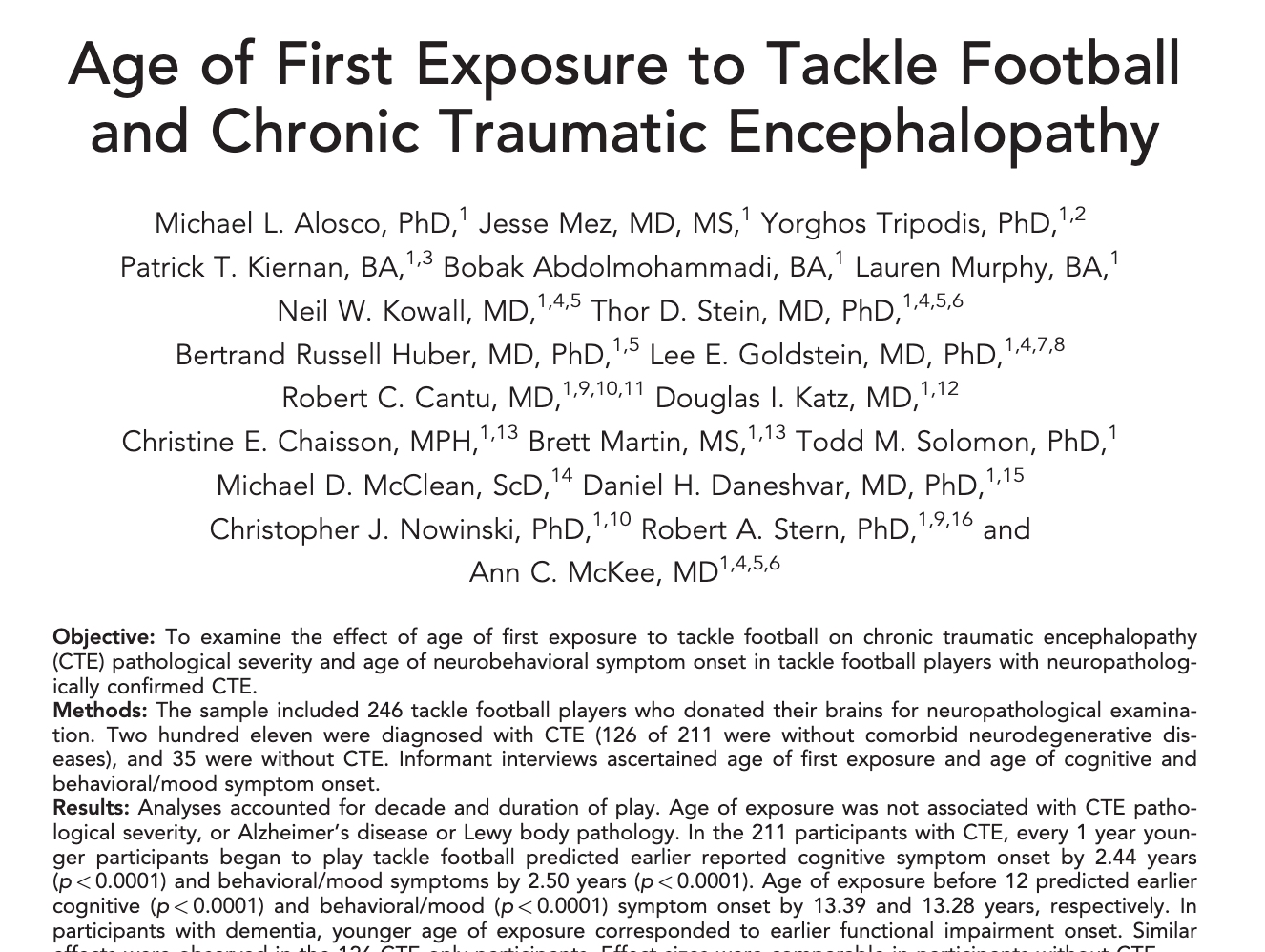
The study looks at people who donated their brains to research— it is enriched with pro players. We can stop right there. It is a convenience sample. You won’t be able to learn anything. The sample size is abysmally small. Most patients have CTE, per the authors. They claim that starting tackle football earlier is linked to having symptoms earlier. Though it isn't linked to worse CTE. Here is their main result
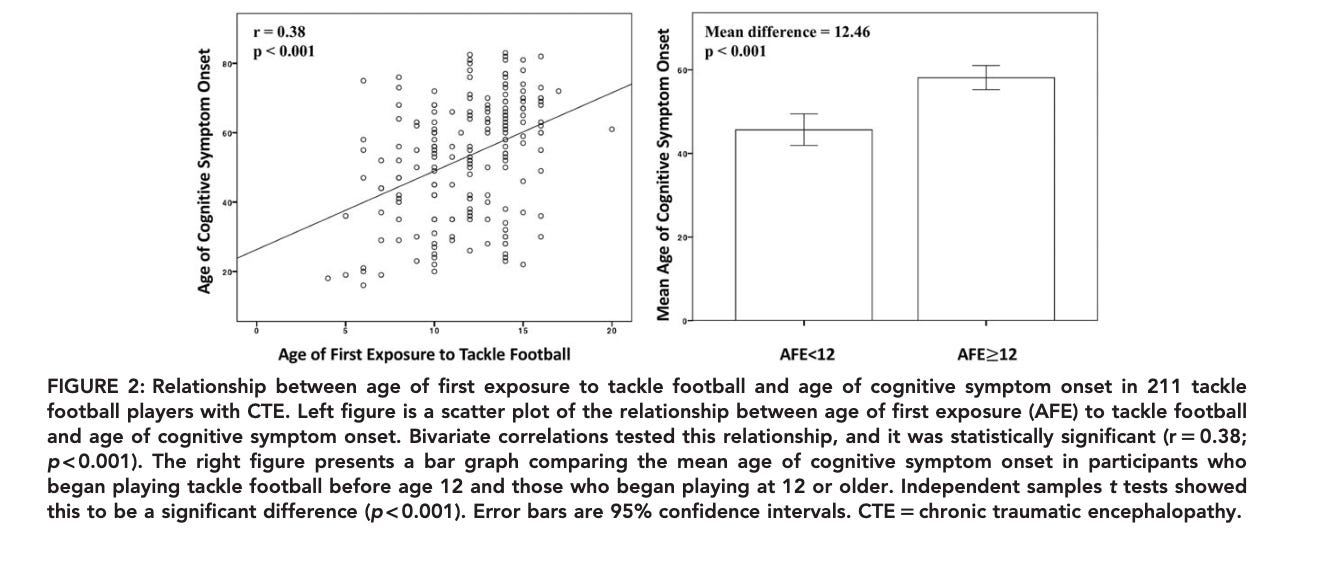
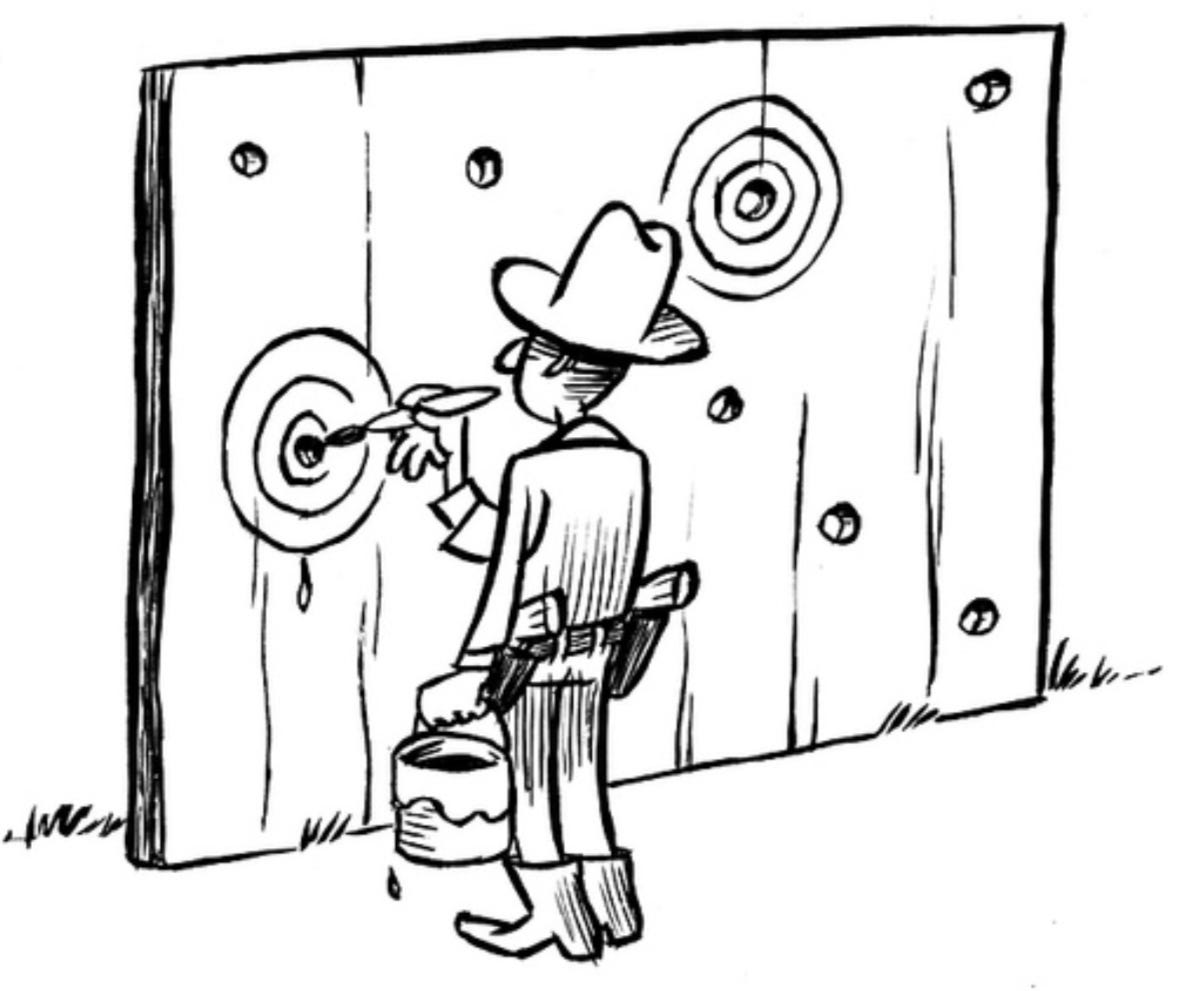
Why don’t you just run a line of best fit through the northern sky? Actually, here is a better graphic that captures the “science” deployed here:
The only way to study this issue is to look for a natural experiment. Where a school closed a sports program for instance. E.g Year 1 soccer and football were both options, Year 2, only soccer was an option, football team lost funding/ or didn’t have a coach, etc. Some football players might do soccer instead, and some kids who would otherwise have done football might be sedentary instead. Some players who would have made the soccer team are now cut, they should also be considered. RDD design would test the question of whether closing the football program, improves or worsens health. Another natural experiment would be if players are cut at random. The problem is that almost never happens. They're cut based on ability.
My prediction if you pooled all such natural experiments— you would find no effect on any outcome or that reducing sport options is generally a bad thing. Mostly for social reasons and weight gain.
Third, all activities have some unwanted effects. Wrestlers can get ringworm. Tennis and golf players can get tendinitis. Cyclists sit on their urethra all day. Fencers have to see the disappointment in people’s eyes when they say they are fencers.
Fourth, the challenges that children face these days are finding joy and community-- being resilient and open-minded— avoiding loneliness and depression. Organized sports are much more likely to have a favorable impact on all of these actual risks, then any theoretical risks on brain function. Reducing the number of sports options may result in some or even most kids picking a different sport, but a few kids will be pushed into doing no sport at all. Sitting around is terrible for all sorts of social and health outcomes.
Fifth, if you disagree with my argument, show me a single paper that can demonstrate that limiting a child's choice to tennis, golf and fencing leads to any better long-term outcome than expanding the choice to all sports. Find any study and please link it below. I will read it and I will show you why it is no good in a future post.
Finally, the substack is supported by people like you. Because I want to show my appreciation to the subscribers, I'm going to make one last point available to those people. Thanks to all those who subscribe.
