

You Can See Everything is a dazzling, edge of your seat, dark psychologic thriller. Part documentary, part re-enactment. This movie is something else entirely. 3 hours is over in a blink of an eye. This film deserves all the awards it will win.
Here is my review and much more about Elizabeth Holmes and Theranos. (Spoilers to follow)
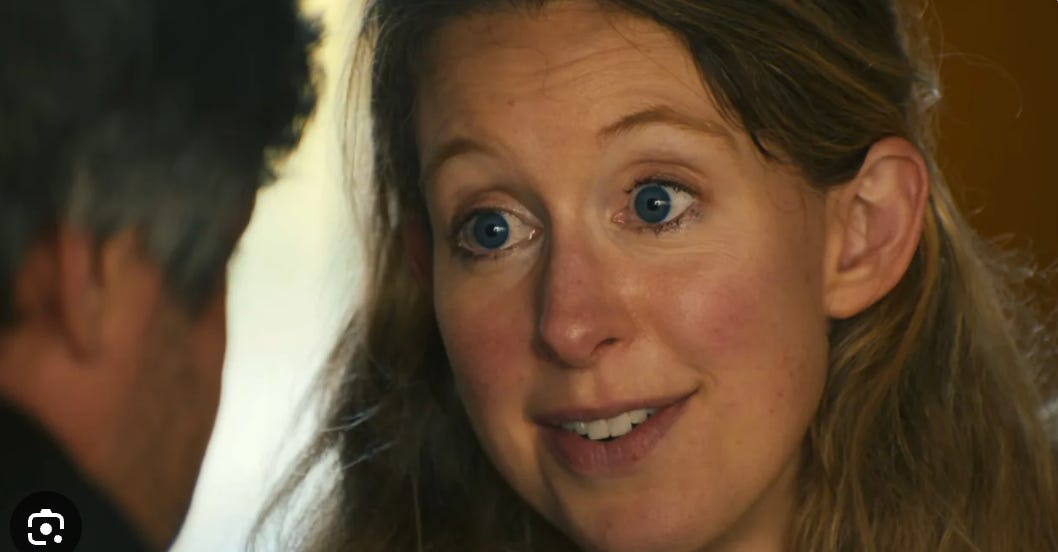
Elizabeth Holmes is psychotic— a sociopath. She is a master manipulator, with intense interpersonal charisma. She lacks remorse, understanding, and at times a sense of humor. She should have been a politician— she would still be in Washington.
She defrauded investors and put patients at risk by repeatedly claiming her testing platform could do things it could not.
If I make a robotic box that promises to make a cheeseburger in 2 minutes, but can’t— you can easily verify that it cannot. If I make a box and tell you that keeping on your nightstand for decades will help you live longer and better— that is harder to verify. Elizabeth Holmes made the first box— her claims were proximal and immediate and easy to measure. Many in biotech make the second box. Drugs and devices and biologics that promise a longer and better life.
Elizabeth Holmes is somewhere on a spectrum of startup founders lying. She overstated claims. So do many others. She is probably only in the 80th percentile of lying to be honest among those who claim to offer revolutionary services. She would barely stand out at a SF founder party.
Elizabeth Holmes is somewhere on a spectrum of selling health care services that don’t work. If she made a gene therapy or drug for neurologic disorder, and made similarly false and harmful claims, she may yet still have a multi-billion dollar company. It takes years— if at all— for the false promise to be detected. She could just change her endpoints mid-trial, give her drug in combination and without a control arm, or claim that you can’t randomize at all and use historical controls. So many ways biotech Theranos could succeed! Theranos is far from the only fraud, i.e. product that claims to make you better off, but doesn’t.
Elizabeth Holmes was knocked down for several reasons 1. she is psychotic 2. her product doesn’t work, but also 3. she flew too high— too much attention (people love to see such successes fail). It makes us all feel better to know the Harvard president was a plagiarist— if you learned the rector at Ghent was a plagiarist, you would shrug. It’s Ghent after all.
Her prison sentence of 10 years exceeds even armed robbery sentences and seems a bit harsh. It feels ‘scapegoaty’. — oh dear, have I also been conned?
There is no interest in medicine in separating real innovation from pseudoinnovation. Singling out Theranos in the latter category, but not seeing it in countless analogous situations reflects that.
The journalists who cover biotech lack medical expertise and can’t see that Theranos is exactly the same as…. the company they are plugging in the next article promising future breakthroughs.
In contrast with most fraudsters, EH did not sell stock, she did not buy nice houses or fancy cars. Her fraud was so deep she believed it too.
Fielder’s movie is dazzling, and one cannot help but feel that he too becomes seduced by the charms of Elizabeth Holmes. His entire film, which many will view as indicting her, is perhaps favorable given the extent of the evidence against her.
At times, the viewer wants to know much more than Fielder probes. How did she put Billy under her spell so quickly in that first conversation? What happened afterwards? In the days and weeks to follow. Why did he not interview others at Theranos?
The viewer, like Amanda Seyfreid, wonders about the Fielder’s objectivity, as he alters the dialog he remembers from the prison visit— because, as he notes— he didn’t feel what she said was that incriminating.
Fielder portrays Billy as controlling, possessive, but I suspect the reality is that EH has orchestrated this. Just as the viewer wonders whether Holmes orchestrated the payment deal for the film, and the inner workings of Theranos itself.
Finally, we should not forget that Holmes chose Fielder— specifically recruited him, a comedian, to make the film. While many will think that decision backfired, I am not so sure— any other film maker may have even had less sympathy for her. The visual of him and her swimming together— a brilliant cut by the editor— leaves the viewer wondering long after the film.
If you enjoy this writing, subscribe
She would be very unhappy if she reads #5 on your list. She’s a master manipulator alright; I’m thinking that she believed her lies so deeply - and likely still does - that it will be impossible for her to understand why she gets to spend jail time thinking about it.
Psychopathy and sociopathy are not forms of psychosis