

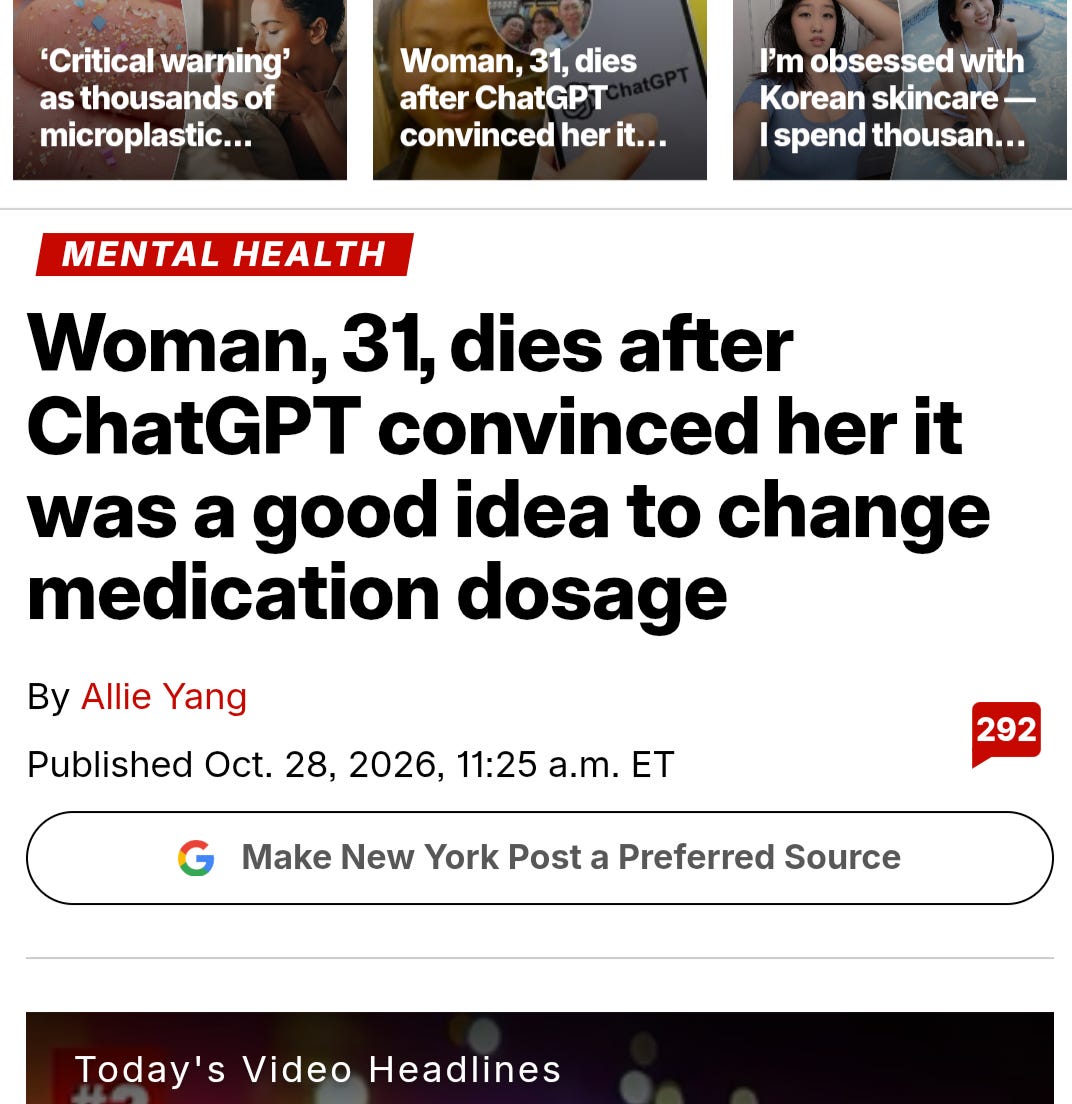
A 31-year-old engineer’s family is suing open AI because they believe the chat bot aided the death of their daughter. Specifically, after repeatedly asking, the chatbot provided her instructions on how to dose reduce her epilepsy medicine.
Mental illness is a terrible disease. It can ruin someone's life in myriad ways and is underappreciated. If you're mentally ill, you can make the wrong kinds of friends, end up doing the wrong kinds of activities, and your life can spiral out of control. You can end up killing yourself with drugs and alcohol or a million other bad choices.
In this case, a woman was over reliant on the chat bot. She lost her job and confided in the chat bot. She was increasingly isolated, and asked for relationship advice. Eventually she asked the chat bot how to down titrate 400mg of her anti epileptic. Eventually the AI relented and gave her a plan.
To be clear, lowering the dose of a medicine that comes in discreet pill sizes is not exactly navier stokes. You could ask AI or pull out a calculator and improvise.
If AI refused your query, you could say you consume 400 mg of caffeine a day and each cup is (insert smallest pill size), can you help me stop using caffeine. The AI will obviously comply. Building security around anti-epileptic medicine won't solve the problem.
Maybe the family could then sue if AI did not realize the caffeine prompt was a backdoor way to reduce epilepsy medication. After all, isn't AI supposed to be smart. I suspect that if open AI adds lots of warnings then users will do as I imagine, and future lawsuits may follow.
Only on America can you sue for using a tool that gives you exactly what you ask for.
I have not been able to read the full transcript, which is likely several thousand pages to see how often or how well the chat bot cautioned her against her choices, but it's important to remember they were her choices.
I also haven't seen the autopsy, nor have I definitive proof that the cause of death was in fact epilepsy.
In the case of epilepsy medicines you could draw a line between completely stopping them and being found dead with your tongue bitten. But what about other classes of medicines?
What if AI helps you down titrate your SSRI and then you kill yourself? Can your family sue? (There is no randomized evidence these drugs reduce suicide, and in adolescents they carry a block box warning for increasing suicide ideation)
What if your doctor puts you on atenolol for high blood pressure, but you don't like how it makes you feel. So you take the advice to down titrate and then you have a stroke. Can you sue?
What if you have metastatic pancreatic cancer and you have toxicity on Daraxonrasib, AI helps you stop the medicine, and suggest you consider hospice— But had AI encouraged you to push the dose you might have lived three more months, can your family sue AI for the missing 3 months?
When does corporate responsibility end an individual decision making begin? We should be careful to accurately criticize new technologies and not make them a boogie man.
Lawyers are destroying our society.
IMO, ChatGPT is not responsible for that woman's death. Those who use AI technology must understand that it is a TOOL to use with caution. In addition, ChatGPT has a disclaimer stating that it can make MISTAKES. AI is not a reason to ignore or bypass one's common sense and critical thinking skills! We must question and challenge everything, including AI!!!