

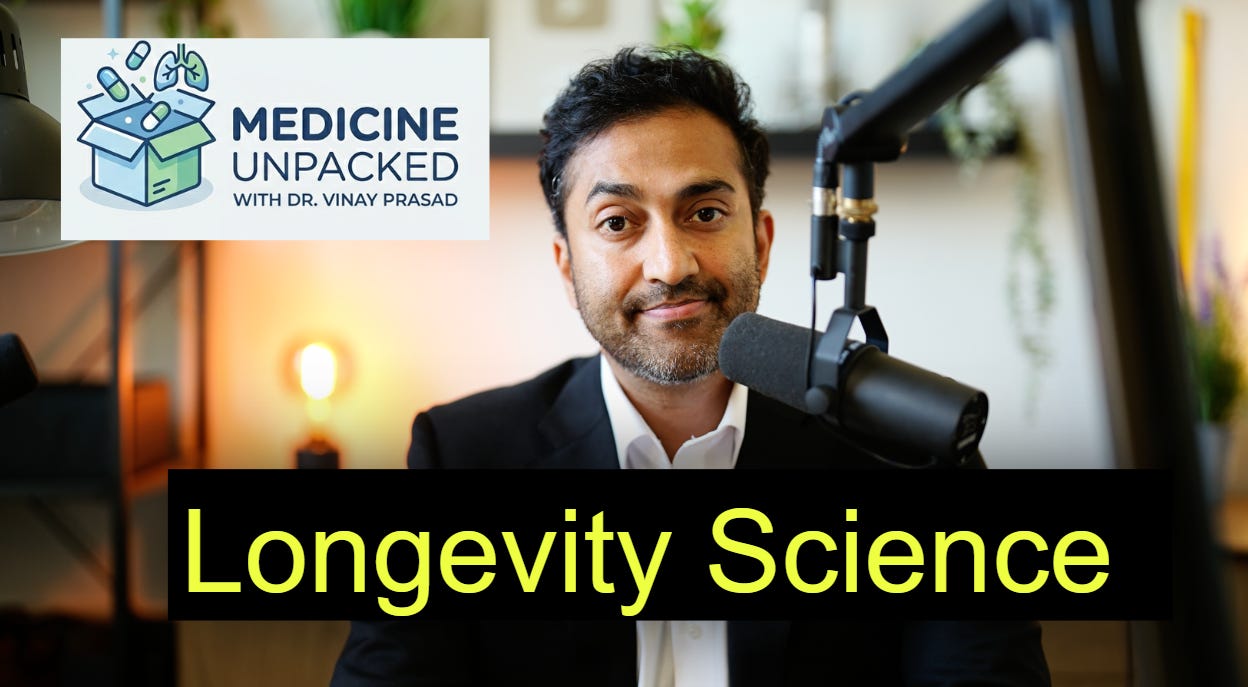
Last week on YouTube, I debuted the first of a multi-part series on Longevity Science, as part of my new series called Medicine Unpacked.
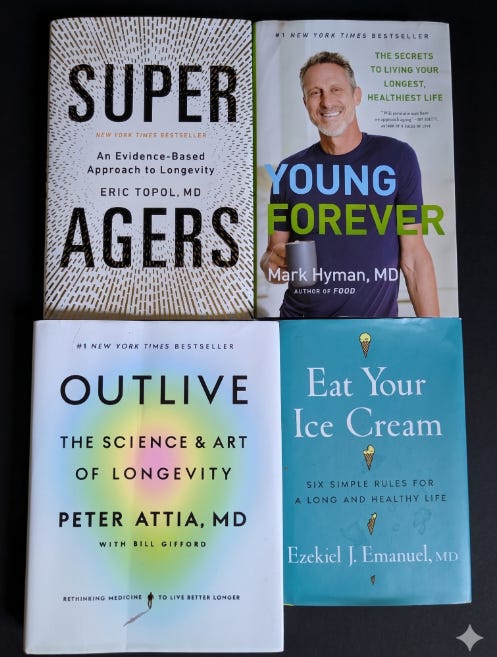
I read 4 longevity books (shown below), and over 100 of the underlying research articles to put together this series, and the first episode introduces my philosophy on the topic, as well as includes Episode 1, Sleep Science, which I will cover in a separate post.
My rules are simple: I am interested in advice given to healthy people to enhance their quality and quantity of life. Of course, I love CAR-T therapy— and happen to know a bit about it— but that is out of scope because CAR-T is being used and developed to treat people who are ill. Instead, I want to know what a healthy person should do to live longer or better.
Next, I read books that spanned a range of voices— from functional medicine doctors to professors. Yet, no matter the ‘expertise’ of the writer, I neutrally appraise the underlying evidence. I am also fascinated by the sheer volume of recommendations that the books have in common— despite the dramatic differences in the authors backgrounds and approaches, and I feature those prominently.
Third, I am interested in, and will judge adherence. Advice that cannot be acted upon and adhered to is wasted breath. If adherence didn’t matter then every diet every devised with caloric restriction would be a winner. You could tell people to follow the “don’t eat anything diet” and complain that anyone who is unsuccessful simply did not adhere to it. Of course, this is ludicrous. Part of what we seek with diet advice is something we can live with and incorporate into our lives.
I believe that just because adherence is high doesn’t mean something extends your life, but rather that we can further investigate it. Instead if adherence is abysmal— then an intervention probably won’t work, and is not worth our time.
Consider a high and low adherence intervention. Many observational studies show pet ownership is linked to living longer. I love dogs, but am unpersuaded this association is causal, i.e. owning the dog extends your life, rather than confounded, people who are living longer and better seek the companionship of a dog— but one thing we must admit is that adherence is high. If you get a new dog, 90% still own the animal a year later. (Interestingly no book recommended pet ownership).
Contrast this with a piece of advice that does make one book: introduce yourself to a new person each day. I spent time trying to find a study of how well people could adhere to this practice, but couldn’t. My commonsense is the same as yours— it is likely unsustainable. As such, I don’t put much stock in it.
Finally, I draw a distinction between avoiding untimely death— i.e. living to 80 instead of dying at 55 from a heart attack— versus true life extension— living to a 120. I am happy to concede that there are many things that can help us prevent untimely death, but which of the authors’ advice pushes us into the latter category. I will discuss over the series.
Listen to the audio podcast here, and video link above. And I will be back with more installments in this series. I also have book reviews, and more observations and thoughts to share with you.
I have been a fan of your writing since the beginning of Covid. I am glad to see you back, and very angry at how you were treated by the media and others this past year. I canceled my WSJ subscription that I've had for years. That newspaper's scathing hysterical commentary on your work at the CDC helped me to make that decision. Thank you for the Longevity Science!!
Welcome back! You were missed!