

If someone were to argue that Jason Arday— a tragic story of a repeat fabulist elevated to Cambridge professor— was just a one off event— an isolated anecdote in no way reflective of institutions losing their sense— that person would be proven wrong by today’s (8/20/2026) events.
Here is the New England Journal of Medicine Voices section (Note NEJM is, last I checked, a medical journal)
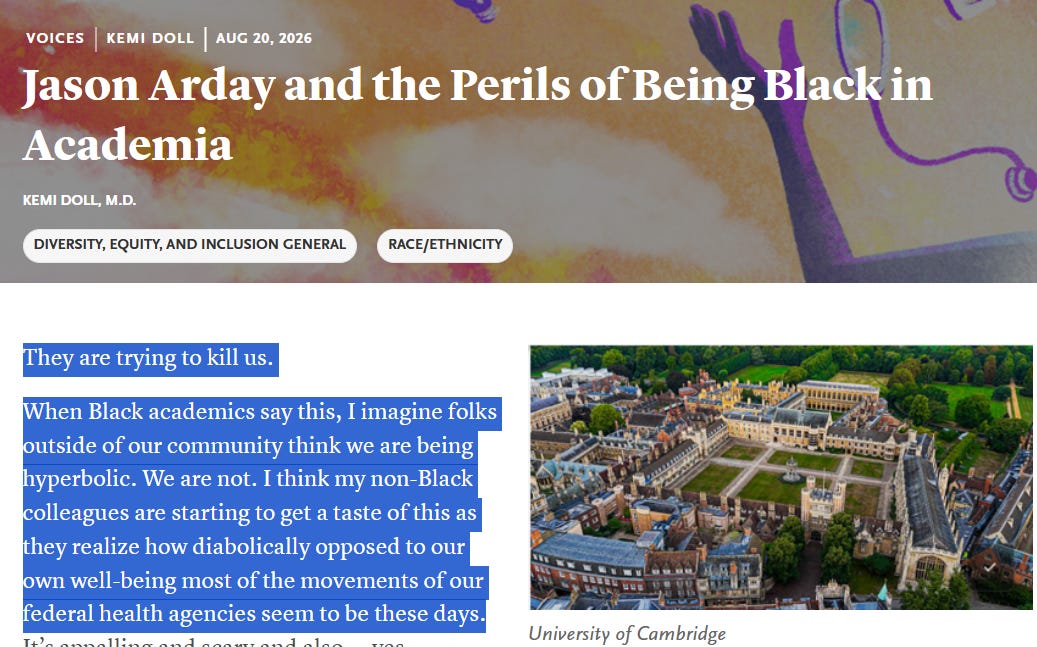
The article makes incredible statements. First, I see no evidence to support the claim that anyone was trying to “kill us” or Jason Arday. I think the rhetoric about federal agencies is irresponsible and wrong. It is tragic Arday’s life ended— in what is widely thought to be suicide— but ultimately that decision, like his fabrications and plagiarism, were a product of his own troubled mind.

How can you claim this is the message? The message to everyone is try to be truthful in what you say about yourself, and don’t plagiarize your academic work. The message to universities is please verify the scholarship of people you hire.
Ironically, I could imagine these lines being said about Roland Fryer rather than Jason Arday. Fryer does stellar work, and was disciplined largely for reaching conclusions that contradicted the liberal narrative. Even this headline misrepresents the allegations, and the role politics and Claudine Gay played.
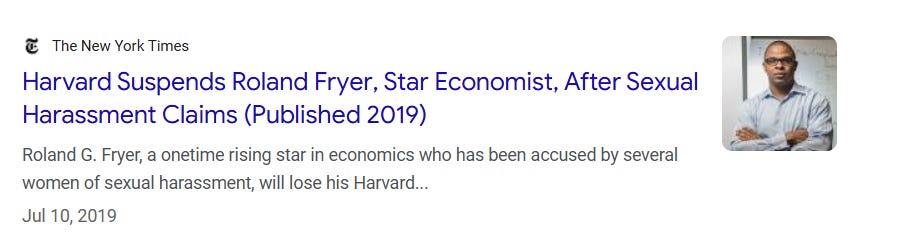
This NEJM line astounded me:

He was cleared of “deliberate” plagiarism? Plagiarism has no distinctions. The intent may determine the punishment, but plagiarism is plagiarism. And the other allegations— that Arday told grand, fabulous, impossible lies are precisely why his plagiarism was put under the spotlight. If one read his work and claims, and saw the plagiarism and falsehoods— how did he get a Cambridge professorship? Unless the university is deeply broken, and missed the obvious. That’s the story in a nutshell.
This was also incredible:
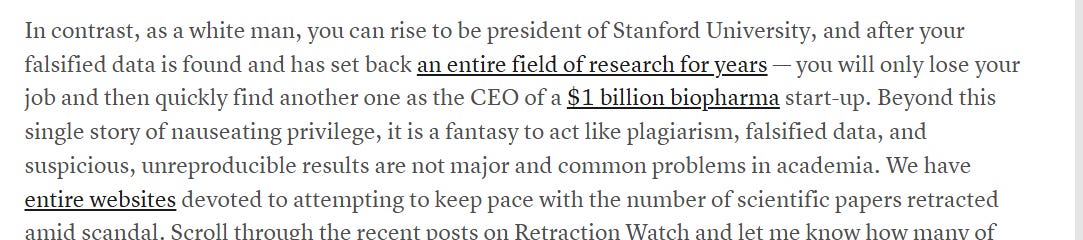
Three things. First, I agree that all of academia is rife with bad work. I write that essay every month (link below)
Second, that said, comparing MTL (discussed below) to Jason Arday is ridiculous. I was critical of MTL, but his failure was pushing his teams so hard that they felt they had to make things ups (at times). Other papers were true, and led to FDA approved drugs. MTL never plagiarized. MTL probably didn’t make up data himself (he just failed to catch it). MTL’s work is broadly hard science (and not sociology). MTL also didn’t say he ran 600 miles in 6 days, or that he couldn’t talk till he was 11, or any other ludicrous and obviously false personal claims. They are not comparable.
Marc Tessier-Lavigne and Jose Baselga

I just finished reading Theo Baker’s engaging book describing his freshman year at Stanford which culminated in toppling the president, Marc Tessier-Lavigne (MTL) for data manipulation in at least 5 papers with suboptimal effort to correct the record.
Third, as I alluded to yesterday with James Frei— had Jason Arday not ended so tragically, he probably could have, like Frei, made a fortune writing books, or perhaps like Frei, embracing his imagination, and turned to fiction writing (AI assisted). MTL is not the Stanford president, but he too has moved on to something different.
Here is the biggest take away. This essay is in… the New England Journal of Medicine.
The mere fact the essay appears in NEJM validates the central problem of the Jason Arday story, which is that institutions which are supposed to be ideologically balanced and adhere to some basic standards of logic and merit, are saying Jason Arday is the most brilliant scholar, and, if you disagree, that “they are trying to kill us.”

This is really wild stuff. We have to celebrate someone who makes things up, and if we don’t it’s on par with trying to kill someone— and this isn’t the deranged view of some rando on the internet— it is the sanctioned view of Cambridge and the New England Journal. This is genuinely concerning.
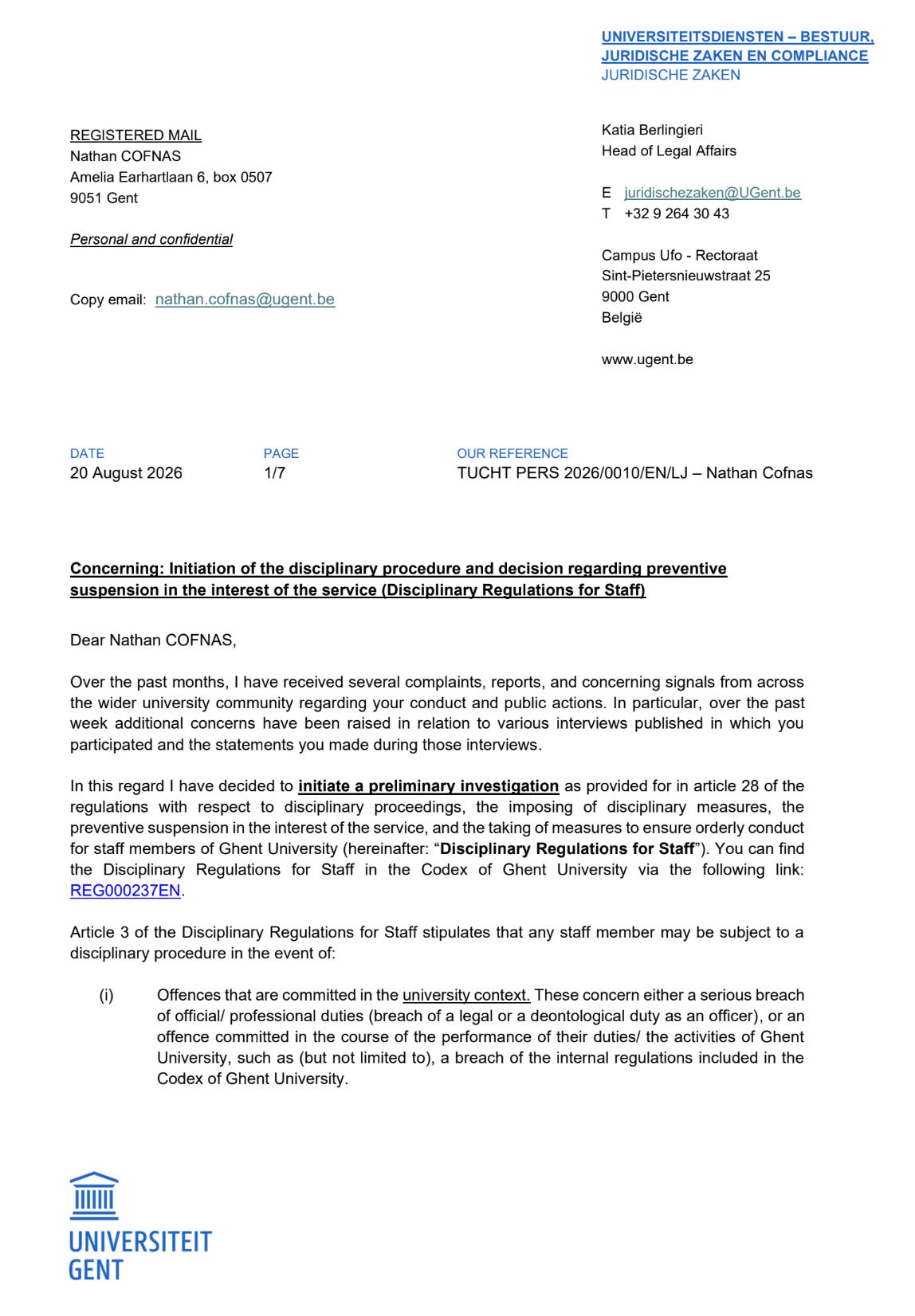
Additionally, I also found the attached letter ridiculous. Nathan Cofras is the postdoc at Ghent who raised the Arday story— now suspended. The attached letter notes his crimes:
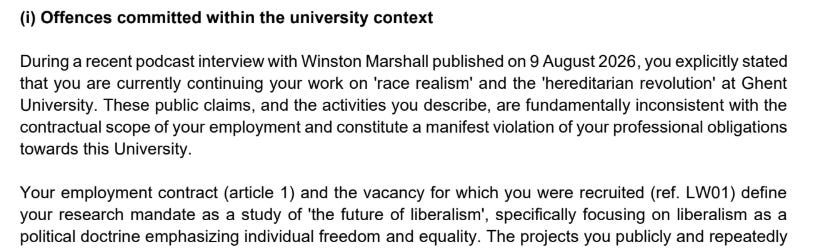
I have never seen a university police how an academic defines the scope of their work— I don’t even know if the above terms fall under ‘future of liberalism’ (vague) or not.
I also was not aware that a postdoc was prohibited from working on things outside of their contract (they all do). In fact, I haven’t read an employment contract spell out the scope of acceptable topics to study. Instead the letter writers are conflating the post to which he applied with what he is allowed to study. It is dangerous to confuse the two.
The letter adds this:

But the “disabled” language is how his supporters refer to him
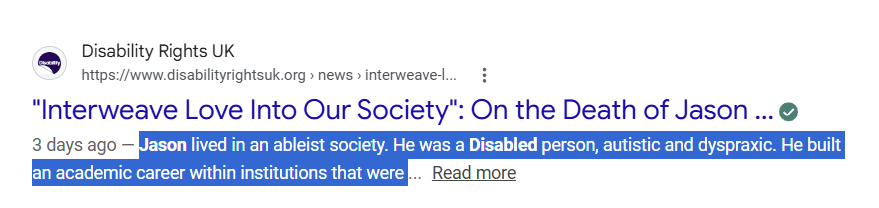
As for “worthless scholar” — that’s harsh no doubt, but universities are full of people who say that about their colleagues every day. I’ve been told that a few times about my own work, and that was just from Adam Cifu.
One grand irony is that if an US university postdoc did exactly what Nathan Cofras did, and their university ejected them, Trump’s DOJ— particularly Harmeet Dhillon— would go after that university, and it may even end in a congressional hearing, etc.
It would probably be an 80:20 issue for the Republicans, i.e. most Americans would think it is clearly absurd that a professor at a top university told so many tall tales, and the post doc who targeted them was clearly the victim of liberal retribution for saying the Emperor had no clothes.
Imagine if that story ended with the boy saying “you have no clothes!” and then the rector of Ghent had the boy arrested; his child ticket clearly says no outbursts besides on the topic of the future of liberalism.
In order to clean up this mess, I offer a 5 point plan:
Whoever at Ghent made the decision to suspend a lowly postdoc— fire that person (this is now the biggest error of the whole story; a vengeful retributive act defying academic freedom).
Whoever hired this troubled man at Cambridge— and said he was the most brilliant scholar. Please demote that person (this person has no business hiring). Also, if you wouldn’t mind writing a review of my books on Amazon… “best book since the bible…” I would appreciate it!
NEJM voices— hire a conservative or heterodox columnist/ and a conservative editor/ come up with policies about when it is appropriate to claim someone is being “killed”
To parents: Send your kids to an SEC college
To all readers: Please subscribe to this stack to support this work
See attached letter

Does this kind of poor judgment from the NEJM cast doubt on everything from that source? How long should once storied institutions continue to rest on wilted laurels?
The victim fatigue has gotten such that, if I wasn’t paying for Vinay’s Substack, I would just pass on this article. NEJM publishing propaganda like that makes me feel for anyone who ever held the publication in any regard. I’m actually kinda speechless.