

I just finished reading Theo Baker’s engaging book describing his freshman year at Stanford which culminated in toppling the president, Marc Tessier-Lavigne (MTL) for data manipulation in at least 5 papers with suboptimal effort to correct the record.
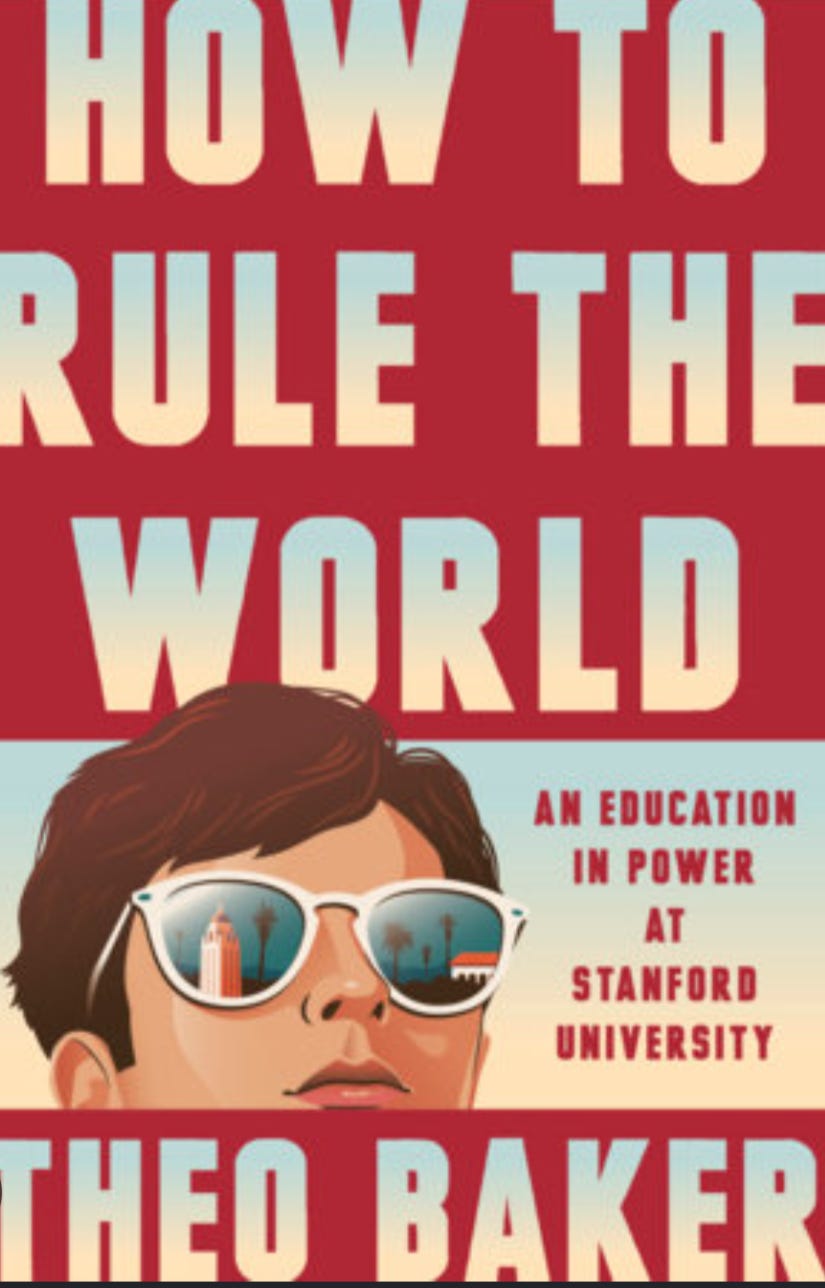
First, the book reminds me of Bad Blood — about the Theranos scandal. It's a quick and engaging read and I commend the author.
Second, the book raises many issues about science that are worthy of further discussion. Because I have so many points (20). I will number them.
1. I am persuaded by Theo Baker that MTL has a problematic research history. Papers at multiple institutions have replicability issues and data/ image manipulation problems. It's hard to know what MTL knew and when. At worst, he is complicit in active fraud. At best, he slow rolled appropriate corrections. I personally lean towards the former, but the truth is unknown.
Scientists should be scrutinized. Scrutiny should be proportionate to the claims they have made (bigger discoveries will get more scrutiny bc that drives more research) and scrutiny should happen equally across the board. You can't just audit University presidents. You should audit all people, and if you have to triage, start with those who make big claims. MTL is one.
People should be punished for wrongdoing.
MTL went down because his work provided raw images. Raw data lets third parties find errors. Most of science hides the raw data and provides only tables and figures summarizing the data. If all raw data were provided, I bet 60, 70 or 80% of research would be found to be untrue, manipulated or fraud. This is compatible with the abysmal reproducibility rate across many fields documented in a series of papers. This is compatible with Ioannidis’ famous thought experiment paper on why most research is false. This is compatible with our work on medical reversal. And this is compatible with my read of tens of thousands of papers over 20 years. This is in contrast with Mr Baker who believes that MTL was exception to the rule. He is the norm. Scientists are engaging in massive manipulation, selective reporting and outright misleading research. At times, they fool even themselves. MTL isn't the lone drug dealer at your college, MTL is the drug dealer heading up the cartel. Some will argue that others aren't as intentionally deceptive. That's like saying it's not stealing bc you didn't know it was someone else's. The weaknesses of science and unwillingness to reform is well known. Now more than ever.
MTL is faulted for being too ambitious. Sadly this is true for probably 99% of Stanford or Harvard professors. You don't get the job without ambition. You won't survive.
Ironically being a university president and being a scientist have nothing to do with each other. MTL’s science misconduct led him to resign a political— and not a scientific— job. Now he is back in drug discovery. Probably it was less risky to have him fundraise for Stanford.
A person like MTL will have lots of enemies. Enemies will use anything to take MTL down. I wonder who weaponized Baker against him. Who was the first anonymous tip in 2022?
Journalism is motivated by taking down individuals and not solving systemic issues. Bad science is a systemic rot. Knocking out MTL doesn't solve the issues. Journalism loves stories about people. They don't love the messy reality that people operate according to incentives and move in herds.
The book reminds me of Jose Baselga. Baselga was physician in chief at Sloan kettering. It is no secret, he and I had our disagreements, but what is less well known is that we interacted frequently since I was a fellow and I quite liked Jose. He made me laugh. Baselga had someone report him to Charlie Orenstein (reporter) for failing to disclose all his payments from pharma in papers. And the allegation was broadly true. It was also par for the course. Oncology was (and is) overrun with faculty taking money from pharmaceutical firms and then recommending those products— even for off label and disputed uses. The field has never done anything about this other than token disclosures. Disclosures, which, by the way, have been shown to be ineffective at mitigating bias. Baselga made a mistake but so many others have made it as well. Instead, someone who has an ax to grind reported him. Journalism pounced. Eventually he resigned and moved to AstraZenica where his salary increased dramatically. Sadly a few years later he would die from Creutzfeld-Jacob disease. Now, a decade later, none of the systemic issues have been changed. It may even be worse. It many ways it's just like MTL. Instead of reform, we pick one prominent scapegoat and slaughter them.
Separate from MTLs research issues, he supported the censure of Dr. Scott Atlas who was opposed to cloth masking, school closure and lockdowns, but made the unforgivable mistake of once touching Donald Trump's hand. The Stanford faculty senate couldn't process the pandemic and MTL called these views misinformation. Ironically, this MTL action is far more relevant to being a university president than Western blots. MTL punished Atlas for the crime of being correct. Bob Harrington (Stanford chair) was another offender. We actually don't need academic leaders to do science, we need them to not interfere with those who are— even when it is hard— especially when it is hard. Both these men failed to meet this bar.
The king is dead, long live the king. Theranos is gone, so there are no longer any biotech companies making false claims— oh wait. MTL is gone, so there are no more scientists doing bad work. Oh wait
A new JAMA IM paper on covid shots contains a preposterous result that invalidates the entire paper
·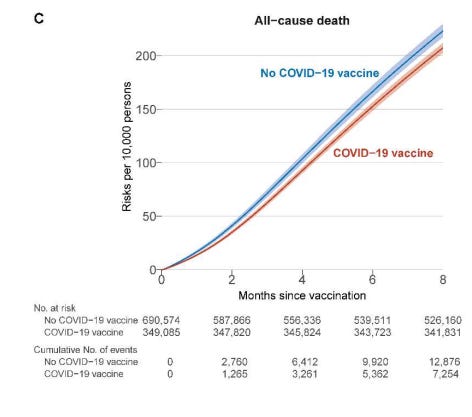
A new paper in JAMA IM claims that the 24-25 covid booster reduces cardiovascular events, but the Supplement contains data that invalidates the entire paper. Here is the main result:
Consider the recent randomized control trial from China on time of day administration of immunotherapy. Of course the randomized study has been retracted. Of course it looks extremely problematic. But what no one has acknowledged is the ocean of retrospective observational studies that are hopelessly confounded that have built this field up. We need a single non-fraudulent randomized study and that has not yet been done. The entire field is broken to churn out more and more retrospective observational studies and not to conduct the correct trial. (See also radiating oligomers). One Chinese study is retracted— people celebrate— but the true answer remains unknown and some one is launching a new retrospective chart review as we speak— the Photoshop of epidemiology.
We should be very careful not to celebrate the downfall of individuals, while systemic issues are completely unaddressed. And let us be clear, they are completely unaddressed. Nearly every lab is selecting the best image for the publication, and nearly every retrospective observational study is playing around with covariates.
At the same time, it must be acknowledged that science is still making progress. If you let your kids make you pancakes, and they make one perfect pancake, but you go into the kitchen and find 24 eggs are broken and fourteen cups of flour are used, you will say it's great that you made a pancake, but next time we have to learn how to do it less wastefully. Science still makes pancakes. Some discoveries are true and useful and progress still occurs. We are just breaking an inordinate amount of eggs to make it. And the incentive to reduce the egg breaking, when it is the federal government footing the bill, is nearly nothing. Instead, advocates cry for more and more federal funding. More and more eggs to make one pancake. No one has shown that every MTL paper is wrong. He did make at least one pancake (e.g. Denali). He just broke a lot eggs.
Making more science true and useful is possible but it will threaten many entrenched interests. These interests are far more powerful than MTL and far more dangerous— in part because they are unified, and capable of misleading entire swaths of reporters. The last year has witnessed unimaginable efforts to oppose grant reforms. Somehow scientists believe both that lots of science is bad, but also that they are perfect and deserve more tax money. No questions asked.
If it is the case that much of science is problematic, and MTL is emblematic and not exceptional then science and universities start to resemble a massive regressive wealth distribution scheme with the token justification of cures and advances. We siphon billions of dollars from taxpayers to fund a growing university administrative state, with the rare byproduct of a real advance, and when a once a century pandemic strikes the President signs off on the censure of the one faculty member who hasn't lost his marbles. (To be clear Atlas and Jay B and John I, and Eran B and others at Stanford were all generally right.)
Mr Baker goes easy on Holden Thorpe and journal editors. Let's be clear: journals protect bad research. I cannot remember how many letters to the editor I wrote that decimated a paper that they refused to print. Now that these pages reach more readers and scientists than most journals— I just post them here. I cannot recall how many follow up questions I asked and how many data requests journals didn't grant. Journals are incentivized to protect their product/ not to enforce standards or truth. Again, a systems issue. In the MTL case, journals only took action when publicity was too much to bear.
Side note: some confuse monetizing a product with scientific success. Scientific success is when a product makes me people’s lives better. Selling your idea in a heavily government subsidized arena means others can resell it— not that it helps anyone or is worth it.
Side note 2: As in the case of the Genentech paper and MTL, it is often a junior person whose hands appear to be the most dirty when it comes to fraudulent data analysis/presentation/ manipulation. This is both a character issue and a systemic issue. I will have more to say about this on a future date.
Mr Baker is a good writer and journalist but I continue to believe that newspapers need in house medical expertise with a focus on critical appraisal if they want to remain fit for purpose. In the meantime, we will do our best on Sensible Medicine
Finally now that MTLs false research on Alzheimer's is corrected, we can focus on the real cure for dementia…. The shingles vaccine…. 😂 The more things change, the more they stay the same. The king is dead, long live the king.

Shingles vaccine(s) and dementia: the only medical intervention to work faster than Tums

I am going to talk about how fast shingles vaccines reverse dementia across 4 papers. Turns out the effect is near instant. But before I do that, let us agree on some facts about the nature of the evidence used to make these claims.
20. What about Harvard? Well, their University president resigned over plagiarism, not image manipulation. That's different. Also, unlike MTL, her scholarship was so unimportant and uninspiring that, had she not been president, it may never have been read at all. If a tree falls and no one hears, it doesn't make a sound? If you Plagiarize and no one reads it… these are the questions for academics. Again, plagiarism is a systemic issue, which remains unaddressed in the millions of academics who aren't Harvard president. Also it is part of a broader problem of repacking others ideas as your own. Also, unaddressed.
In short, Theo Baker writes a riveting book. Many will read it as a story of one bad apple climbing to the highest perch. But the real story is far more terrifying and threatening. Of 50 billion in annual science funding, what percent is true and useful? How much is siphoned and stolen? What efforts are there to fix this?
Instead of tackling those questions, I look forward to journalism informing me that actually all vaccines halt dementia, AI is albert einstein for finding St elevation MI in a smoker with crushing chest pain that all doctors missed, and a new EKG algorithm finds more people who benefit from ICDs.
So long Theranos and MTL, and a warm welcome to the new companies and leaders who offer the real discoveries.
So many good points, Vinay. And so many places to pivot.
As you point out, what exactly do taxpayers receive for all the science funded?
If there is a return on investment, why don’t private individuals or foundations fund it? America is the richest country in history, and plenty of billionaires are incredibly generous, including funding medicine. Michael Bloomberg, Carl Icahn, Sandy Weill and Ken Langone have all made massive donations to medical schools.
My bet is most of the government funding is wasted, which is why people screamed so loudly about potential cuts and why taxpayers are stuck with the bill.
Vinay, Your most compelling piece in a very long time. Kudo's.