

Just out is a new print seeking to replicate the Wales finding across England— askign if shingles vaccine eligibility reduces dementia.
Astute readers of VP’s Observations and thoughts will know that I took this issue to task last month— as implausible, unrealistic and poor quality research. Now we have a larger update.
Shingles vaccine(s) and dementia: the only medical intervention to work faster than Tums

I am going to talk about how fast shingles vaccines reverse dementia across 4 papers. Turns out the effect is near instant. But before I do that, let us agree on some facts about the nature of the evidence used to make these claims.
Here is what you need to know. The entire analysis hinges on the fact that people born beyond a certain date are much more likely to be vaccinated than people born before that date according the way vaccines were deployed in England (and Wales). That creates a natural experiment. We don’t expect people just before and just after the cutoff to differ dramatically— so it is almost randomized. In these cases, we can look for a regression discontinuity- a jump in the graph— to see the effect of our policy.
First, lets look at the effect on shingles. This is the 8 year cumulative risk of shingles, before and after the program launch
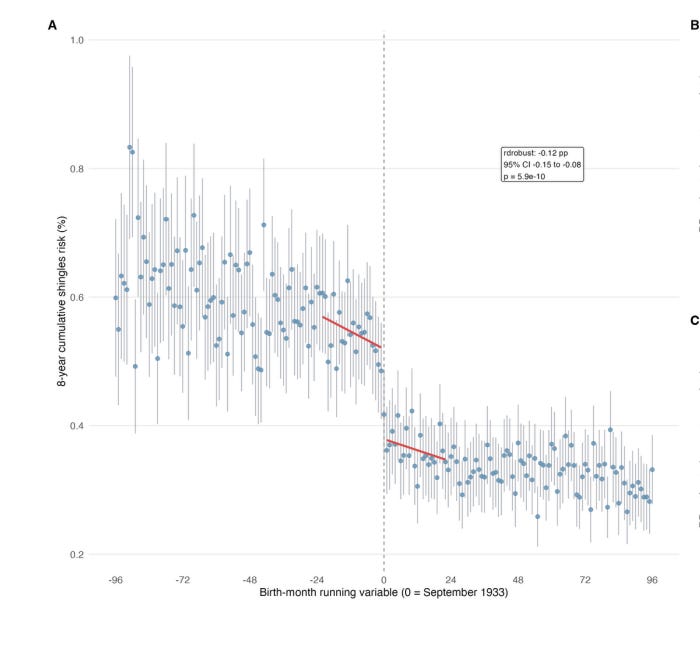
It drops by 0.12 percentage points— which means 833 people post cutoff date avoid a case of shingles over 8 years due to the program. We don’t know exact rate of vaccination. But it is good to consider the effectiveness of the program itself— and magnitude thereof. Fair to say, it is visible and small.
Now let us look at dementia.
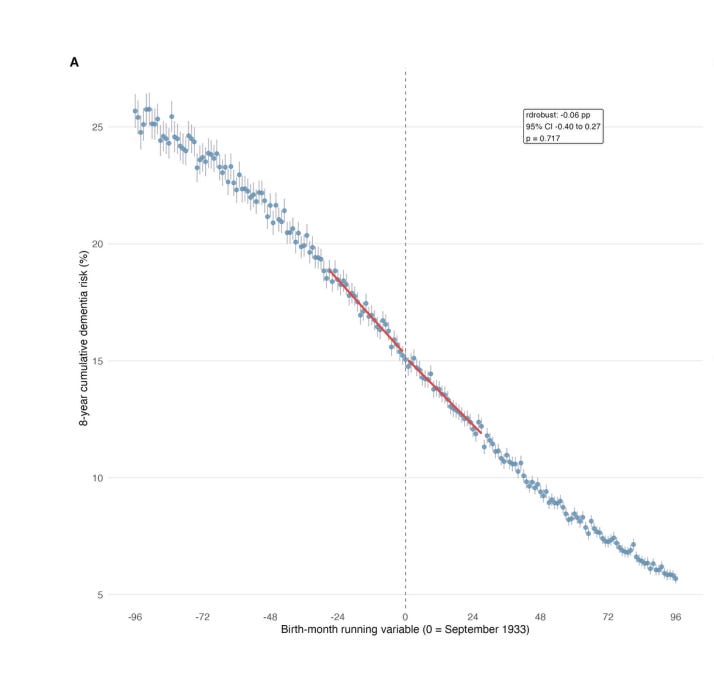
Wow, dementia rates are plumetting— but the vaccine does literally nothing. There is no step at all.
Now they look at dementia with a 12 month grace period (vaccines can’t work super fast), and tighter window around the potential RDD— and again, totally null
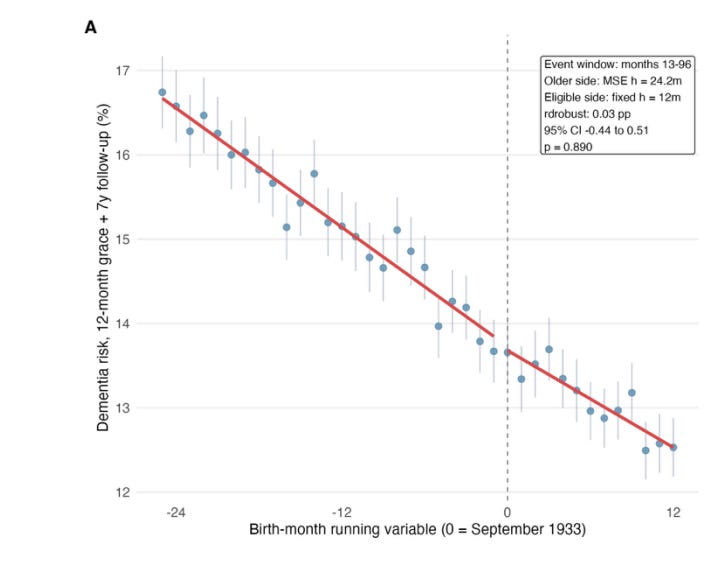
Not also the secular trend— it was and is getting better over time.
Finally the authors go to great pains to recapulate the Wales results and to see if their analytic choices can nullify the results. They find differences in magnitude of effect, but not direction. That leaves the mystery open. The data are 18x smaller, and the entire effect may be a persistent artifact.
Finally, there are two randomized trials— these and these ALONE— will be the definitive verdict on the topic.

What is the overall lesson?
I personally put little stock in both (a) amateur internet analyses of this topic and (b) the media and academic literature on this topic. In response to excessive and unjustified skepticism from the former group, we are witnessing unjustified and excessive cheerleading from the latter group. As such, the public understanding is a disaster. Adam Cifu reminded me last weekend that my bias is that (b) annoys me more than (a) for the simple reason— they should know better. As always, he nailed it.
All medications are harmful, some are beneficial, and some have benefits greater than harms. If the latter is true, it typically applies under careful conditions and settings. Believing that shingles vaccines could lower the rate of dementia by massive amounts (20%, 30%, etc) in short time frames (6 months) is completely irrational— totally bonkers— and yet this is the stated position of many academic researchers.
Based on your side comment that there’s a drop of shingles, but the effect is small. I see no reason to get a Shingrex vaccine
Is the overall decrease in dementia risk simply a feature of increasing life expectancy? E.g. is there truly less dementia - or are people just being diagnosed with dementia even later in life? Is there a real decrease in the likelihood a person will ever be diagnosed with dementia before they die?